 |

| Title: Astronomy Picture of the Day | |
| friendsoffortiesfive > General > General Discussion | Go to subcategory: |


| Author | Content |
Niceguy2

|
|
|
Date Posted:03/06/2014 11:29 PMCopy HTML I really love this site and |
|
Niceguy2
|
#6551 |
|
Re:Astronomy Picture of the Day Date Posted:11/22/2026 4:06 AMCopy HTML 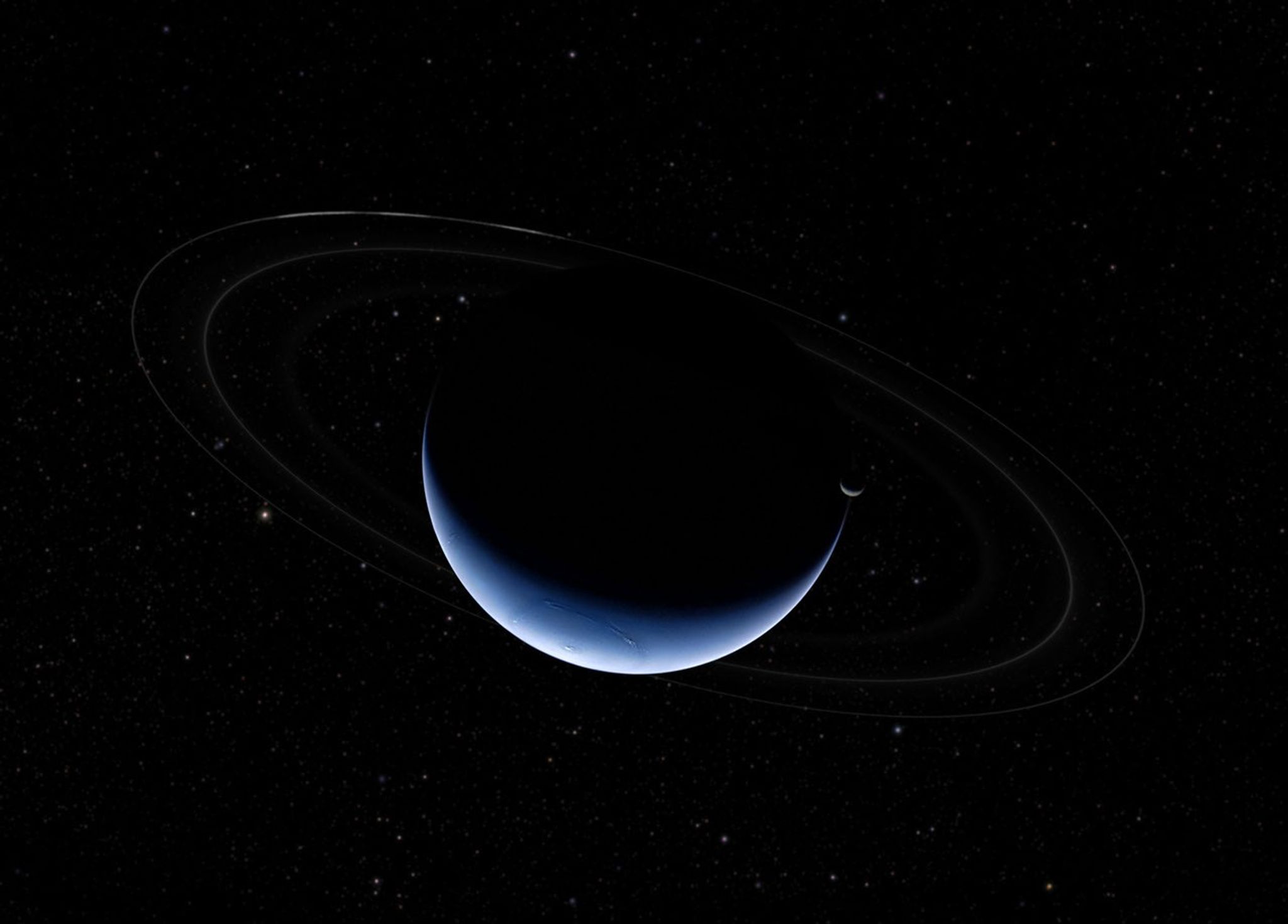 Voyager's NeptuneExplanation: Cruising through the outer solar system, the Voyager 2 spacecraft made its closest approach to Neptune on August 25, 1989, the only spacecraft to visit the most distant ice giant planet. Based on the images recorded during its close encounter and in the following days, this inspired composited scene covers the dim outer planet, largest moon Triton, and faint system of rings. From just beyond Neptune's orbit, the interplanetary perspective looks back toward the Sun, capturing the planet and Triton as thin sunlit crescents. Cirrus clouds and a dark band circle Neptune's south polar region, with a cloudy vortex above the pole itself. Parts of the very faint ring system along with the three bright ring arcs were first imaged by Voyager during the fly-by, though the faintest segments are modeled in this composited picture. Spanning 7.5 degrees, the background starfield is composed from sky survey data centered on the constellation Camelopardalis, corresponding to the outbound Voyager's view of the magnificent Neptunian system. Still cruising in 2026, the Voyager 2 spacecraft is now in interstellar space. |
|
Niceguy2
|
#6552 |
|
Re:Astronomy Picture of the Day Date Posted:11/23/2026 12:42 AMCopy HTML 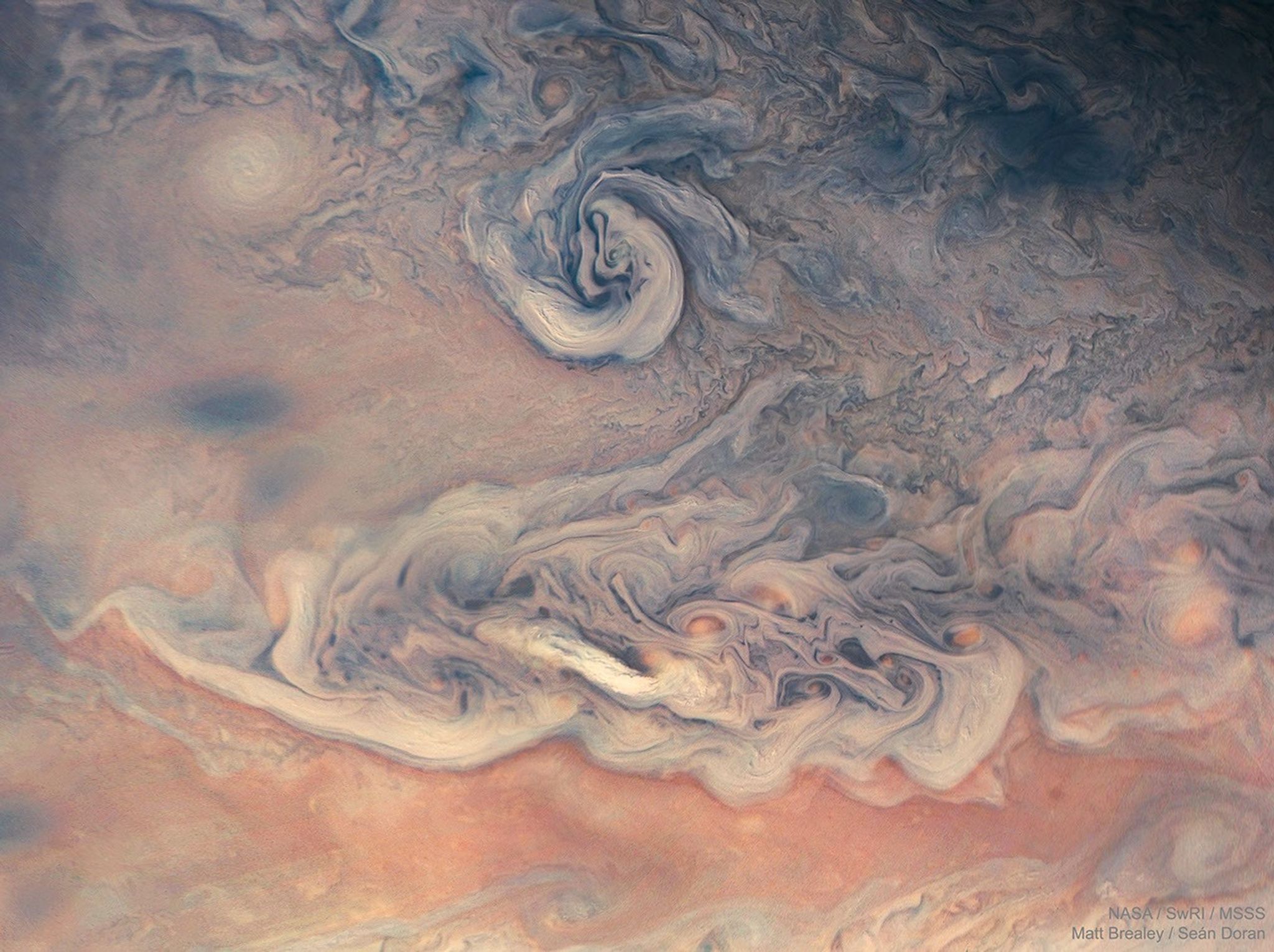 Swirls and Colors on Jupiter from JunoExplanation: What creates the colors in Jupiter's clouds? No one is sure. The thick atmosphere of Jupiter is mostly hydrogen and helium, elements which are colorless at the low temperatures of the Jovian cloud tops. Which trace molecules provide the colors remains a topic of research, although small amounts of ammonium hydrosulfide are one leading candidate. What is clear from the featured color-enhanced image -- and many similar images -- is that lighter clouds are typically higher up than darker ones. Pictured, light clouds swirl around reddish regions toward the lower right, while they appear to cover over some darker domains on the upper right. The featured image was taken by the robotic Juno spacecraft in 2018 during its 14th low pass over Jupiter. Juno continues in its looping elliptical orbit, swooping near the huge planet every 33 days and exploring a slightly different sector each time around. |
|
Niceguy2
|
#6553 |
|
Re:Astronomy Picture of the Day Date Posted:11/24/2026 3:39 AMCopy HTML 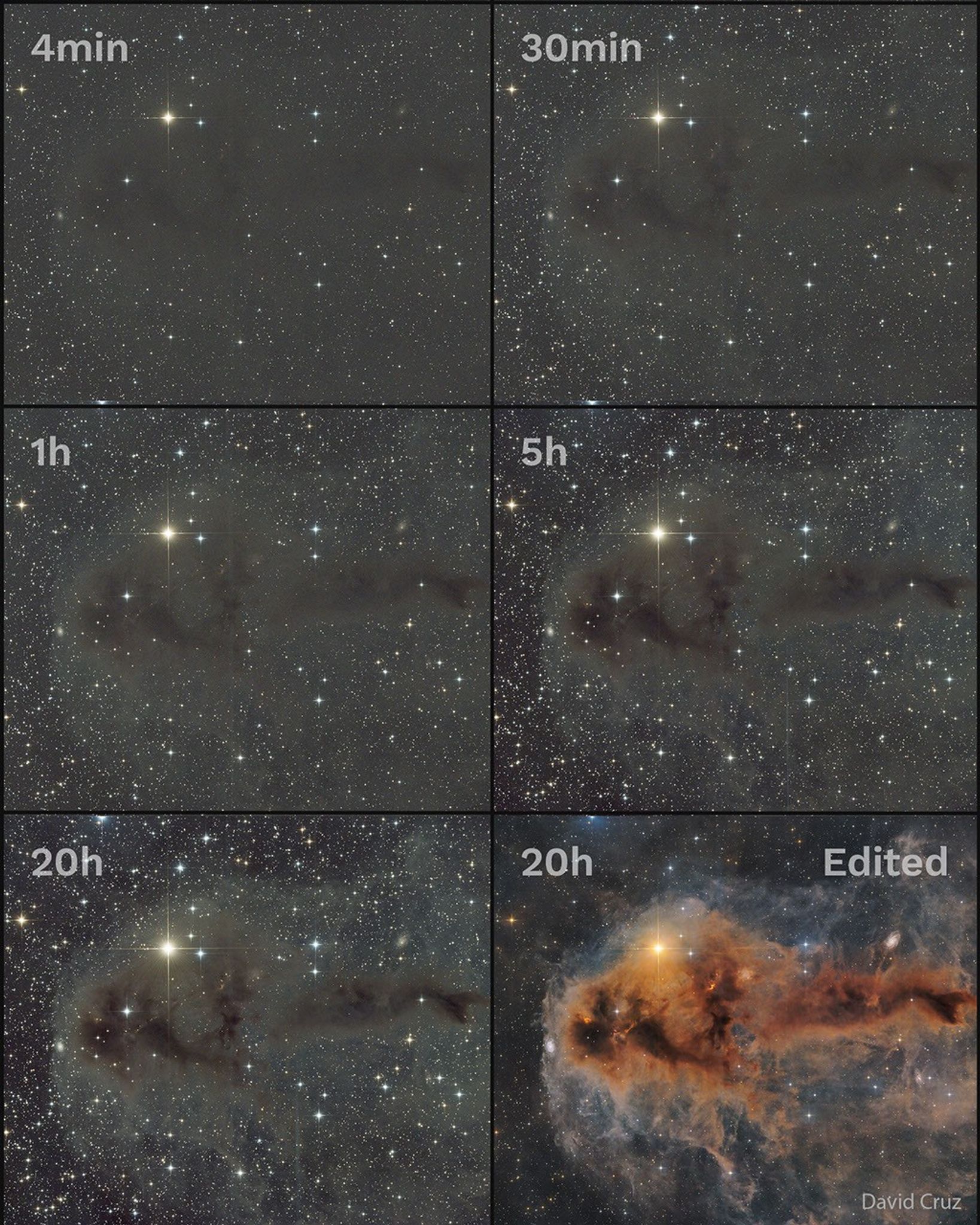 The Emergence of Dark Nebula Lynds 1251Explanation: If you stare into space for a long time, what might you see? At first, you might only see the usual brightest stars, but if your eyes (or camera) could continue to collect light, you would see increasingly more. In the direction of the featured image, after only a few minutes, you would begin to notice some regions without stars. As your staring continued, the dark region would become better defined, and after a full 20 hours, you would notice a strange dark structure. To celebrate, you use digital processing to brighten the image and enhance the colors. At the end, you might have an excellent image of Lynds 1251 (LDN 1251), a star-forming region laced with opaque brown-appearing interstellar dust. Also known as the Rotten Fish Nebula, LDN 1251 is home not only to young stars and dust, but also, your long staring indicates, energetic shock waves, fast stellar winds, and powerfully beamed jets. |
|
Niceguy2
|
#6554 |
|
Re:Astronomy Picture of the Day Date Posted:11/25/2026 2:24 AMCopy HTML 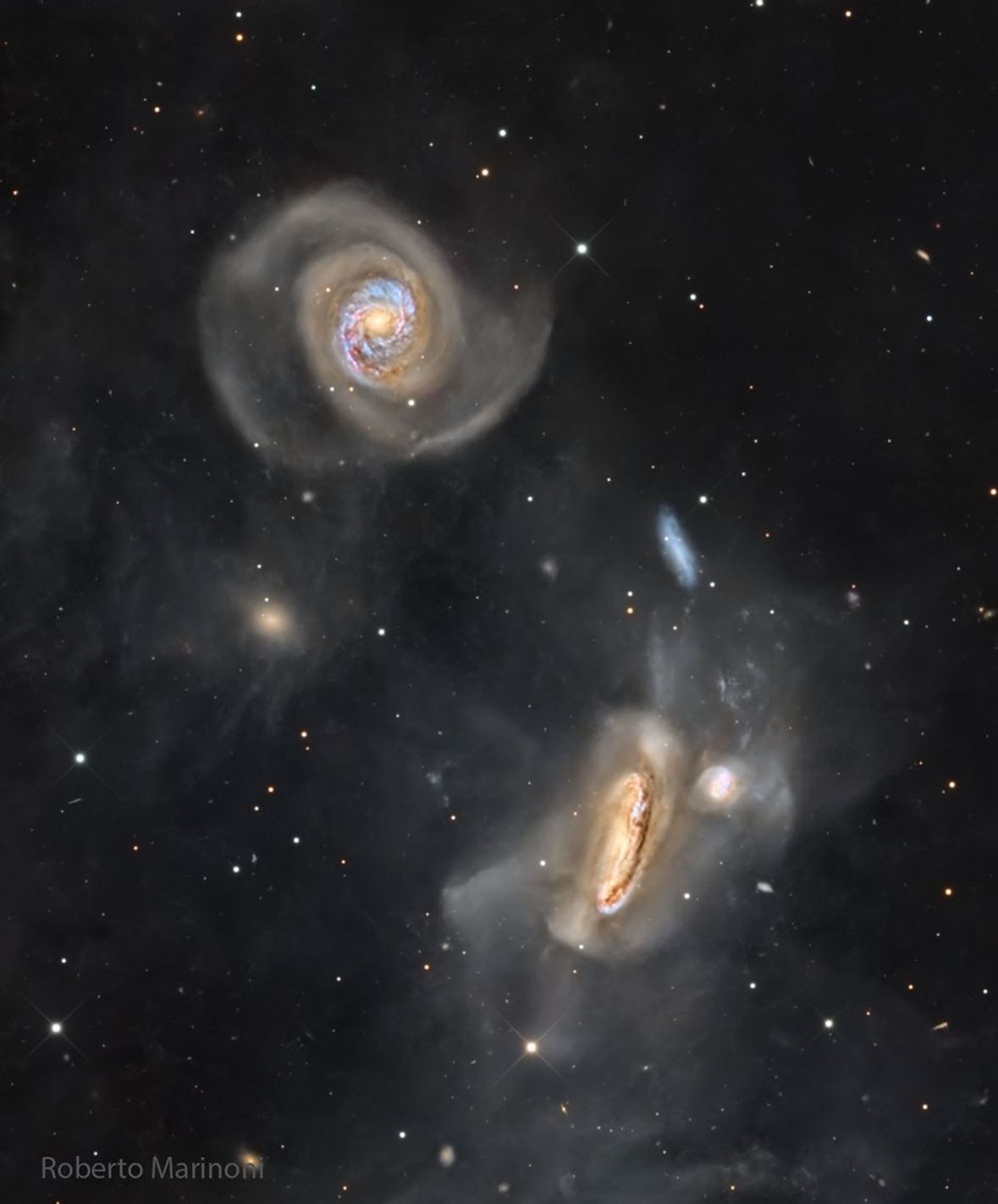 Galaxies Battle in the NGC 7771 GroupExplanation: After this galaxy battle, only one galaxy will remain. Already visible in the featured picture are rings and faint star swirls from previous gravitational encounters. Known collectively as the NGC 7771 Group, these galaxies lie almost 200 million light-years away toward the high-flying constellation Pegasus. The largest galaxy, barred spiral NGC 7771 on the lower right, is itself about 75,000 light-years across, and the galaxy on the upper left is spiral NGC 7769, which is almost as large. As these and other smaller galaxies make repeated close passages, they will all likely merge into one very large galaxy. Playing out over billions of years, the merger process is understood to be a normal part of the evolution of galaxies. Studying galaxy clashes like this helps humanity to better understand the possible merger between our own Milky Way and Andromeda galaxies. |
|
Niceguy2
|
#6555 |
|
Re:Astronomy Picture of the Day Date Posted:11/26/2026 3:47 AMCopy HTML -0:00 VIDEO NOT AVAILABLESPHEREx Seeing Through DustExplanation: What is blocking the center of the Milky Way? During its 13 billion years, our Milky Way has collected a lot of dust. In contrast to the skin cells, dirt, pollen, and other debris that make up the dust behind your couch, cosmic dust is hundreds of times smaller and made of tiny compounds of oxygen, carbon, and other elements released into space when a star dies. Today’s video shows infrared light from the Milky Way’s center gathered by NASA’s SPHEREx satellite. Each false color in the video corresponds to the infrared color associated with the wavelength shown in the top left. In the near-infrared, like 1.2 microns, light gets absorbed and scatters off of dust particles. SPHEREx then sees the Galactic Center almost entirely blocked by clouds of dust. In the mid-infrared, though, light is able to pierce through the dust and reach SPHEREx. This is similar to, but not exactly, why sunsets are red! |