https://i.postimg.cc/CxwrQNF8/welcomebearclowns.gif
friendsoffortiesfive Aimoo Forum List | Ticket | Today | Member | Search | Who's On | Help | Sign In | |
friendsoffortiesfive > General > General Discussion Go to subcategory:
Post New Topic Reply
Author Content
Niceguy2
  • Rank:Diamond
  • Score:350205
  • From:USA
  • Register:01/12/2009 5:00 AM

Date Posted:03/06/2014 11:29 PMCopy HTML

I really love this site and 
this is an awesome photo!
Kind of makes me realize how
small this planet Earth is....
Joe


Astronomy Picture of the Day

Discover the cosmos! Each day a different image or photograph of our fascinating universe is featured, along with a brief explanation written by a professional astronomer.

2014 March 6
See Explanation.  Clicking on the picture will download the highest resolution version available.

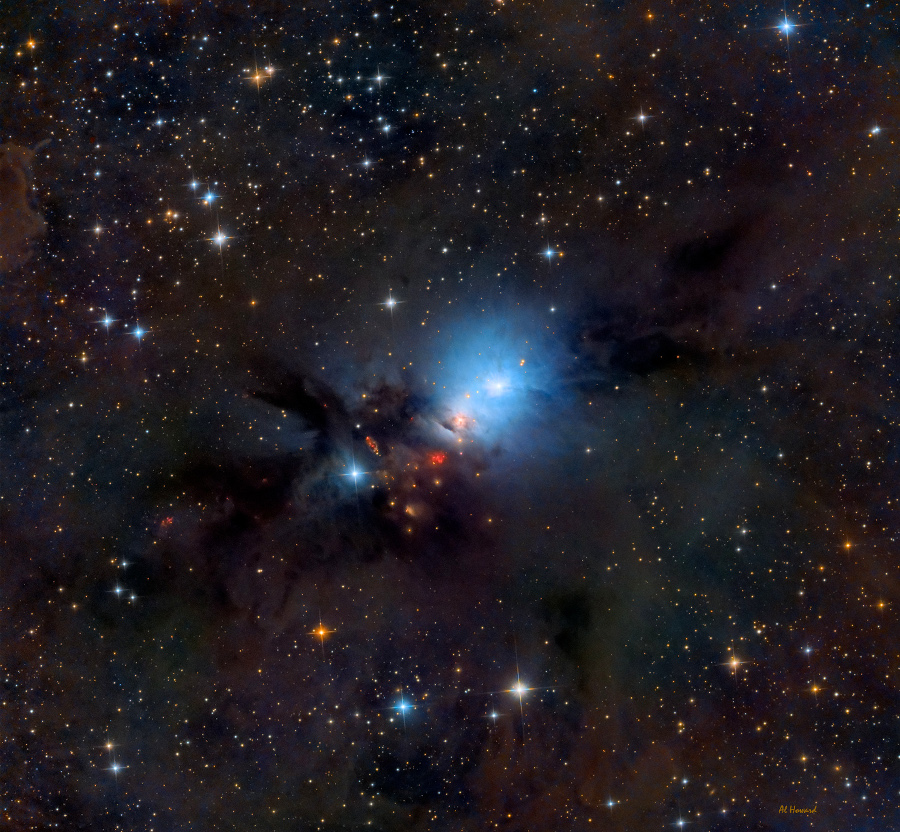
NGC 1333 Stardust 
Image Credit & Copyright
Al Howard

Explanation: NGC 1333 is seen in visible light as a reflection nebula, dominated by bluish hues characteristic of starlight reflected by dust. A mere 1,000 light-years distant toward the heroic constellationPerseus, it lies at the edge of a large, star-forming molecular cloud. This striking close-up view spans about two full moons on the sky or just over 15 light-years at the estimated distance of NGC 1333. It shows details of the dusty region along with hints of contrasting red emission from Herbig-Haro objects, jets and shocked glowing gas emanating from recently formed stars. In fact, NGC 1333 contains hundreds of stars less than a million years old, most still hidden from optical telescopes by the pervasive stardust. The chaotic environment may be similar to one in which our own Sun formed over 4.5 billion years ago.

Niceguy2 #6401
  • Rank:Diamond
  • Score:350205
  • From:USA
  • Register:01/12/2009 5:00 AM

Re:Astronomy Picture of the Day

Date Posted:07/03/2026 5:00 AMCopy HTML

2026 July 2
Against a bright field of stars, a yellow nebula with blue details,
	  a purple filament on the left and a bright star on the right.

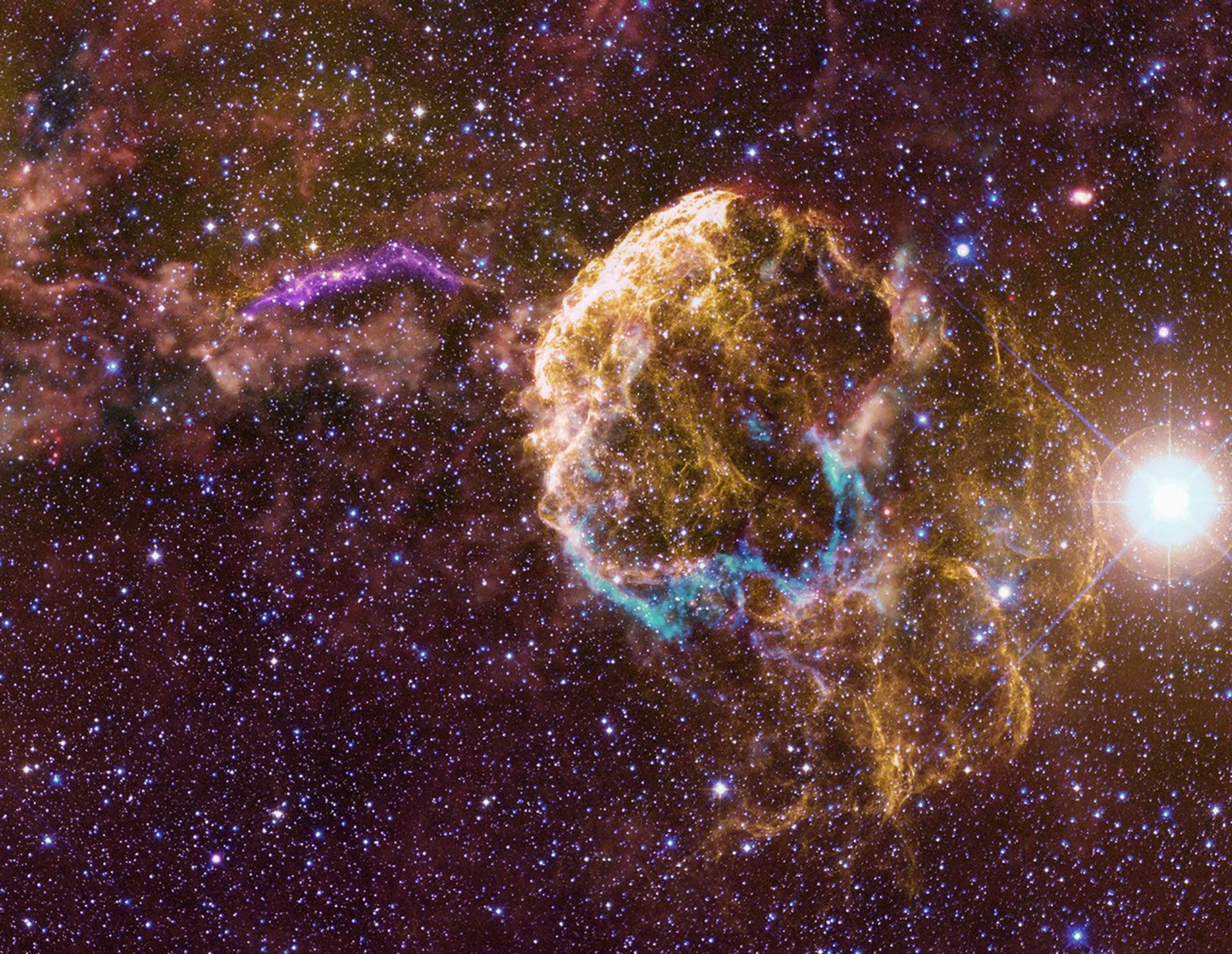
Sibling Supernova Remnants
Image Credit: NASA Goddard Space Flight Center and M. Michailidis et al. 2026; optical: DSS; infrared: NASA/WISE/JPL-Caltech/UCLA; ultraviolet: NASA/Swift
Text: Cecilia Chirenti (NASA GSFC, UMCP, CRESST II)

Explanation: What happens when one of the stars in a binary goes supernova? This image combines visible (yellow), ultraviolet (purple) and infrared light (cyan, red and orange) to show two supernova remnants and their surrounding environment, about 6,000 light-years away. The younger one is the well-known Jellyfish Nebula in the center (mostly in yellow). If we could see it by eye, it would appear larger than the full moon in the sky. The filament shown in purple is part of an older, overlapping supernova remnant, G189.6+3.3. A new study used data from NASA's Fermi Gamma-ray Space Telescope to piece together their story. Astronomers believe that there were two stars in a binary system, then the first one exploded as a supernova, kicking away its companion, which also exploded as a supernova tens of thousands of years later, creating the superimposed supernova remnants we see today. The bright star on the right is actually a triple star system named Propus.


Post New Topic Reply
Copyright © 2000- Aimoo Free Forum All rights reserved.
Skin by SandhillsDebby - Elements from DivaAmyMarie.blogspot.com