 |
|

| Title: Astronomy Picture of the Day | |
| friendsoffortiesfive > General > General Discussion | Go to subcategory: |


| Author | Content |
Niceguy2

|
|
|
Date Posted:03/06/2014 11:29 PMCopy HTML I really love this site and |
|
Niceguy2
|
#6376 |
|
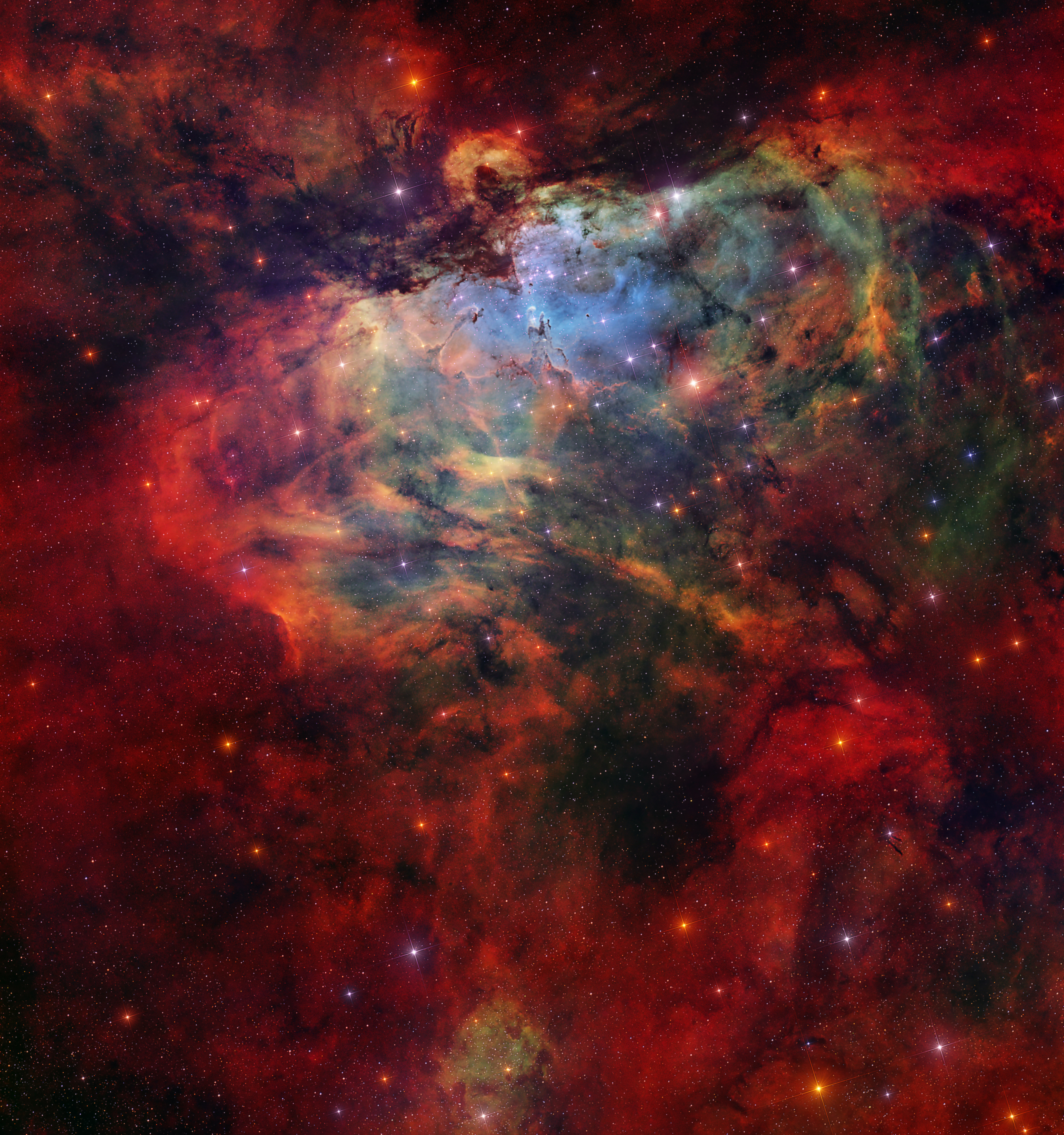
Re:Astronomy Picture of the Day Date Posted:06/11/2026 3:32 AMCopy HTML 2026 June 10 Image Credit & Copyright: Emmanuel Delgadillo Text: Keighley Rockcliffe (NASA GSFC, UMBC CSST, CRESST II) Explanation: What looks as if it is going to swallow the great Pillars of Creation? The Eagle Nebula (M16) is not a bird, a plane, or Superman. M16 is actually a combination of several celestial objects. NGC 6611 is the young star cluster that appears to peak out beneath the Eagle’s “wings”. The ultraviolet light from these stars ionizes the surrounding gas, creating the emission nebula IC 4703. The Stellar Spire is seen reaching towards the Pillars of Creation from the left. Both are structures of cold gas and dust that are optimal for star formation. Some astronomers previously thought the Pillars of Creation had been evaporated away by a supernova. Because M16 is 6,000 light years away, we would not be able to see the Pillars’ destruction for thousands more years. However, there is no conclusive evidence of the theorized supernova, so the Pillars of Creation will likely continue to create stars for millions of years. |
|
Niceguy2
|
#6377 |
|
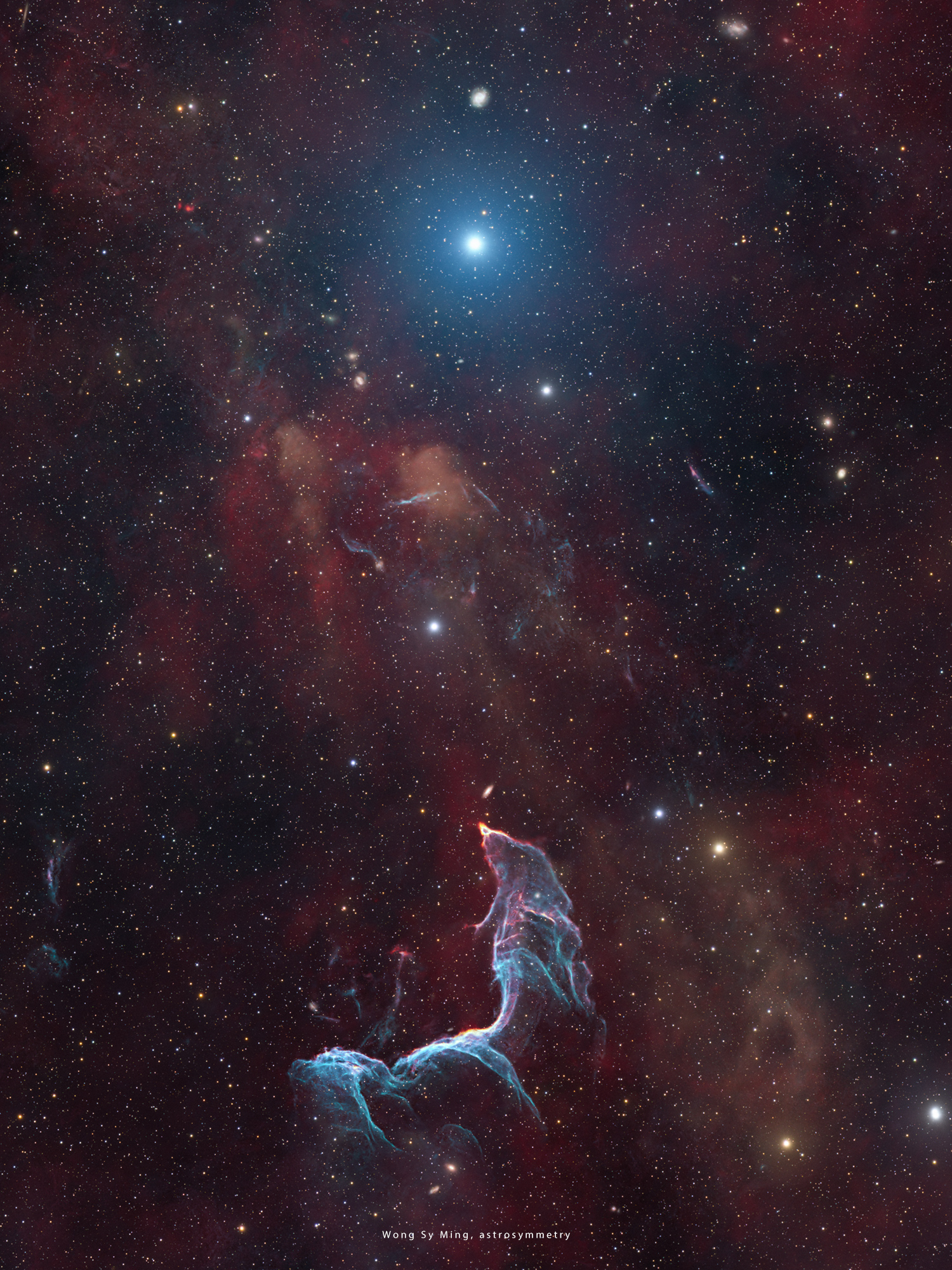
Re:Astronomy Picture of the Day Date Posted:06/12/2026 2:24 AMCopy HTML 2026 June 11 Image Credit & Copyright: Data acquisition: Sy Ming Wong; Processing: Guangyan Gao Text: Cecilia Chirenti (NASA GSFC, UMCP, CRESST II) Explanation: Could the Little Mermaid turn into stardust instead of seafoam? It would seem so in this beautiful nebula. The featured image shows the Mermaid Nebula, also known as the Betta Fish Nebula, which is part of the G296.5+10.0 Supernova Remnant. The blue color visible here originates from doubly ionized oxygen (OIII), while the deep red is emitted by hydrogen gas. Estimated to be located a few thousand light-years away and about 10,000 years old, this nebula was formed when a massive star exploded as a supernova. It left behind a peculiar pulsar, a young radio-quiet neutron star that spins around about twice every second. The bright stars shown in the image are unassociated with the nebula. The pulsar can be detected in the X-rays but it does not have a confirmed detection in the optical (visible light) so far. As a result, the pulsar itself is not visible in this image. |
|
Niceguy2
|
#6378 |
|
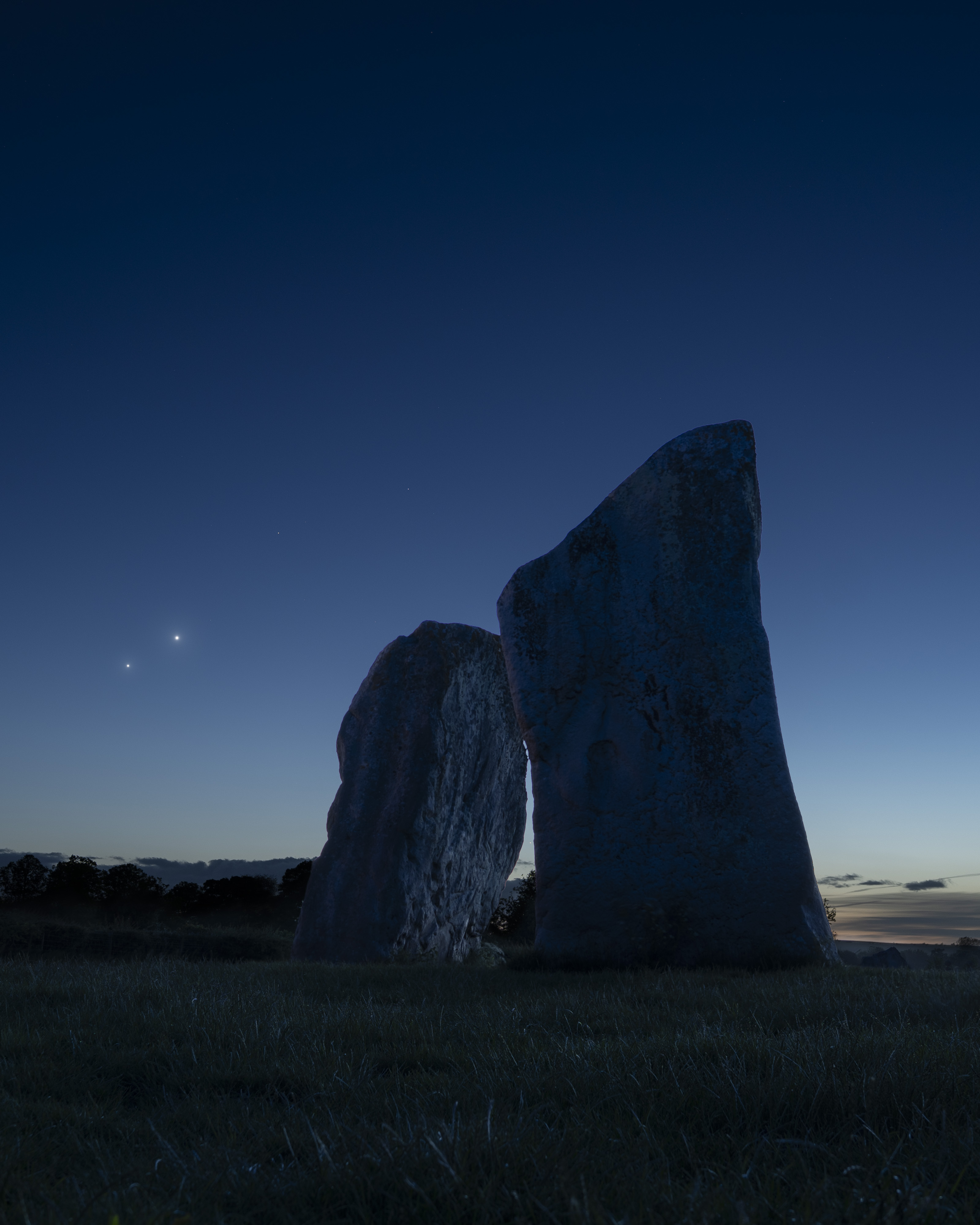
Re:Astronomy Picture of the Day Date Posted:06/13/2026 3:40 AMCopy HTML 2026 June 12 Image Credit & Copyright: Josh Dury Explanation: To see Venus and Jupiter together this month, you won't need binoculars or even a telescope. Just look up after sunset and you'll find them emerging as the sky grows dark near the western horizon. In fact, on June 9 the two brightest planets were in close conjunction, separated on the sky by less than 2 degrees from our perspective. Since (brighter) inner planet Venus orbits the Sun faster than outer planet Jupiter, it catches up with and passes the outer planet along the ecliptic roughly every 13 months. But every three years or so their resulting conjunction can be viewed far enough from the Sun to be easily seen in Earth's twilight skies. On June 9, the two celestial beacon's close "cosmic kiss" was captured here next to the two large standing stones at the cove within a 4,000 year old stone circle at Avebury, UK. Larger than Stonehenge, the Avebury henge and stone circle complex is also recognized as one of the most significant neolithic ceremonial sites on planet Earth. |
|
Niceguy2
|
#6379 |
|
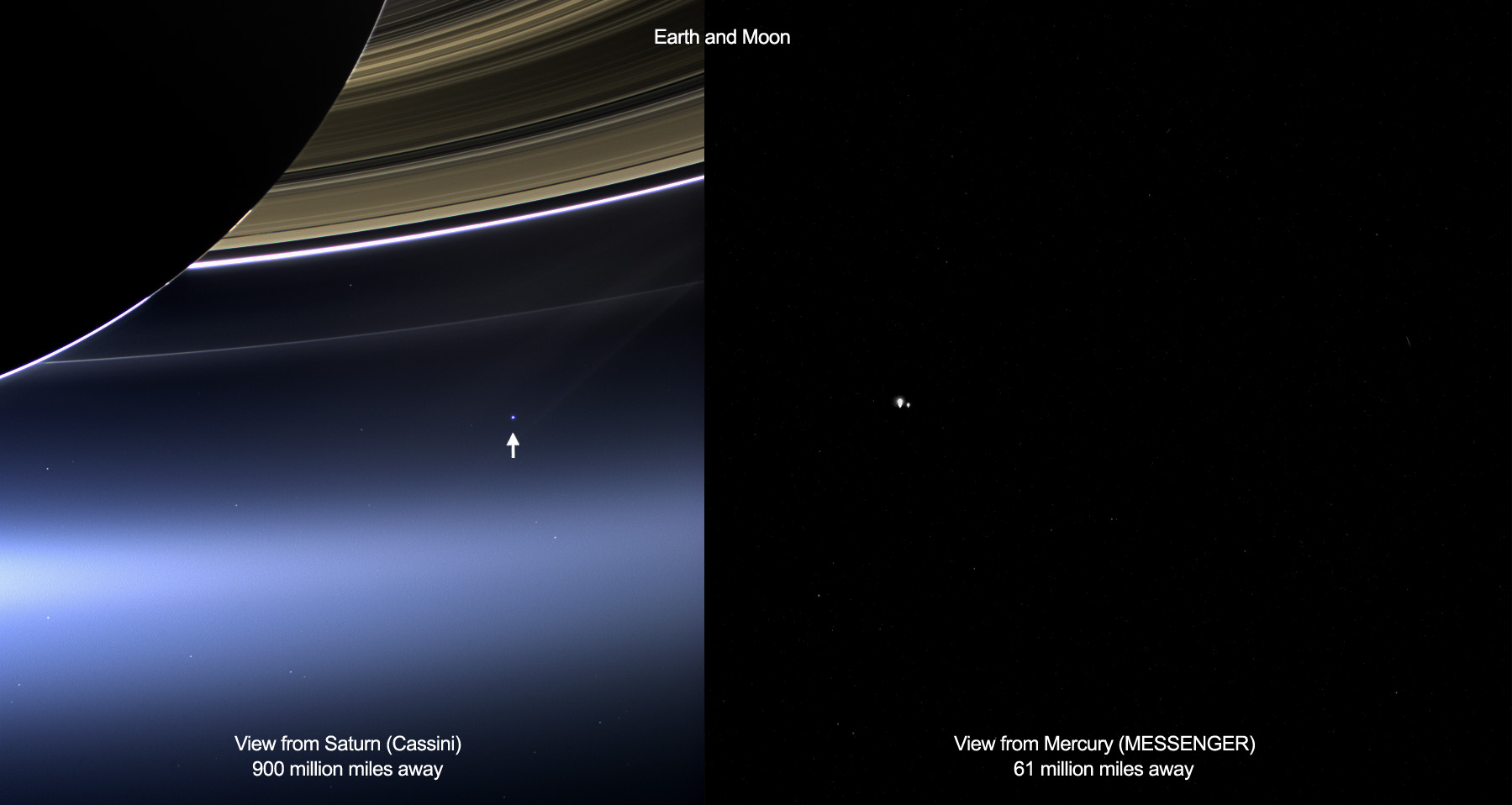
Re:Astronomy Picture of the Day Date Posted:06/14/2026 2:20 AMCopy HTML 2026 June 13 Image Credit: Cassini Imaging Team, SSI, JPL, ESA, NASA & NASA / JHU Applied Physics Lab / Carnegie Inst. Washington Explanation: In an interplanetary first, on July 19, 2013 Earth was photographed on the same day from two other worlds of the Solar System, innermost planet Mercury and ringed gas giant Saturn. Pictured on the left, Earth is the pale blue dot just below the rings of Saturn, as captured by the robotic Cassini spacecraft then orbiting the outermost gas giant. On that same day people across planet Earth snapped many of their own pictures of Saturn. On the right, the Earth-Moon system is seen against the dark background of space as captured by the sunward MESSENGER spacecraft, then in Mercury orbit. MESSENGER took its image as part of a search for small natural satellites of Mercury, moons that would be expected to be quite dim. In the MESSENGER image, the brighter Earth and Moon are both overexposed and shine brightly with reflected sunlight. Destined not to return to their home world, both Cassini and MESSENGER have since retired from their missions of Solar System exploration. |
|
Niceguy2
|
#6380 |
|
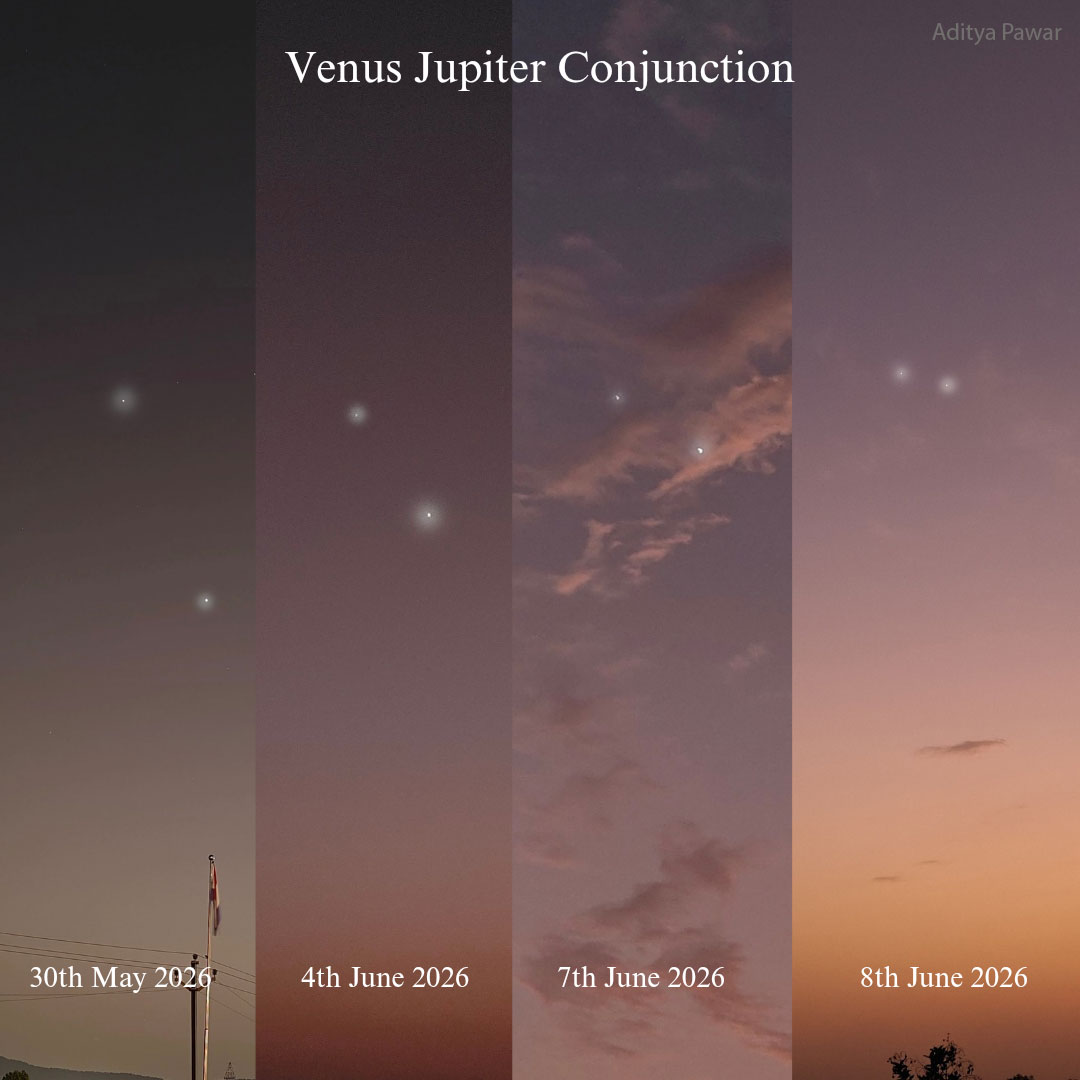
Re:Astronomy Picture of the Day Date Posted:06/15/2026 2:18 AMCopy HTML 2026 June 14 Image Credit & Copyright: Aditya Pawar Explanation: Venus and Jupiter may have caught your attention lately. The recent close conjunction of the two brightest planets in recent evening skies has been hard to miss. With Jupiter at the top, starting on May 30 and ending on June 8, their close approach was chronicled daily, left to right, in the featured panels from Maharashtra, India. Near the western horizon, the evening sky colors and exposures used for each panel depend on the local conditions near sunset. At their closest on June 9, the celestial pair appeared to be only about three times the width of a full moon apart. Of course, on that date, the two planets were physically separated by over 600 million kilometers in their orbits around the Sun. In the coming days, Jupiter will slowly settle into the sunset glare, but Venus will continue to move farther from the Sun in the western sky to excel in its current role as the brilliant evening star. |
|
Niceguy2
|
#6381 |
|
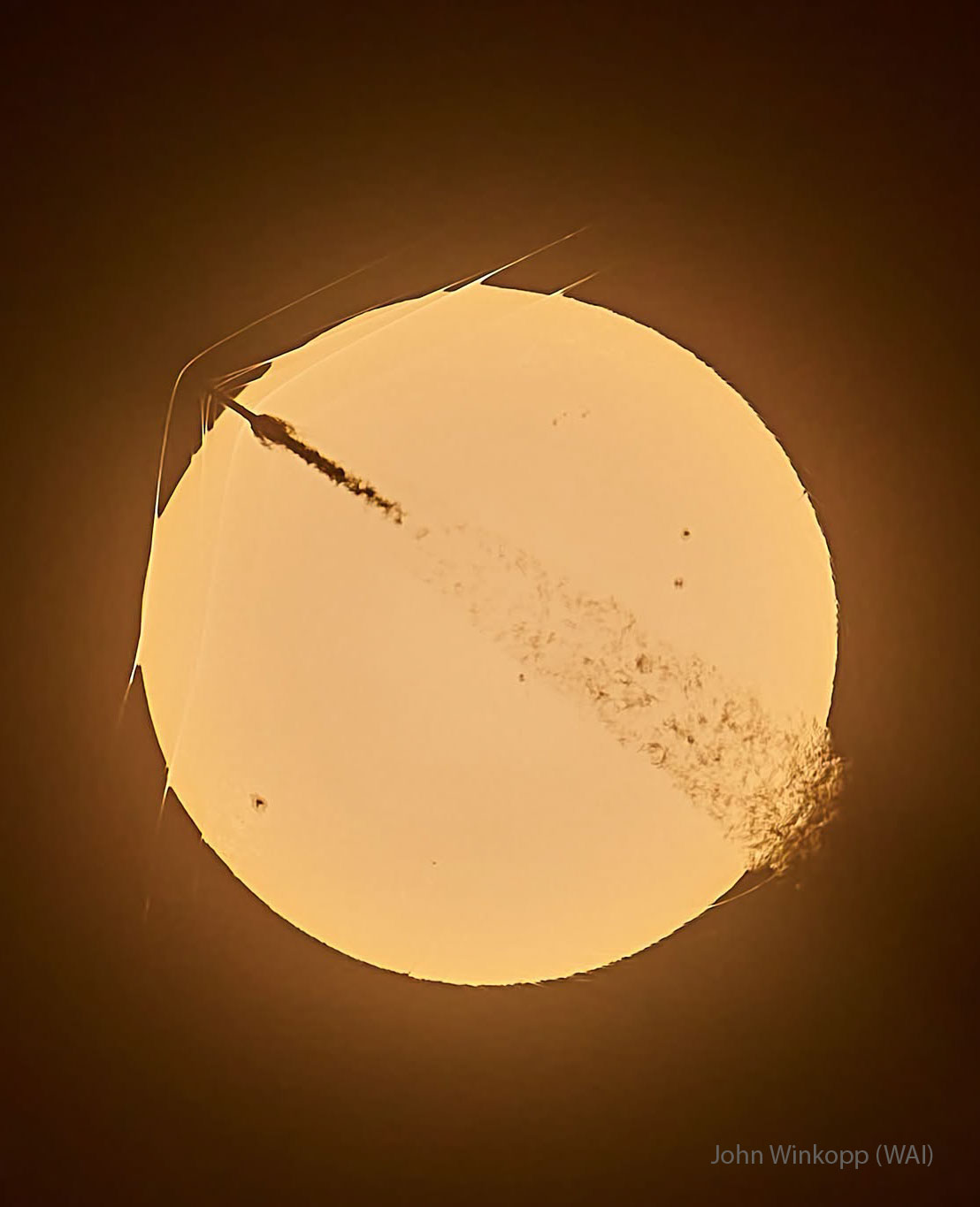
Re:Astronomy Picture of the Day Date Posted:06/16/2026 2:57 AMCopy HTML 2026 June 15 Image Credit & Copyright: John Winkopp (WAI Media) Explanation: What's happening to this Sun-crossing rocket? The SpaceX Falcon 9 rocket, visible on the upper left, launched only about one minute before this amazing image was captured. As it rose to low Earth orbit from Cape Canaveral, Florida, USA, in late May, the rocket became supersonic before it crossed the disk of the distant Sun -- from the perspective of the well-placed photographer. The spacecraft's high speed caused bow-shaped compressed-air shockwaves to form across leading surfaces, with at least three visible even outside the Sun's disk because they refract sunlight. The trailing exhaust caused turbulence visible on the lower right. None of this was damaging to the robotic Starlink 10-53 mission, which delivered 29 communications satellites to low Earth orbit as planned. And if that isn't amazing enough - the Sun had spots! |
|
Niceguy2
|
#6382 |
|
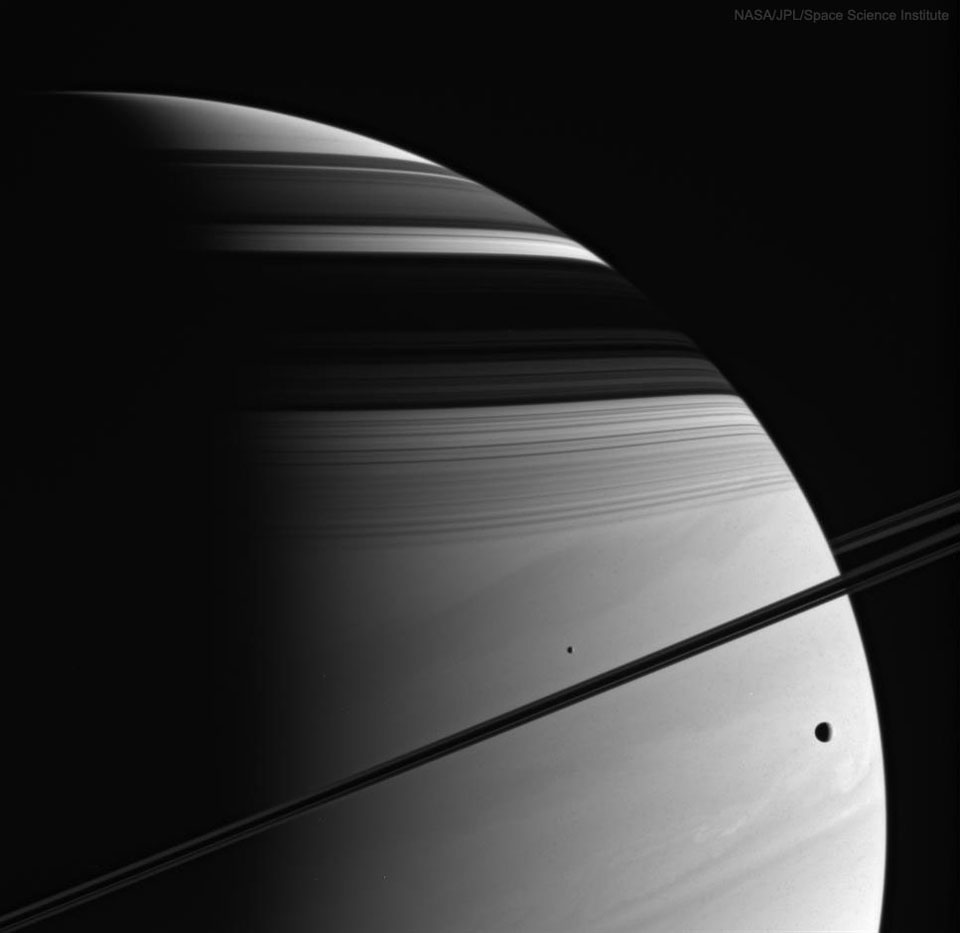
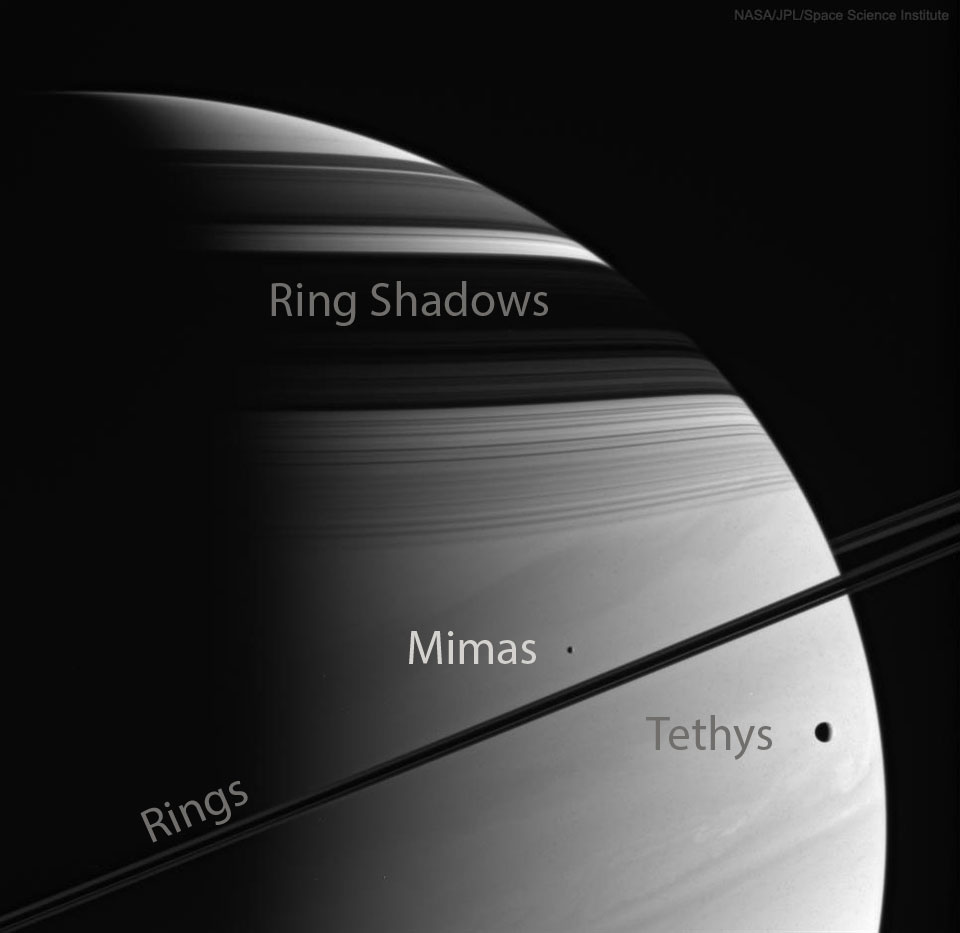
Re:Astronomy Picture of the Day Date Posted:06/17/2026 3:20 AMCopy HTML 2026 June 16 Image Credit: NASA, JPL-Caltech, Space Science Institute Explanation: While cruising around Saturn, be on the lookout for picturesque arrangements of moons, rings, and shadows. One such striking sight occurred in 2005 and was captured by the then Saturn-orbiting Cassini spacecraft. In the featured image, moons Mimas (left) and Tethys (right) are visible on either side of Saturn's thin rings, which are seen nearly edge-on. Across the top of Saturn are dark shadows of the wide rings, exhibiting their impressive complexity. The violet-light image brings up the texture of the backdrop: Saturn's clouds. Cassini orbited Saturn from 2004 until mid-2017, when the robotic spacecraft was directed to dive into Saturn to keep it from contaminating any moons. |
|
Niceguy2
|
#6383 |
|
Re:Astronomy Picture of the Day Date Posted:06/17/2026 3:20 AMCopy HTML
|
|
Niceguy2
|
#6384 |
|
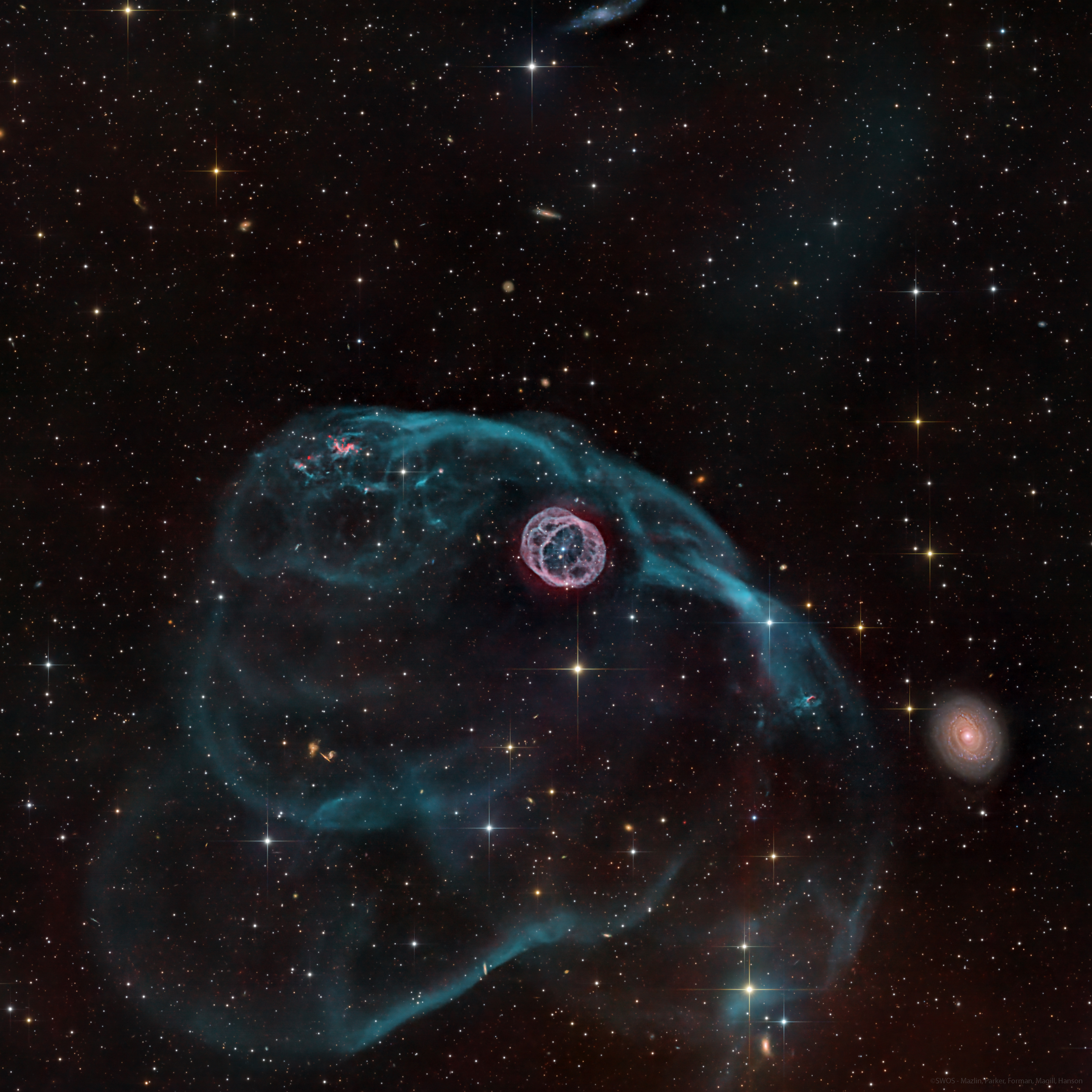
Re:Astronomy Picture of the Day Date Posted:06/18/2026 1:18 AMCopy HTML 2026 June 17 Image Credit & Copyright: Mazlin, Parker, Forman, Magill, Hanson Text: Keighley Rockcliffe (NASA GSFC, UMBC CSST, CRESST II) Explanation: How did a hamster wheel get into space? The Hamster Wheel Nebula (Longmore 8) was discovered by Andrew Longmore in 1976 as a part of a larger survey of the southern sky. This survey employed several improvements in photographic technology, including the use of highly sensitive film, to capture deeper and fainter objects on plates that were examined by eye and catalogued. The featured image, taken at Observatorio El Sauce in Chile, depicts an intricate wheel structure of glowing hydrogen that was thrown out into space by a dying star and ionized by the leftover white dwarf. This structure was barely visible on the original plate, emphasizing the power of modern telescopes and cameras. Two opposing clumps of red hydrogen gas encased in the blue veil of ionized oxygen hint at the presence of a companion to the bright white dwarf at the wheel’s center! |
|
Niceguy2
|
#6385 |
|
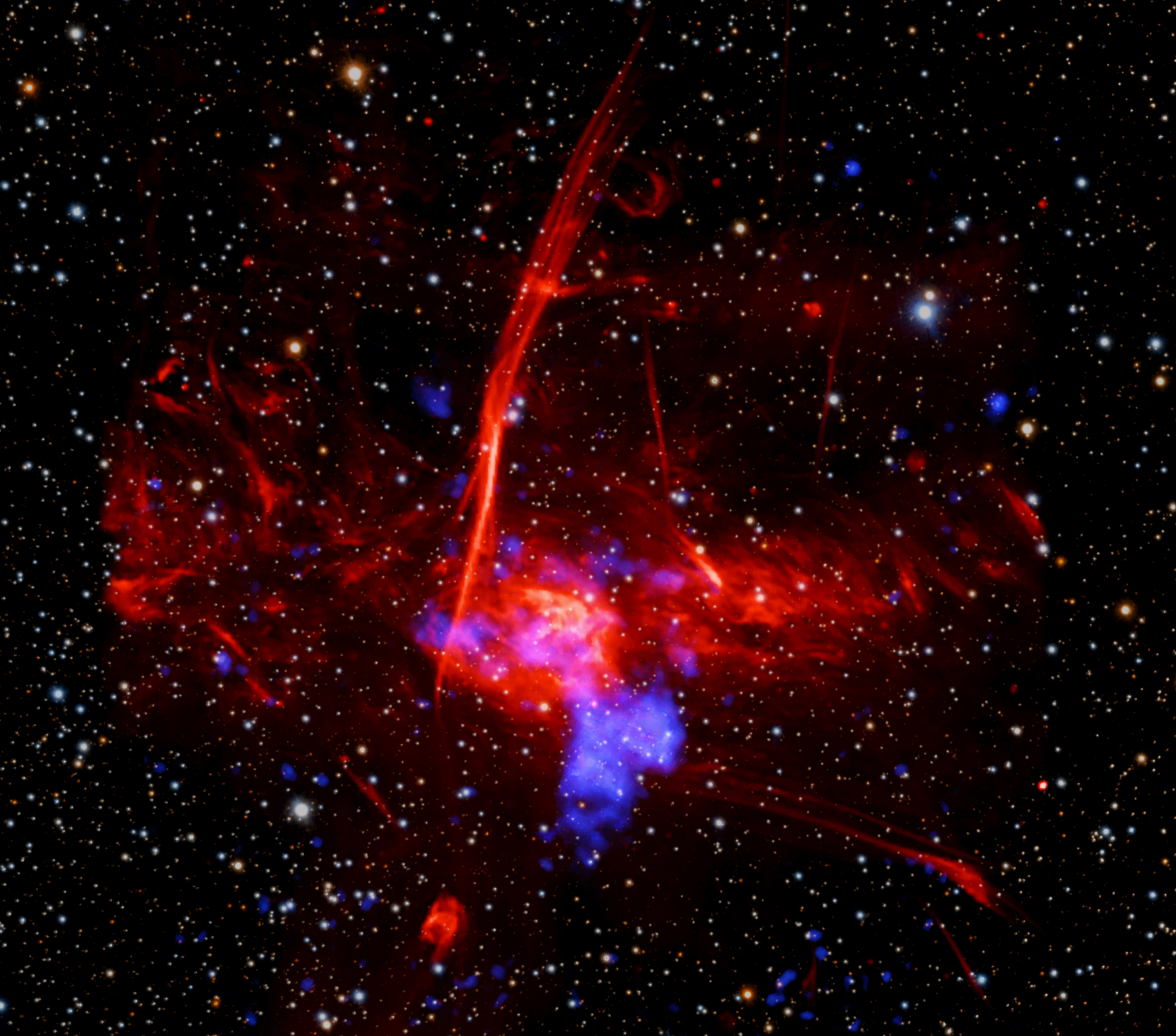
Re:Astronomy Picture of the Day Date Posted:06/19/2026 2:14 AMCopy HTML 2026 June 18 Image Credit & Copyright: X-ray: NASA/CXC/UCLA/Z. Zhu et al.; ESA/XMM-Newton; Optical: PanSTARRS; Radio: MeerKAT; Image Processing: NASA/CXC/SAO/L. Frattare and P. Edmonds Text: Cecilia Chirenti (NASA GSFC, UMCP, CRESST II) Explanation: Do you see that blue blob to the lower right of the image center? Astronomers think that it shows where a massive star exploded as a supernova whose light reached Earth 1,700 years ago. The image combines optical data from the PanSTARRS telescopes in Hawaii (background stars in red, green, and blue), radio from the MeerKAT telescope in South Africa (large red cloud) and X-rays from NASA's Chandra X-ray Observatory and ESA’s XMM-Newton (shown in blue). The large cloud is a star forming region called Sagittarius C, which is approximately 50 light-years in extent and about 26,000 light-years from Earth. It is located only about 260 light-years from the supermassive black hole in the center of the Galaxy (off to the left of the image). If the blue blob is confirmed to be a supernova remnant, it would be one of the closest ever discovered to the Galactic Center. In this dense region, the deaths of massive stars are connected to the birth of new stars through gas and magnetic fields in a complex way. |
|
Niceguy2
|
#6386 |
|
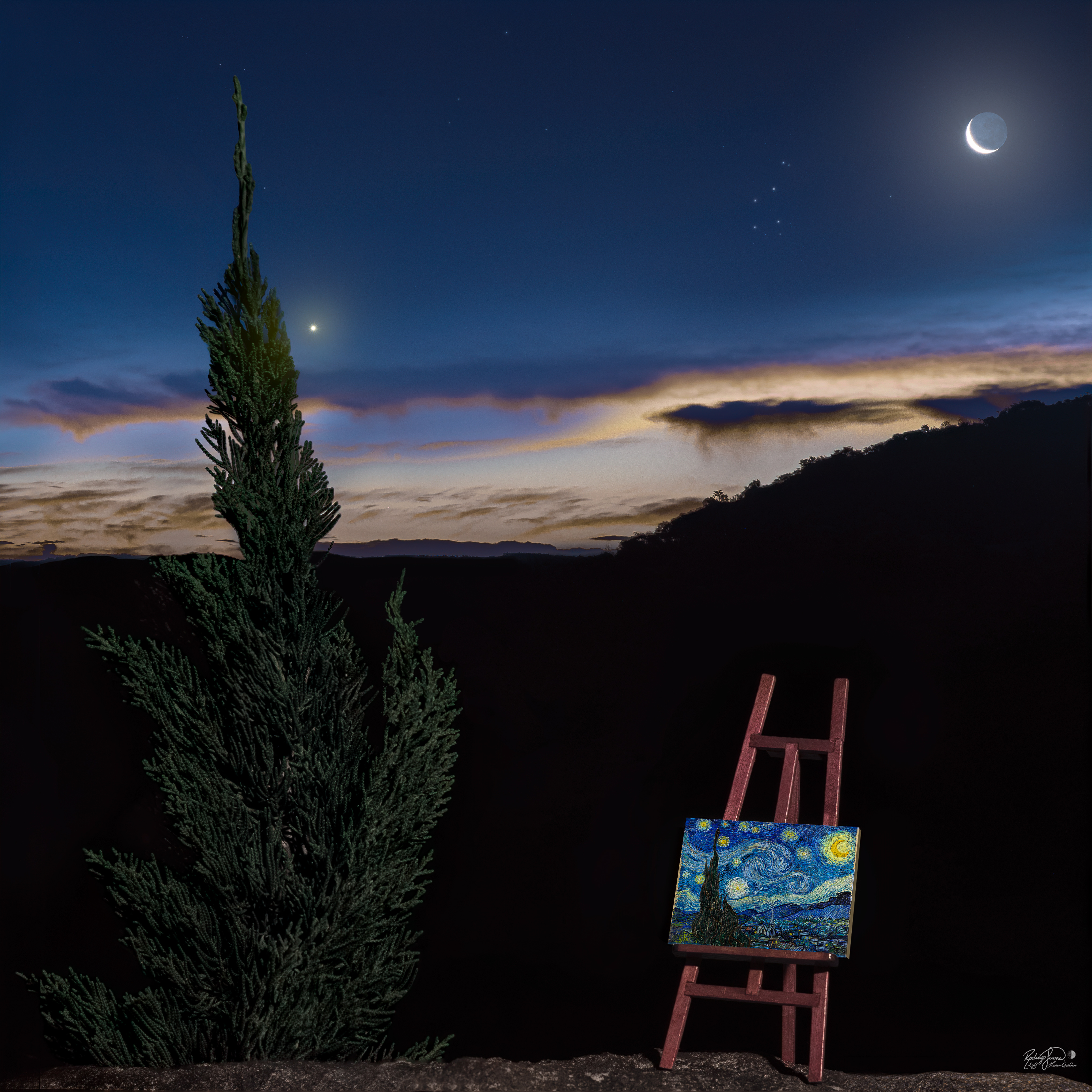
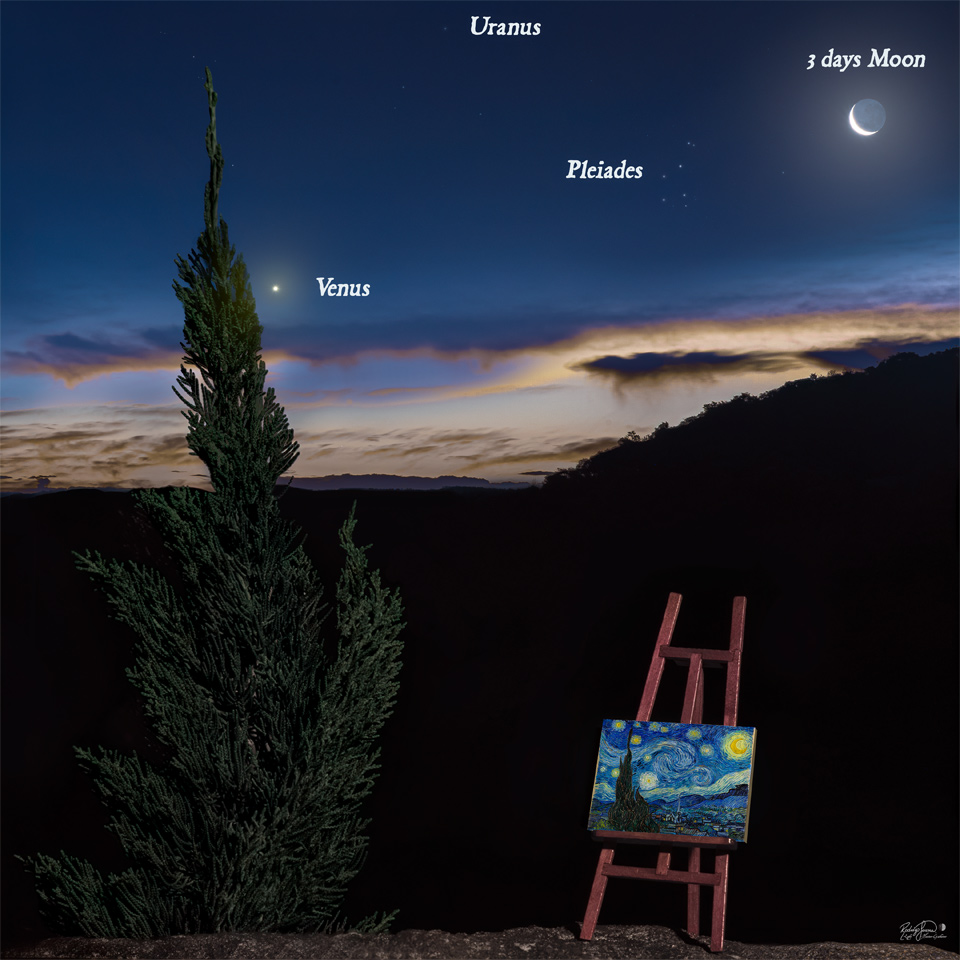
Re:Astronomy Picture of the Day Date Posted:06/20/2026 2:45 AMCopy HTML 2026 June 19 Image Credit & Copyright: Rodrigo Guerra, Original Painting: Vincent van Gogh Explanation: Does this scene look familiar? It is a modern recreation of the famous painting Starry Night by Vincent van Gogh. Both the image and the painting depict a tall tree on the left, a crescent moon on the upper right, the planet Venus just to the right of the tree, a foreground horizon rising from left to right, and clouds above the horizon. Differences include that the photograph was taken in mid-April earlier this year in Cascavel, Brazil, while the painting was composed in Saint-Rémy-de-Provence, France, in 1889. The original Starry Night is considered by many to be one of the three most famous paintings in the world today and a statement about the wonders of the night sky. Today is (roughly) the anniversary of the morning that van Gogh saw the sky that he later painted in his version of Starry Night. |
|
Niceguy2
|
#6387 |
|
Re:Astronomy Picture of the Day Date Posted:06/20/2026 2:45 AMCopy HTML
|
|
Niceguy2
|
#6388 |
|
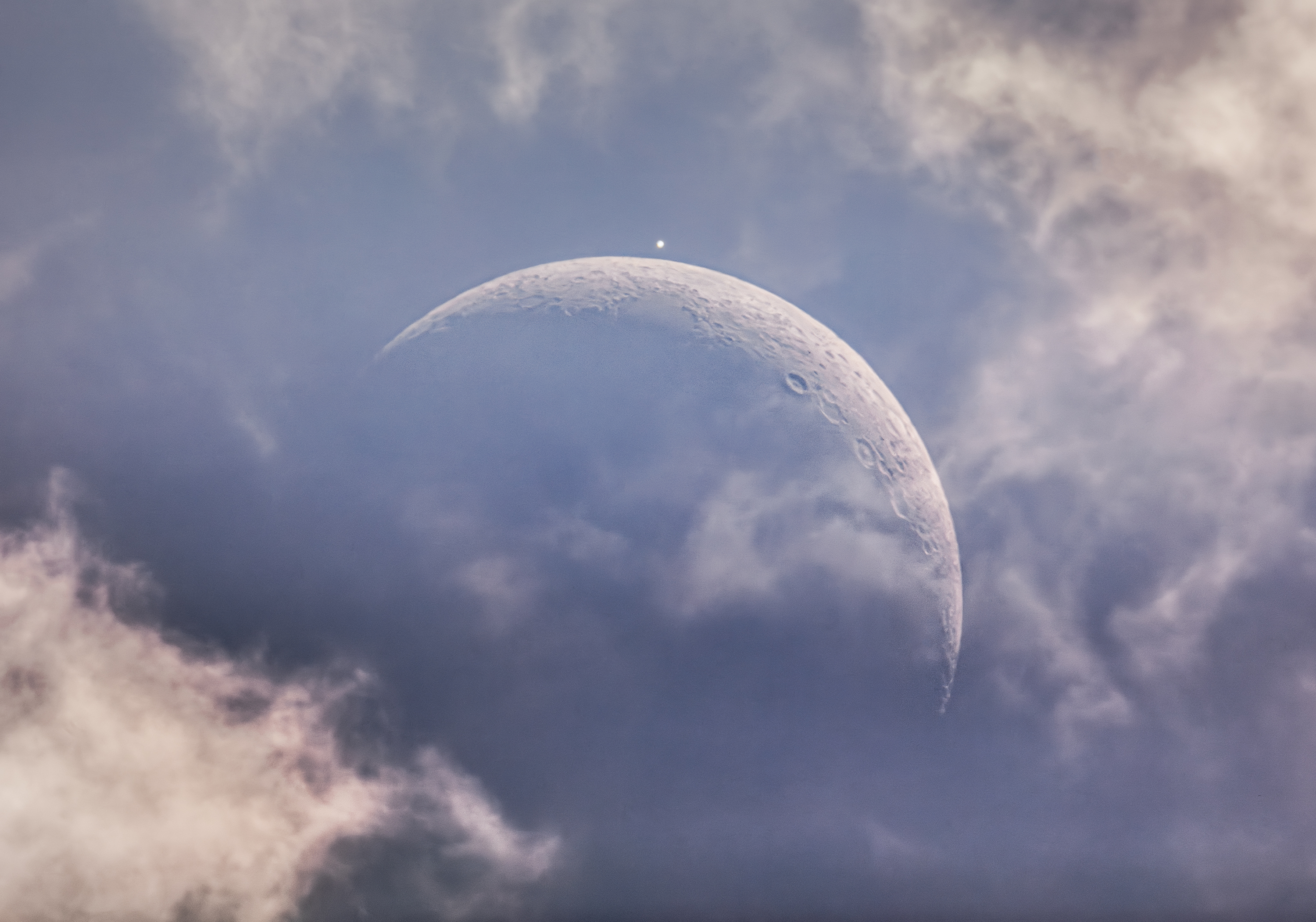
Re:Astronomy Picture of the Day Date Posted:06/21/2026 2:02 AMCopy HTML 2026 June 20 Image Credit & Copyright: Debra Ceravolo Explanation: Venus is now appearing on the celestial stage as Earth's brilliant evening star, performing with the Moon, other wandering planets, and bright stars in western skies. For evening sky gazers on June 17, the celestial beacon rose after sunset close by a young, slender, crescent Moon. But from some locations the Moon could be seen to occult or pass in front of Venus. And from a backyard observatory in southern British Columbia, Canada, the lunar occultation was played out in daylight. This stunning telescopic snapshot captured a scene in dramatically cloudy skies, following Venus' hour long disappearance, as the evening star emerged beyond the bright lunar limb. |
|
Niceguy2
|
#6389 |
|
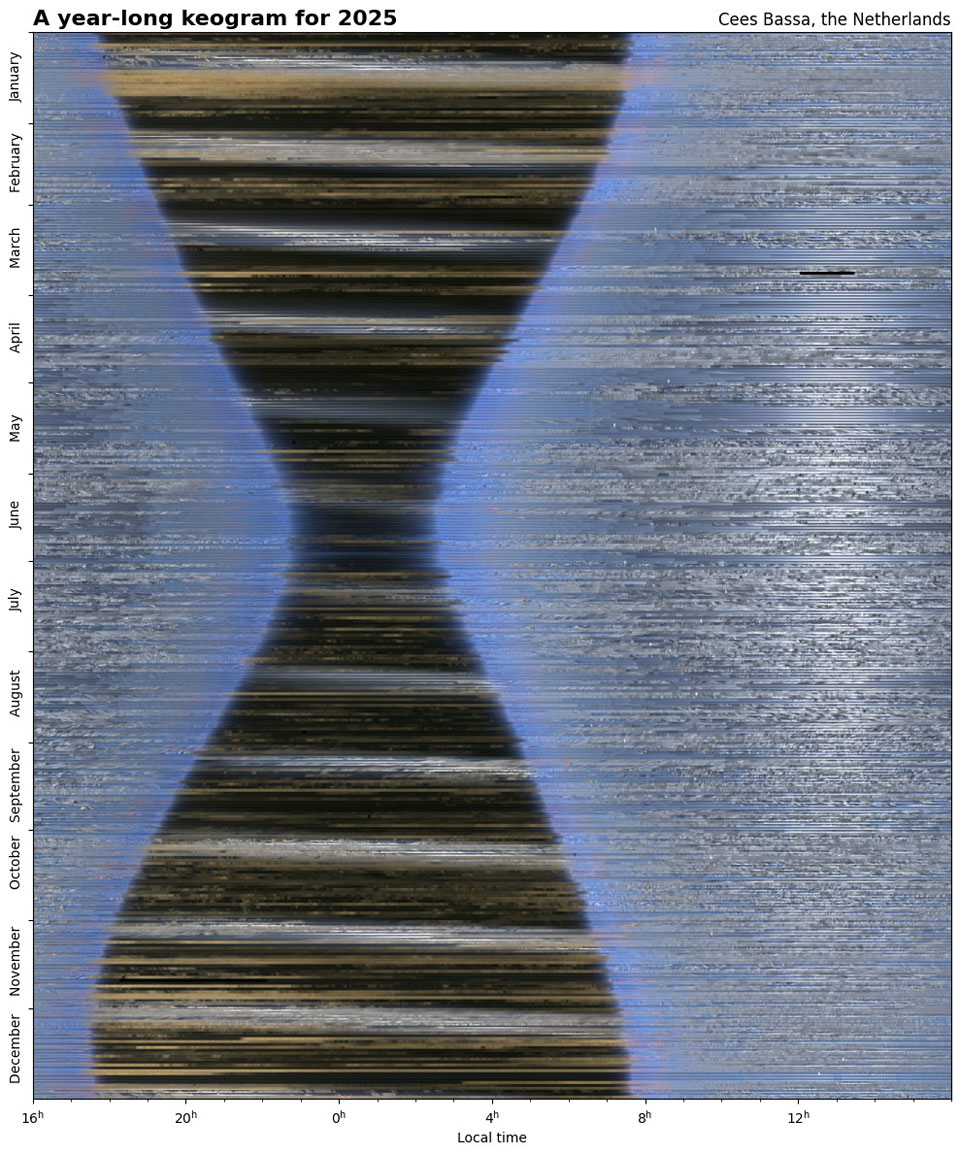
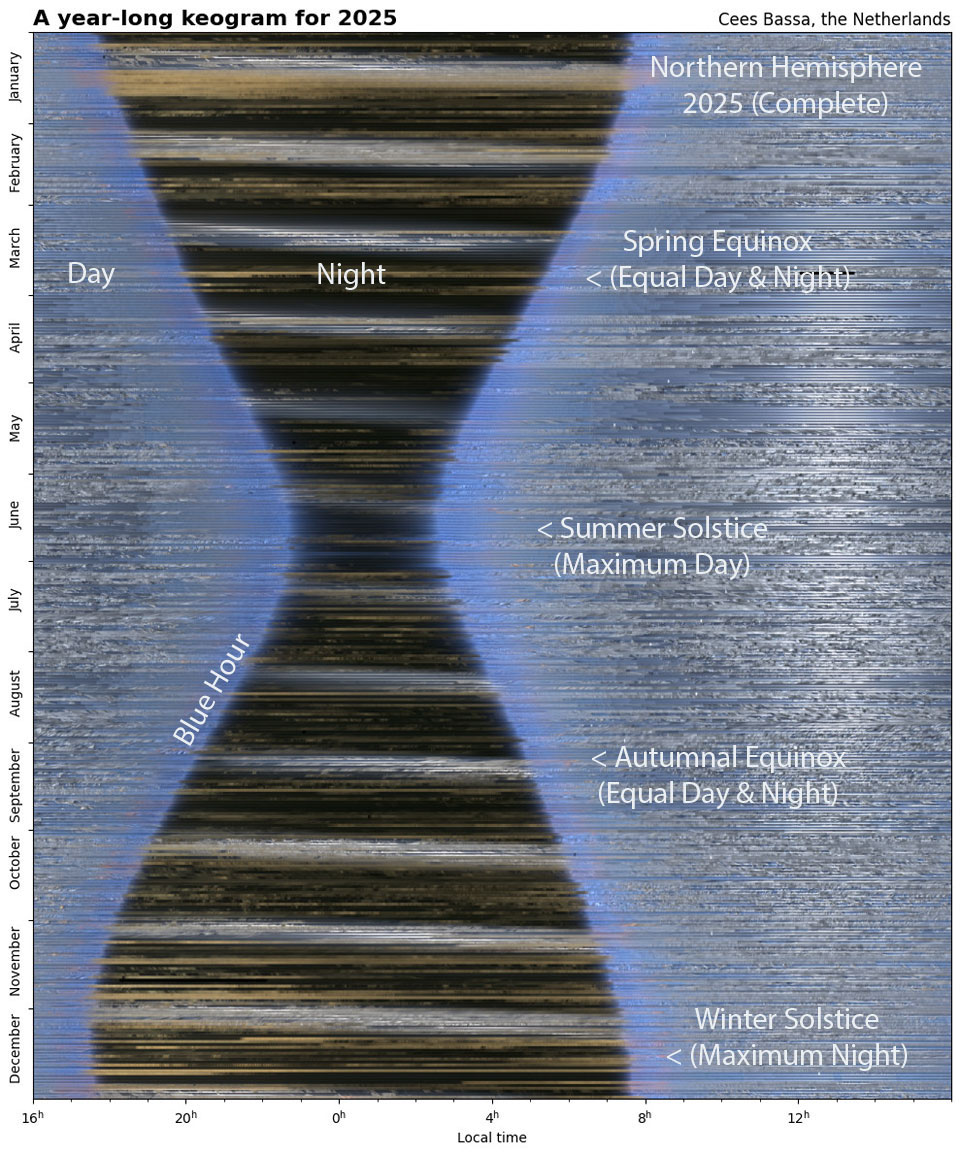
Re:Astronomy Picture of the Day Date Posted:06/22/2026 1:19 AMCopy HTML 2026 June 21 Image Credit & License: Cees Bassa (Netherlands Institute for Radio Astronomy) Explanation: What if you could see the entire sky -- all at once -- for an entire year? That, very nearly, is what is pictured here. Every 15 seconds during 2025, an all-sky camera took an image of the sky over the Netherlands. Central columns from these images were then aligned and combined to create the featured keogram, with January at the top, December at the bottom, and the middle of the night running vertically just left of center. What do we see? Most obviously, the daytime sky is mostly blue, while the nighttime sky is mostly black. The twelve light bands crossing the night sky are caused by the glow of the Moon. The thinnest part of the black hourglass shape occurs during the summer solstice, like today, when days are the longest, while the thickest part occurs at the winter solstice. Equinoxes can also be located in the keogram, for example the northern-spring equinox from one year ago is about three-quarters of the way up. |
|
Niceguy2
|
#6390 |
|
Re:Astronomy Picture of the Day Date Posted:06/22/2026 1:20 AMCopy HTML
|
|
Niceguy2
|
#6391 |
|
Re:Astronomy Picture of the Day Date Posted:06/23/2026 2:35 AMCopy HTML 2026 June 22 Image Credit & Copyright: Francesco Antonucci Explanation: Is this what will become of our Sun? Quite possibly. The first hint of our Sun's future was discovered inadvertently in 1764. At that time, Charles Messier was compiling a list of diffuse objects not to be confused with comets. The 27th object on Messier's list, now known as M27 or the Dumbbell Nebula, is a planetary nebula, one of the brightest planetary nebulas on the sky and visible with binoculars toward the constellation of the Fox (Vulpecula). It takes light about 1000 years to reach us from M27, featured here in colors enhanced by red for hydrogen and blue for oxygen. We now know that in about 6 billion years, our Sun will shed its outer gases into a planetary nebula like M27, while its remaining center will become an X-ray hot white dwarf star. Understanding the physics and significance of M27 was well beyond 18th century science, though. Even today, many things remain mysterious about planetary nebulas, including how their intricate shapes are created. |
|
Niceguy2
|
#6392 |
|
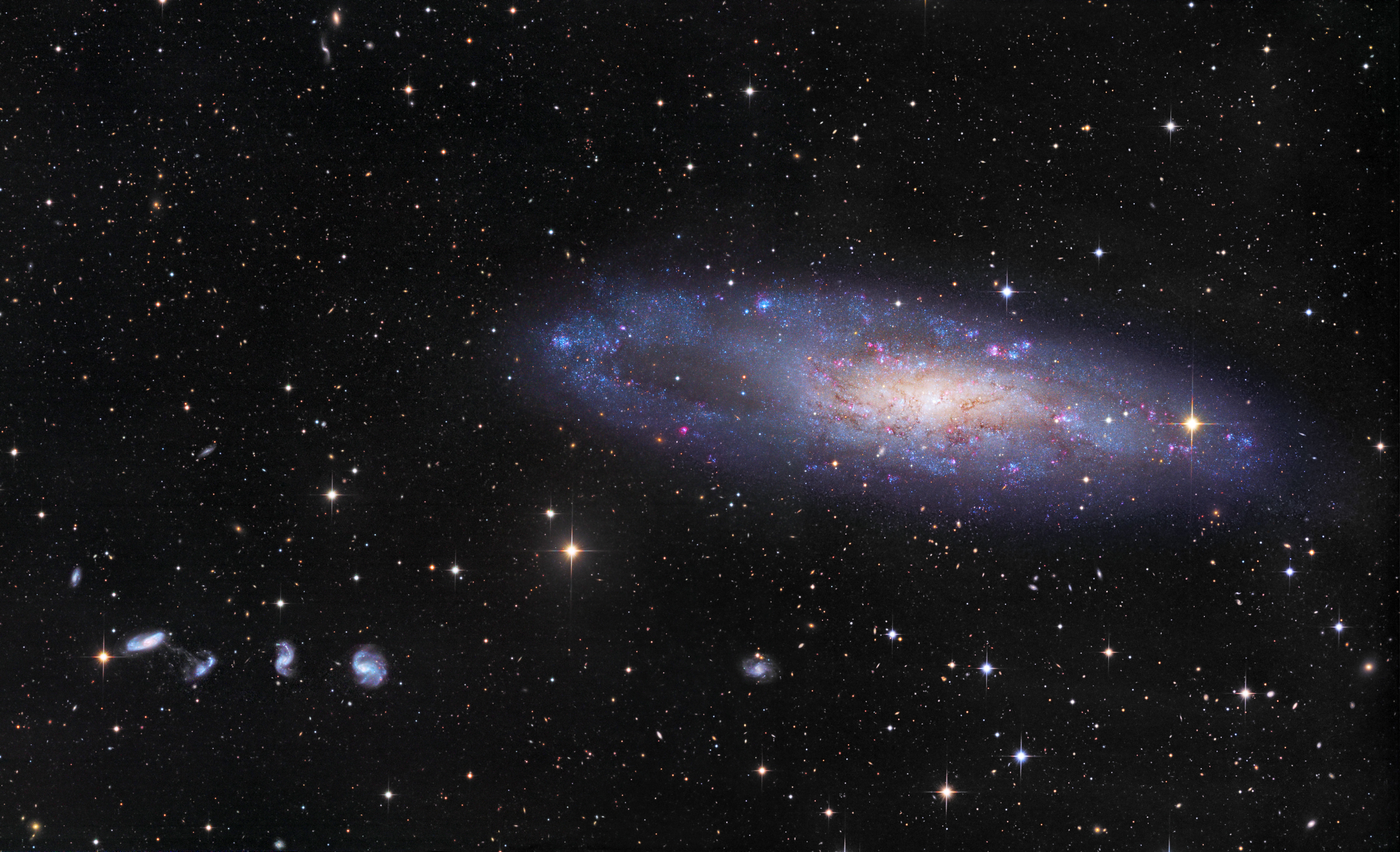
Re:Astronomy Picture of the Day Date Posted:06/24/2026 2:22 AMCopy HTML 2026 June 23 Image Credit & Copyright: CHART32 Team, Processing - Johannes Schedler Explanation: About 70,000 light-years across, NGC 247 is a spiral galaxy smaller than our Milky Way. Measured to be only 11 million light-years distant it is nearby though. Tilted nearly edge-on as seen from our perspective, it dominates this telescopic field of view toward the southern constellation Cetus. The pronounced void on one side of the galaxy's disk recalls for some its popular name, the Needle's Eye galaxy. Many background galaxies are visible in this sharp galaxy portrait, including the remarkable string of four galaxies just below and left of NGC 247 known as Burbidge's Chain. Burbidge's Chain galaxies are about 300 million light-years distant. The deep image even reveals that the two leftmost galaxies in the chain are apparently interacting, joined by a faint bridge of material. NGC 247 itself is part of the Sculptor Group of galaxies along with the shiny spiral NGC 253. |
|
Niceguy2
|
#6393 |
|
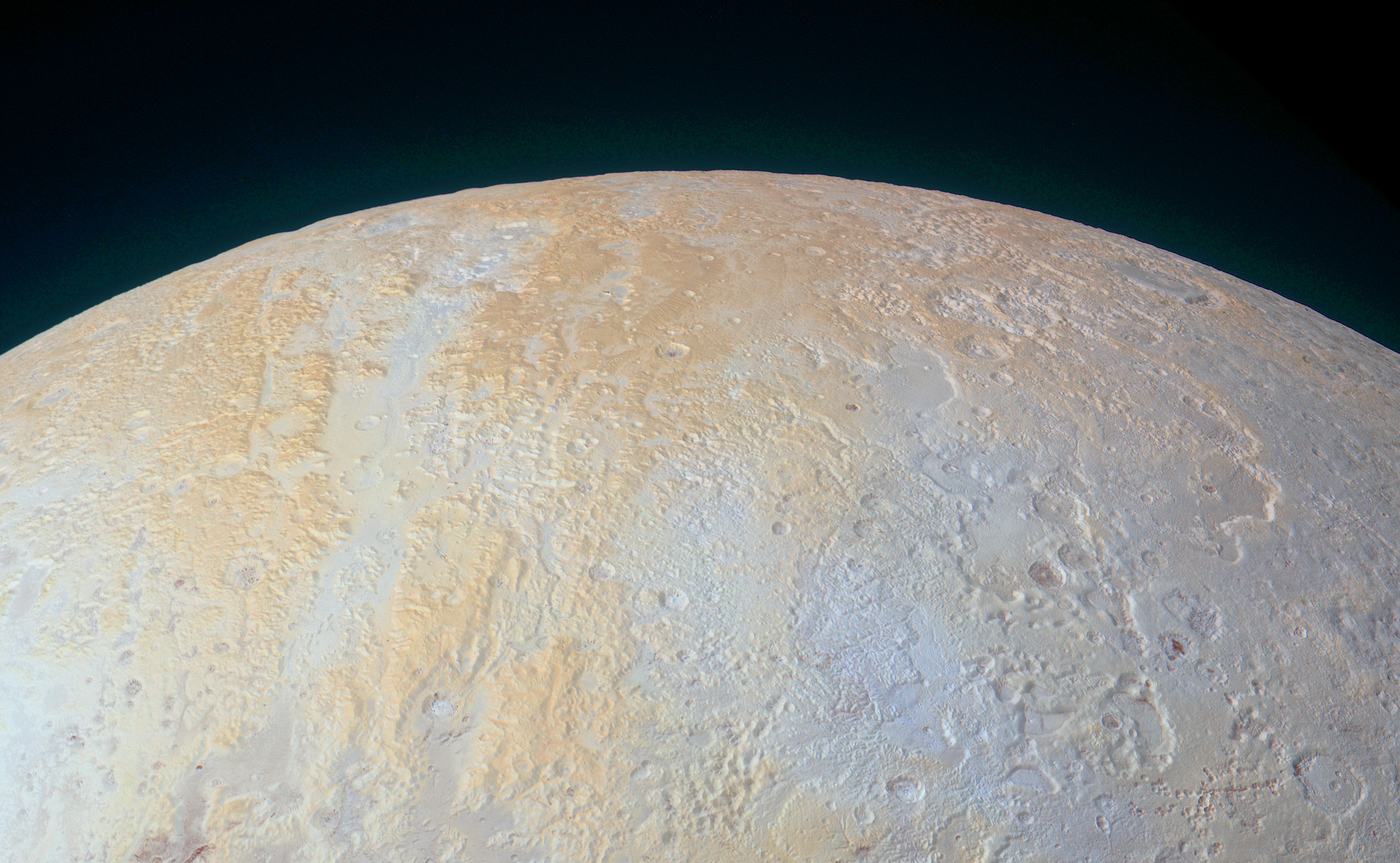
Re:Astronomy Picture of the Day Date Posted:06/25/2026 2:38 AMCopy HTML 2026 June 24 Image Credit: NASA, Johns Hopkins Univ./APL, Southwest Research Institute Explanation: Gaze across the frozen canyons of northern Pluto in this contrast enhanced color scene, imaged last July by the New Horizons spacecraft. Currently known as Lowell Regio, the region has been informally named for Percival Lowell, founder of the Lowell Observatory. Also famous for his speculation that there were canals on Mars, in 1906 Lowell started the search that ultimately led to Pluto's discovery. Pluto's North Pole itself is above and left of center in the the frame. The pale bluish floor of the broad canyon on the left is about 70 kilometers (45 miles) wide, running vertically toward the south. Higher elevations take on a yellowish hue. New Horizon's measurements have determined that in addition to nitrogen ice, methane ice is abundant across northern Pluto's Lowell Regio. |
|
Niceguy2
|
#6394 |
|
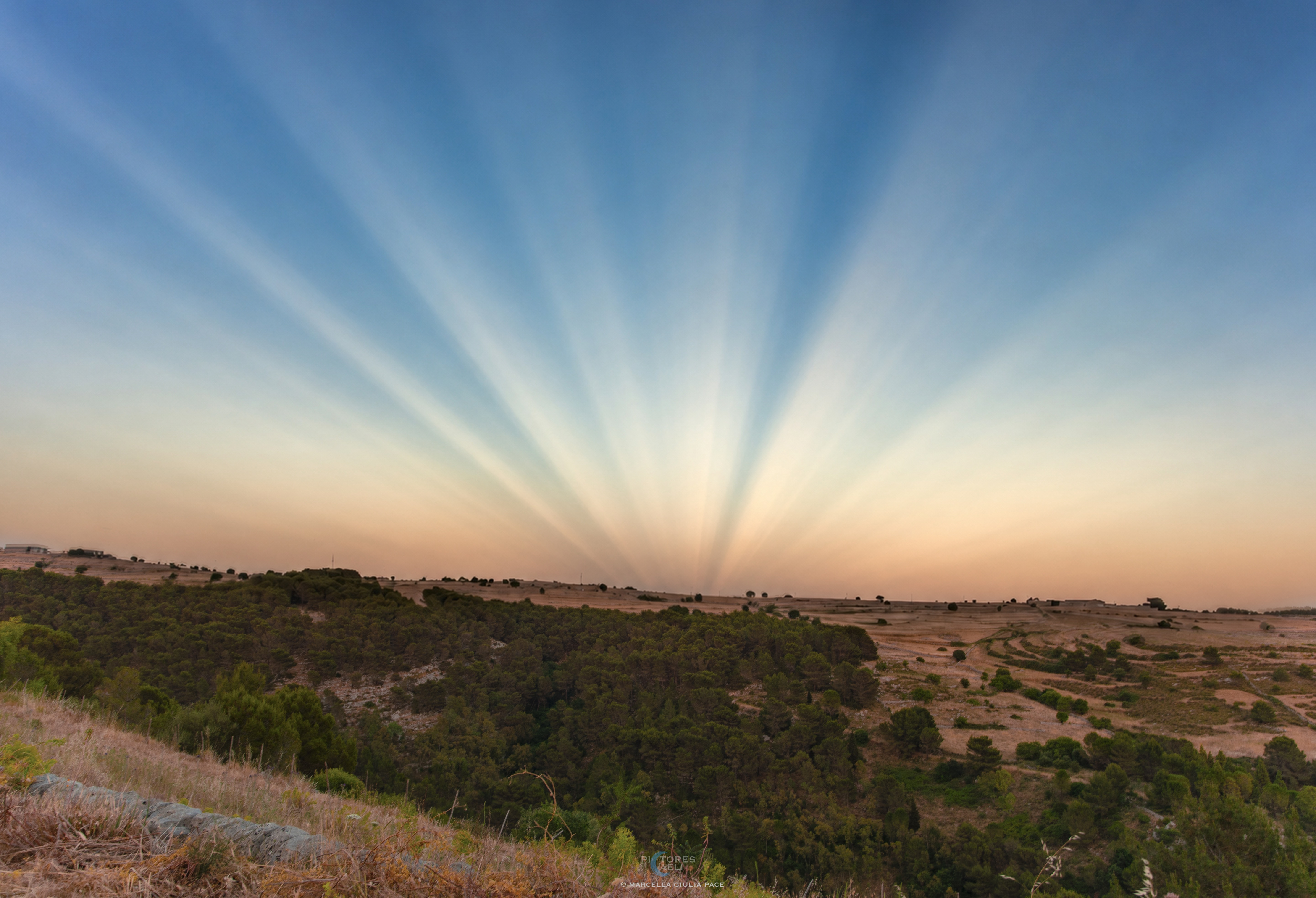
Re:Astronomy Picture of the Day Date Posted:06/26/2026 2:20 AMCopy HTML 2026 June 25 Image Credit & Copyright: Marcella Giulia Pace Text: Cecilia Chirenti (NASA GSFC, UMCP, CRESST II) Explanation: The Sun has just set... in the opposite side of the sky. Pictured here are anticrepuscular rays apparently converging in the east in this image of the limestone plateau in the heart of the Hyblaean Mountains of southeastern Sicily, in Italy. How were these anticrepuscular rays formed, if the Sun wasn't there? After the Sun set (in the west, as usual) its light still illuminated a cloud higher up in the sky. Partially blocked by the cloud, the sunlight produced patterns of light and shadow, crossing the sky in parallel lines. Perspective makes it look like they converge in the east, in the same way that train tracks appear to meet in the distance. This effect can also happen at sunrise, only the directions are exchanged. In rare cases, both crepuscular and anticrepuscular rays can be seen at the same time. |
|
Niceguy2
|
#6395 |
|
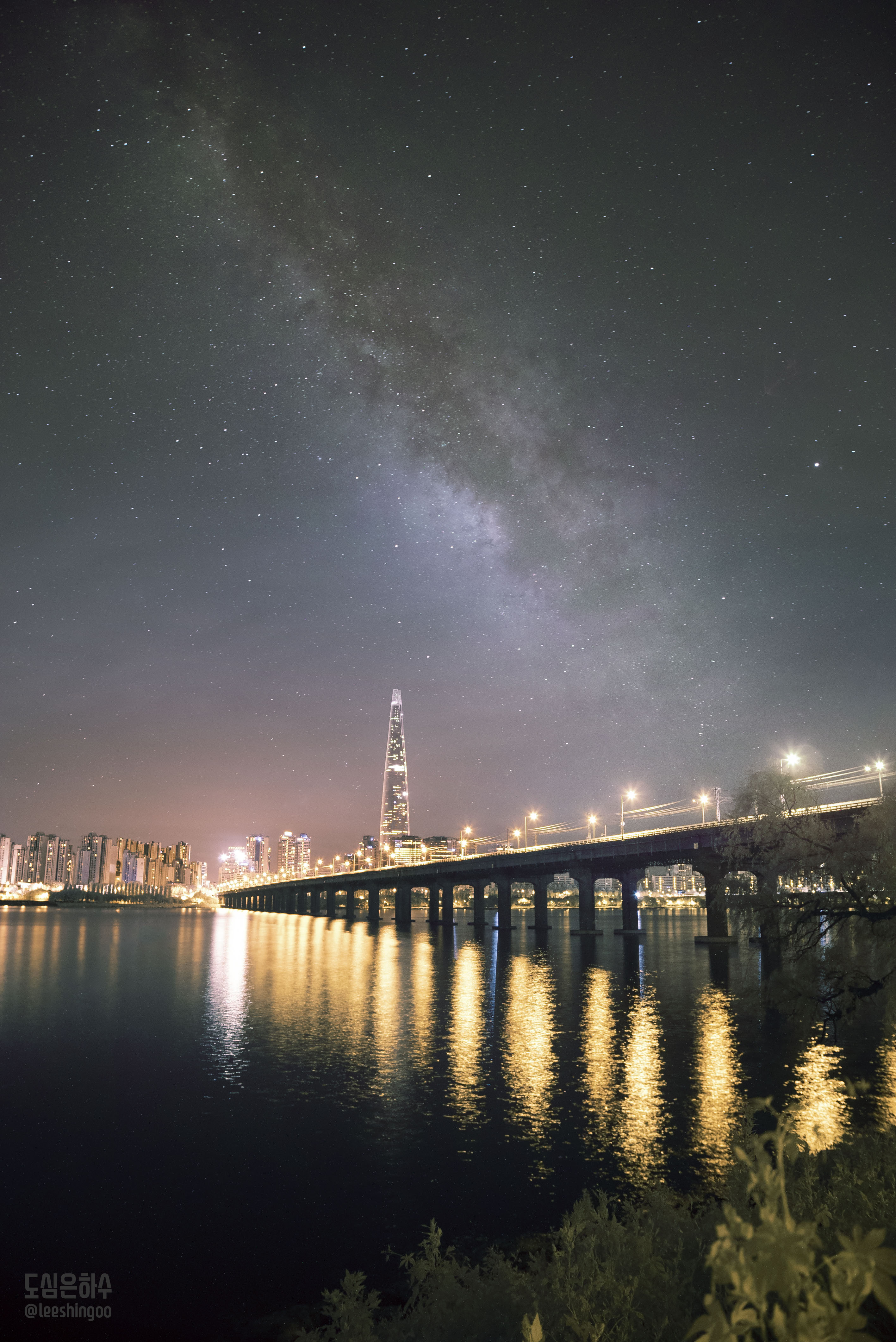
Re:Astronomy Picture of the Day Date Posted:06/27/2026 4:12 AMCopy HTML 2026 June 26 Image Credit & Copyright: Shingoo Lee Explanation: In a cosmic vista you can never see, the Milky Way arcs through the night above Seoul, South Korea. Remarkably, this urban night skyscape reveals our galaxy's faintly luminous central region and dark obscuring dust clouds in spite of the brilliant city lights. To overcome the extreme light pollution of the metropolitan area and record faint cosmic details, an infrared filter was used to capture the night scene in a single exposure. While the filter transmits predominately infrared light, it still passes some visible light to give the scene a natural appearance. The view is from Seoul's Ttukseom Hangang Park, with the Han River and a well lit railway bridge across the foreground. The 123 story Lotte World Tower looms in the distance, the tallest building in South Korea. |
|
Niceguy2
|
#6396 |
|
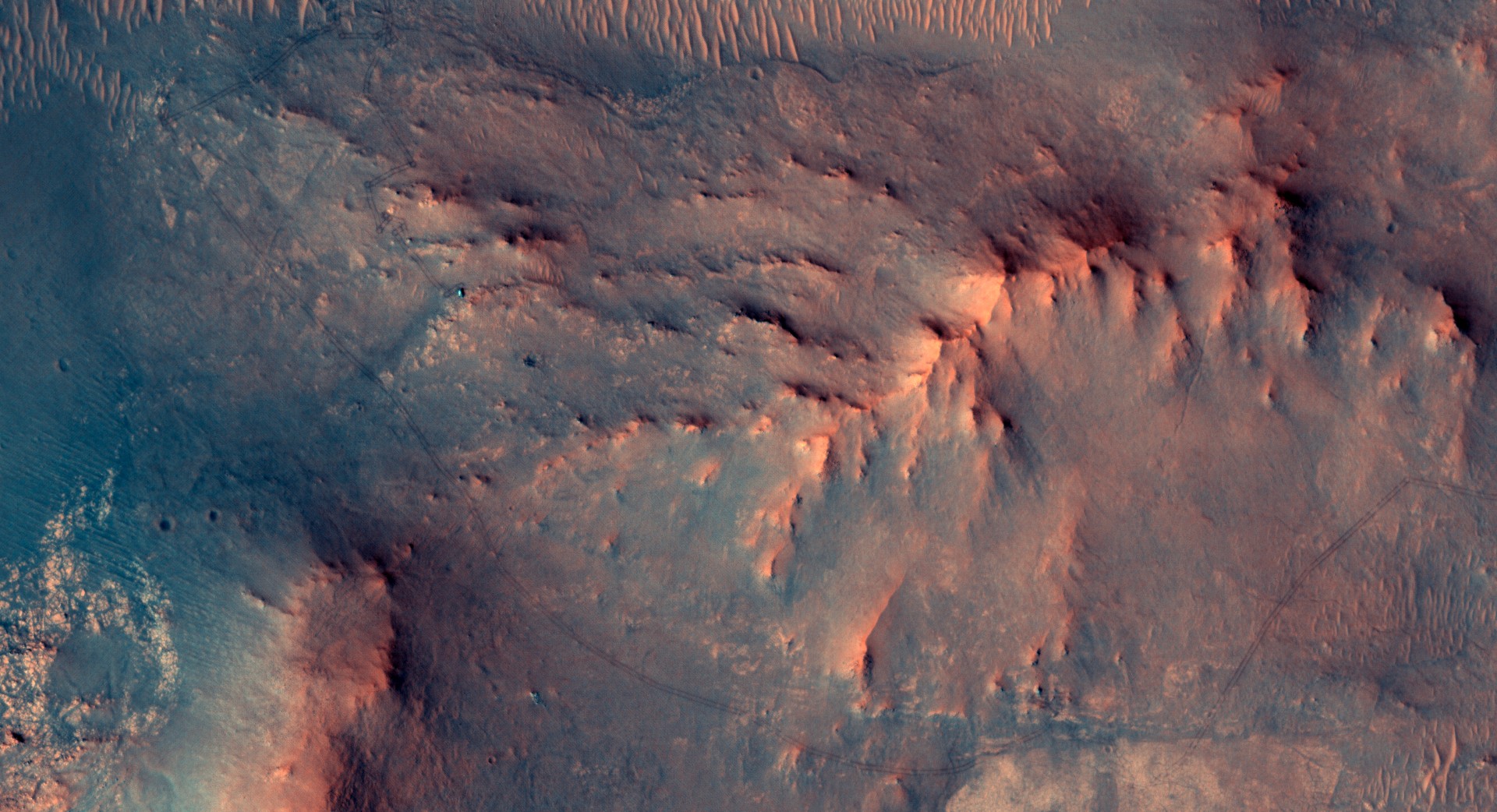
Re:Astronomy Picture of the Day Date Posted:06/28/2026 3:29 AMCopy HTML 2026 June 27 Image Credit: NASA, LPL (U. Arizona), MRO, HiRISE Explanation: In this recent HiRISE view from the Mars Reconnaissance Orbiter, the little green dot indicated on the surface of the big Red Planet is the Perseverance Mars rover. Recorded on June 13, the car-sized, six-wheeled robot was imaged a day before completing a Martian marathon, traveling a total distance of 26.218 miles (42.195 kilometers) since it began exploring the surface of Mars. That equivalent marathon distance was achieved by Perseverance on its mission sol (Martian day) 1,890, after about 5 Earth years and 4 Earth months of driving. Perseverance is continuing to hunt for biosignatures. In the HiRISE image, the Mars rover's tracks can be seen leading to its location in an area west of its landing site in Jezero crater near an ancient river delta. |
|
Niceguy2
|
#6397 |
|
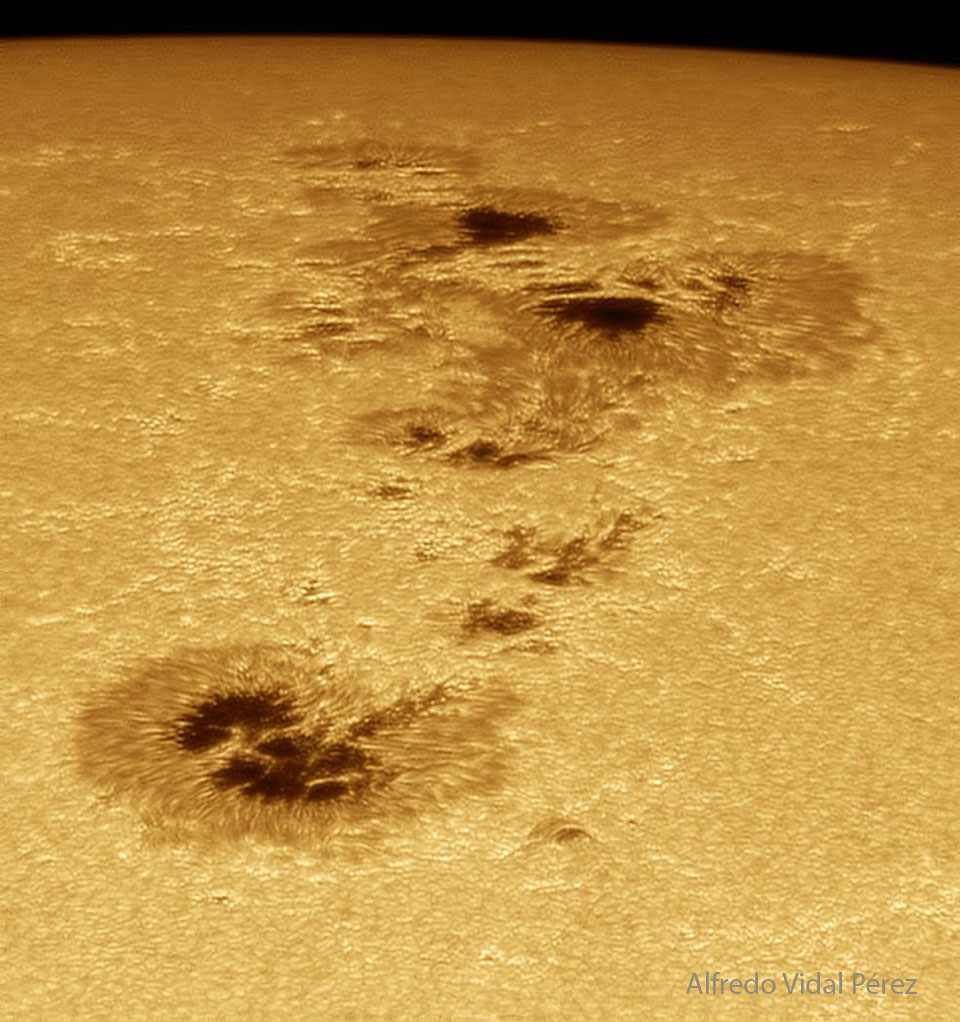
Re:Astronomy Picture of the Day Date Posted:06/29/2026 3:23 AMCopy HTML 2026 June 28 Image Credit & Copyright: Alfredo Vidal Pérez Explanation: Right now, one of the largest sunspot groups in recent history is crossing the Sun. Active Region 4478 is not only big -- it's violent, showing tangled magnetic fields capable of throwing off huge clouds of particles into the Solar System. Some of these CMEs might impact the Earth. At the extreme, these solar storms could cause some Earth-orbiting satellites to malfunction, the Earth's atmosphere to slightly distort, and electrical power grids to surge. When impacting Earth's upper atmosphere, these particles can produce beautiful auroras. Pictured here, AR 4478 and its dark sunspots were captured in visible light a few days ago from Barcelona, Spain. Almost as large as AR 3664 was in 2024, the AR 4478 sunspot group is so big that it is visible just with glasses specially designed to view solar eclipses. This week, skygazing enthusiasts all over the globe will not only be tracking AR 4478 during the day -- but keenly watching night skies for its corresponding bright auroras. |
|
Niceguy2
|
#6398 |
|
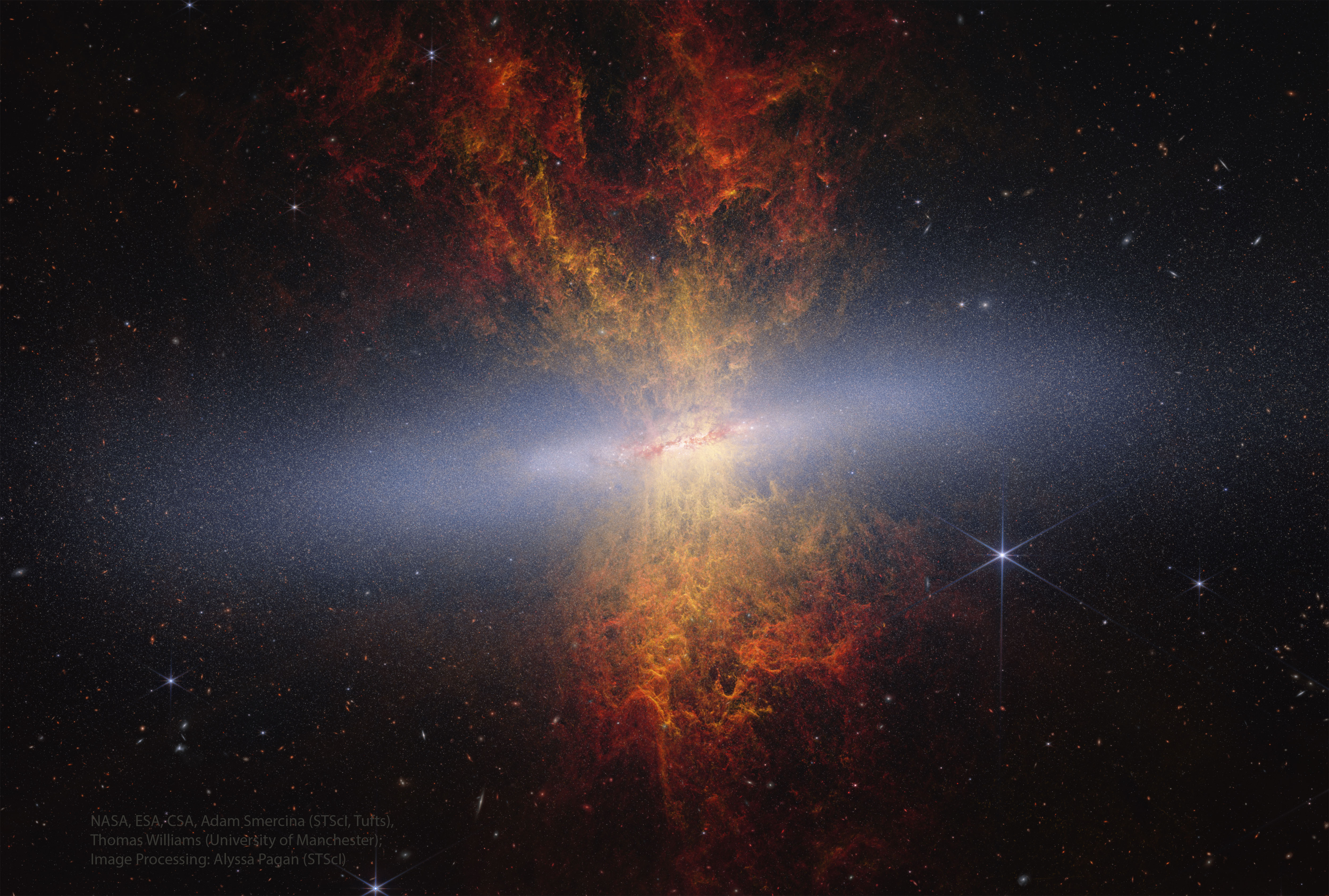
Re:Astronomy Picture of the Day Date Posted:06/30/2026 2:47 AMCopy HTML 2026 June 29 Image Credit: NASA, ESA, CSA, A. Smercina (STScI, Tufts), T. Williams (U. Manchester); Image Processing: A. Pagan (STScI) Explanation: Why is the Cigar Galaxy billowing red smoke? M82, as this starburst galaxy is also known, was stirred up by a recent pass near large spiral galaxy M81. This doesn't fully explain the source of the red-glowing outwardly expanding gas and dust, however. Evidence indicates that this gas and dust is being driven out by the combined emerging particle winds of many stars, together creating a galactic superwind. The dust particles are thought to originate in M82's interstellar medium and are actually similar in size to particles in cigar smoke. The featured photographic mosaic combines images taken in visible light from the Hubble Space Telescope and images taken in infrared light from James Webb Space Telescope. It shows the light-colored central galaxy nearly edge on across the image center with tremendous orange and red colored filaments of gas and dust extending both up and down. The filaments extend for over 10,000 light years. The 12-million light-year distant Cigar Galaxy is the brightest galaxy in the sky in infrared light and can be seen in visible light with a small telescope towards the constellation of the Great Bear (Ursa Major). |
|
Niceguy2
|
#6399 |
|
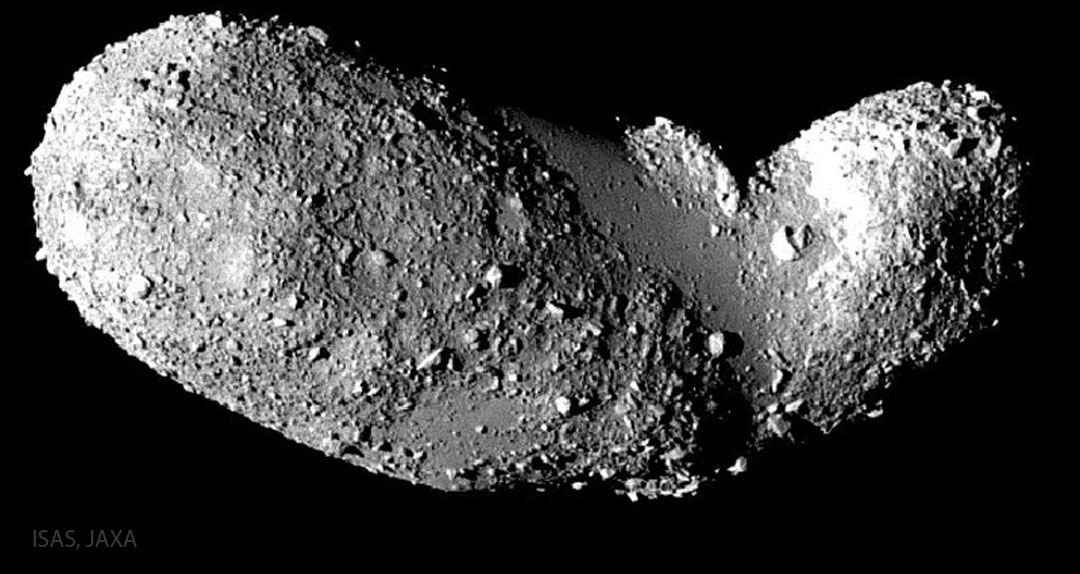
Re:Astronomy Picture of the Day Date Posted:07/01/2026 2:38 AMCopy HTML 2026 June 30 Image Credit: JAXA, ISAS Explanation: Why are parts of this asteroid's surface so smooth? The answer seems likely to do with the dynamics of an asteroid that is a loose pile of rubble rather than a solid rock. The unusual asteroid Itokawa was visited by the Japanese spacecraft Hayabusa in 2005 which imaged and documented its unusual structure and mysterious lack of craters. Analyses of the border regions between smooth and rugged sections indicate that jostling of the asteroid might be creating segregation between large and small rocks near the surface, like the Brazil nut effect. The robotic Hayabusa actually touched down on one of the smooth patches, dubbed the MUSES Sea, and collected soil samples. These samples were returned to Earth and are not only giving clues to the ancient history of this unusual asteroid, but also about the early years of our entire Solar System. Computer simulations show that 500-meter asteroid Itokawa may impact the Earth within the next few million years. |
|
Niceguy2
|
#6400 |
|
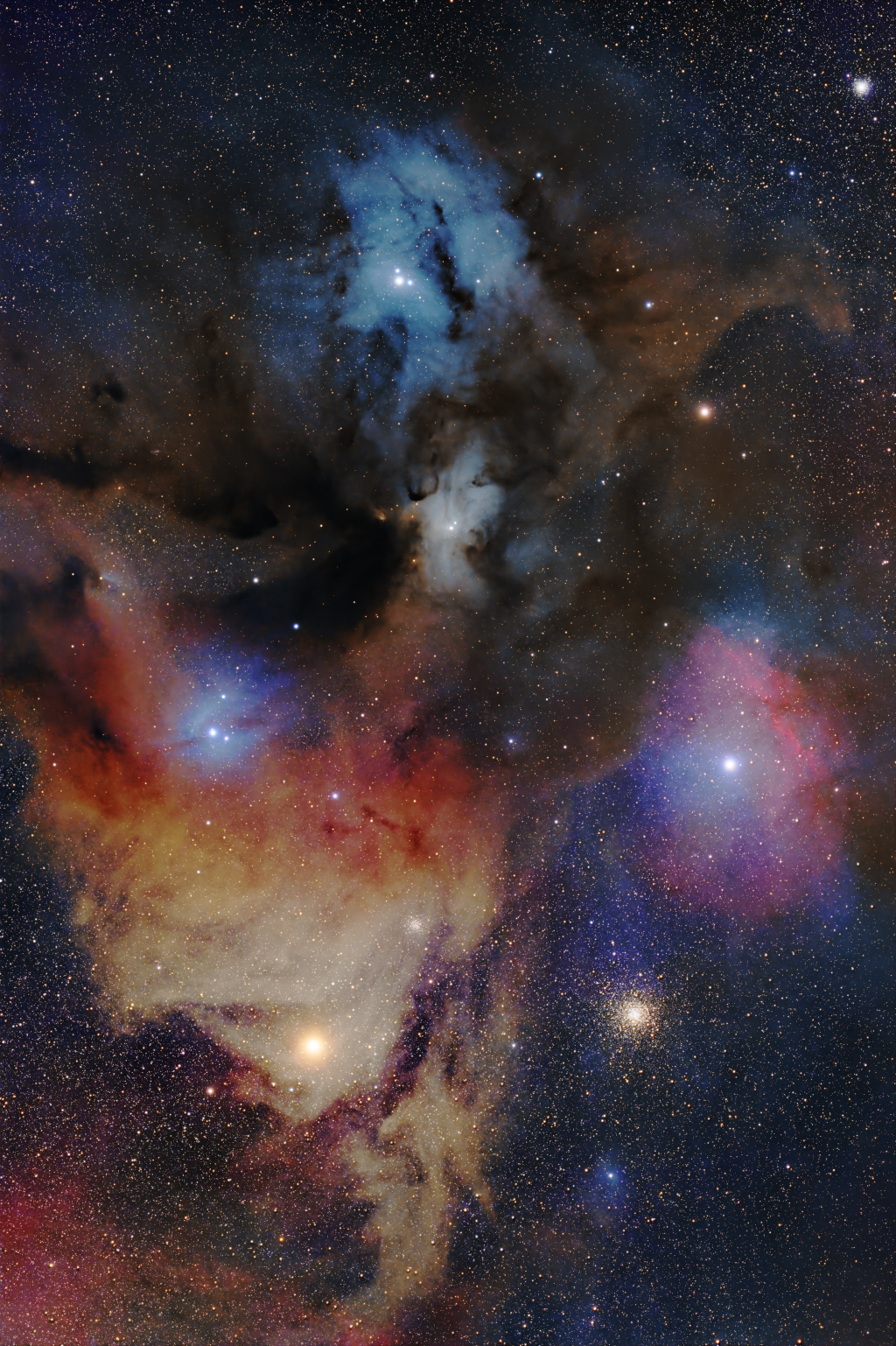
Re:Astronomy Picture of the Day Date Posted:07/02/2026 2:52 AMCopy HTML 2026 July 1 Image Credit & Copyright: Ángel Molina Text: Keighley Rockcliffe (NASA GSFC, UMBC CSST, CRESST II) Explanation: Although they look like cotton candy, you cannot eat these clouds! Taken in Cádiz, Spain, today's image features the Rho Ophiuchi complex, a rich tapestry of young and old astronomical phenomena. This colorful cloud complex is a nearby star-forming region containing hundreds of young stellar objects, including protostars and T Tauri stars. Light from the triple star system at its center reflects off of small dust grains to create the blue reflection nebula. Ultraviolet light from hot stars ionizes the surrounding hydrogen gas, creating the red emission nebula. Antares, a red supergiant big enough to engulf the Solar System’s asteroid belt, lights up the yellow region. Dark interstellar dust blocks some of the complex’s color. Recent JWST observations exhibit shadows cast by hidden circumstellar disks, the beginning stages of planet formation. Messier 4, a globular cluster almost as old as the universe, sits in the bottom right and witnesses yet another chaotic burst of youth in the Milky Way. |









:max_bytes(150000):strip_icc():focal(999x0:1001x2):format(webp)/dog-eclipse-2000-ef0176770ff64e6b913f2af6e8273a24.jpg)

