|
|

| Title: Astronomy Picture of the Day | |
| friendsoffortiesfive > General > General Discussion | Go to subcategory: |


| Author | Content |
Niceguy2

|
|
|
Date Posted:03/06/2014 11:29 PMCopy HTML I really love this site and |
|
Niceguy2
|
#6326 |
|
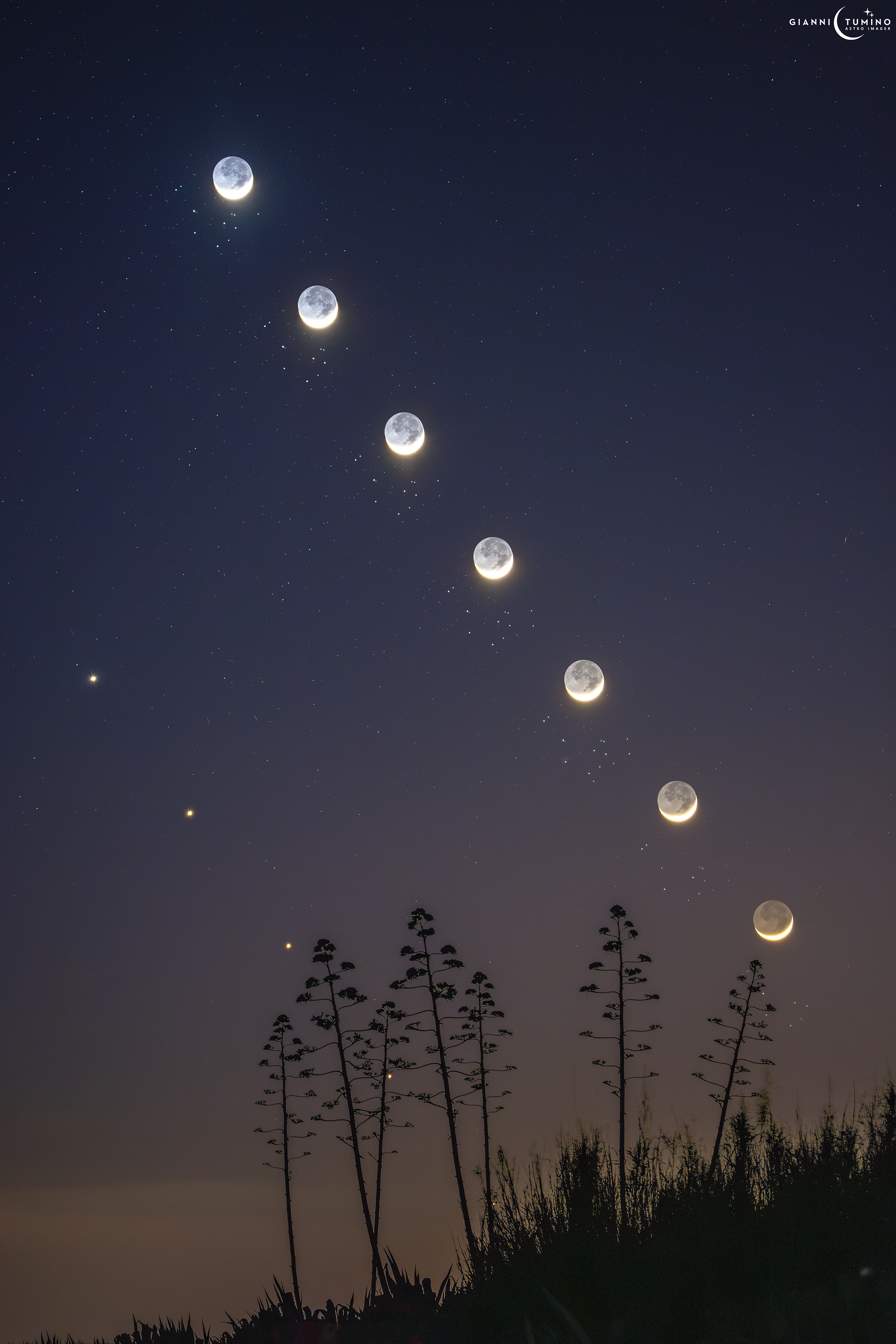
Re:Astronomy Picture of the Day Date Posted:04/30/2026 1:55 AMCopy HTML 2026 April 29 Image Credit & Copyright: Gianni Tumino Text: Keighley Rockcliffe (NASA GSFC, UMBC CSST, CRESST II) Explanation: No, Earth did not recently acquire six more moons! Today’s APOD is a combination of images following the Moon, Venus, and the Pleiades across a southern Sicilian sky as twilight turned to evening on April 19. From 2023 to 2029, the Pleiades' and the Moon “visit" each other once per month due to the Pleiades' location in the ecliptic plane. April 2026 saw the celestial alignment of their visit with Venus. About six stars in the Pleiades cluster (Messier 45) are typically visible with the unaided eye. Due to the cluster’s visibility across the world, there are many myths and legends across cultures associated with the Pleiades. The Haudenosaunee people of North America, for example, say that seven boys danced so enthusiastically that they lifted off into the sky. Astronomers recently found thousands more Pleiades members, showing that after thousands of years of gazing upon this cluster, there is yet more to learn about the Pleiades. |
|
Niceguy2
|
#6327 |
|
Re:Astronomy Picture of the Day Date Posted:05/01/2026 2:51 AMCopy HTML 2026 April 30 Image Credit: Cassini Imaging Team, SSI, JPL, ESA, NASA Explanation: Some moons wouldn't survive the collision. Tethys, one of Saturn's larger moons at about 1000 kilometers in diameter, survived the collision, but today exhibits the resulting expansive impact crater Odysseus. Sometimes called the Great Basin, Odysseus occurs on the leading hemisphere of Tethys and shows its great age by the relative amount of smaller craters that occur inside its towering walls. The density of Tethys is similar to water-ice. The featured image was captured in November by the robotic Cassini spacecraft in orbit around Saturn as it swooped past the giant ice ball. Cassini has now started on its Grand Finale Tour which will take it inside Saturn's rings and culminate in September with a dive into Saturn's thick atmosphere. |
|
Niceguy2
|
#6328 |
|
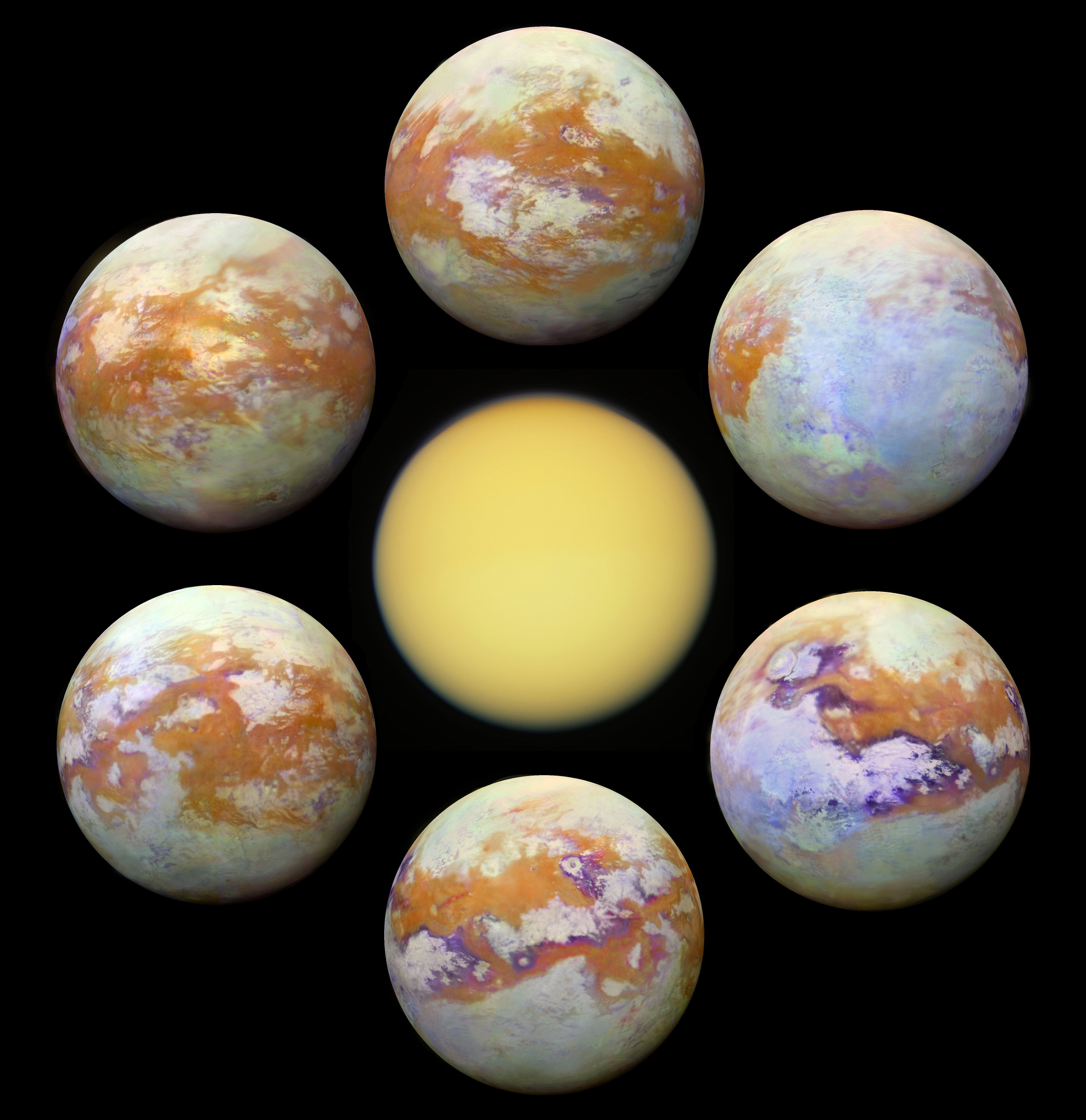
Re:Astronomy Picture of the Day Date Posted:05/02/2026 4:10 AMCopy HTML 2026 May 2 Image Credit: VIMS Team, Univ. Arizona, U. Nantes, ESA, NASA Explanation: Shrouded in a thick atmosphere, the surface of Saturn's largest moon, Titan, is really hard to see. Small particles suspended in Titan's upper atmosphere cause an almost impenetrable haze, strongly scattering light at visible wavelengths and hiding surface features from prying eyes. Still, Titan's surface is better imaged at infrared wavelengths, where scattering is weaker and atmospheric absorption is reduced. Arrayed around this visible light image (center) of Titan are some of the clearest global infrared views of the tantalizing moon so far. In false color, the six panels present a consistent processing of 13 years of infrared image data from the Visual and Infrared Mapping Spectrometer (VIMS) on board the Cassini spacecraft orbiting Saturn from 2004 to 2017. They offer a stunning comparison with Cassini's visible light view. NASA's revolutionary rotorcraft mission to Titan's surface is due to launch no earlier than July, 2028. |
|
Niceguy2
|
#6329 |
|
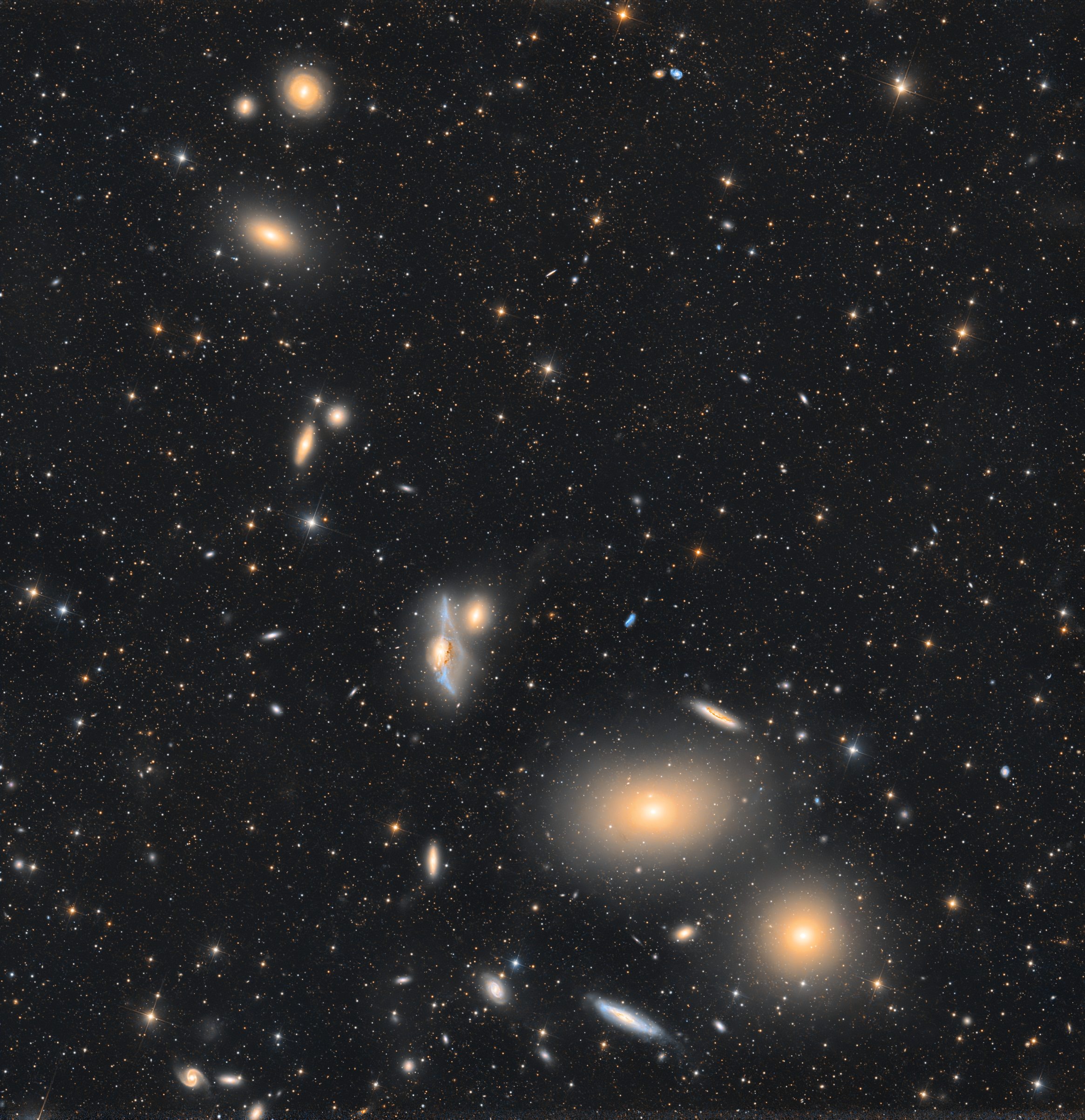
Re:Astronomy Picture of the Day Date Posted:05/03/2026 2:29 AMCopy HTML 2026 May 1 Image Credit & Copyright: Chuck Ayoub Explanation: Near the heart of the Virgo Galaxy Cluster, a string of galaxies known as Markarian's Chain stretches across this telescopic field of view. Anchored in the frame at bottom right by prominent lenticular galaxies, M84 (bottom) and M86, you can follow the chain's gentle arc up and toward the left. Near center you'll spot the pair of interacting galaxies NGC 4438 and NGC 4435, known to some as Markarian's Eyes. An estimated 50 million light-years distant, the Virgo Cluster itself is the nearest galaxy cluster. With up to about 2,000 member galaxies, it has a noticeable gravitational influence on our own Local Group of Galaxies. Within the Virgo Cluster at least seven galaxies in Markarian's Chain appear to move coherently, while others may appear to be part of the chain by chance. |
|
Niceguy2
|
#6330 |
|
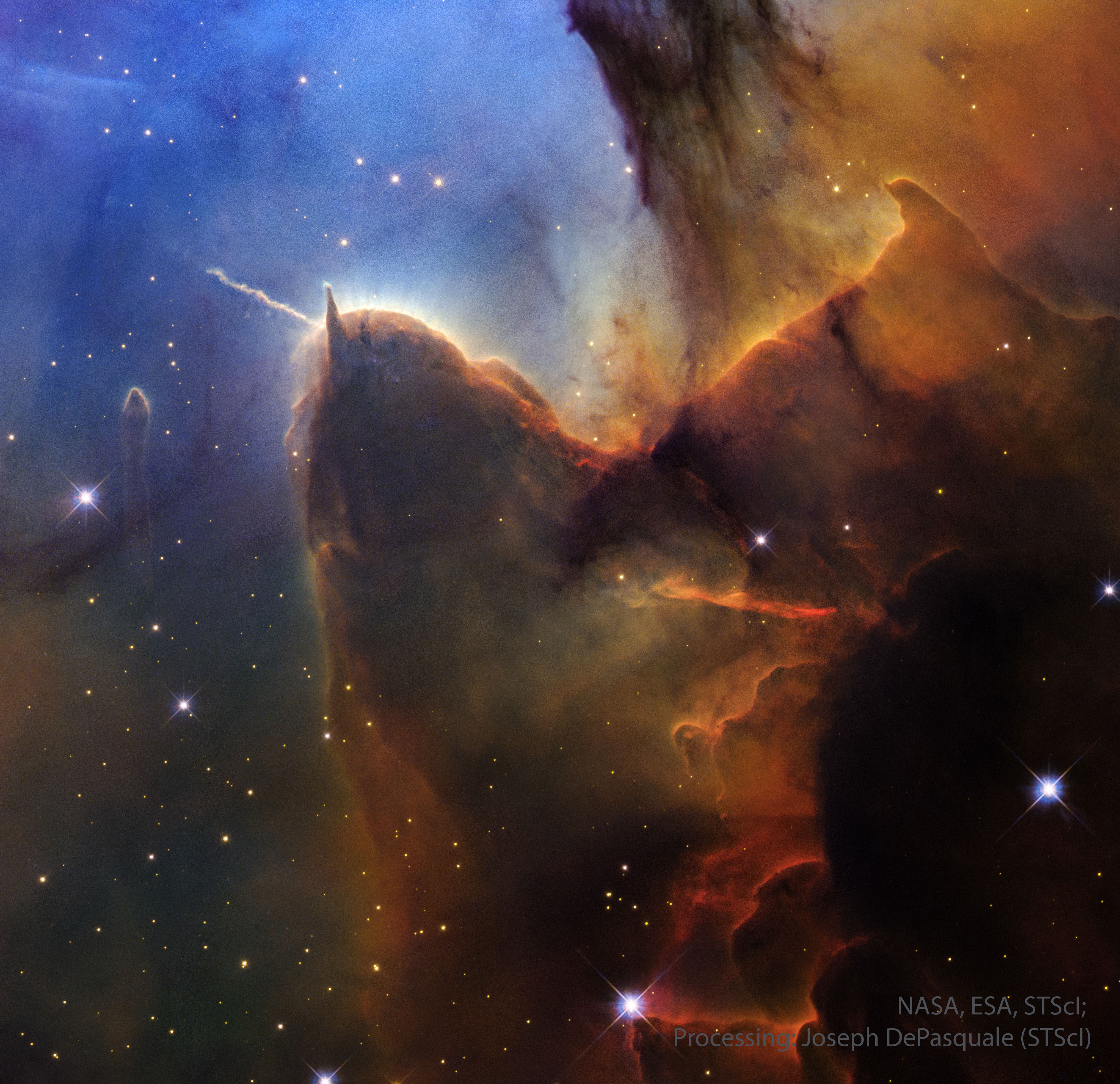
Re:Astronomy Picture of the Day Date Posted:05/04/2026 3:07 AMCopy HTML 2026 May 3 Image Credit: NASA, ESA, STScI; Processing: J. DePasquale (STScI) Explanation: Dust pillars are like interstellar mountains. They survive because they are more dense than their surroundings, but they are slowly being eroded away by a hostile environment. Visible in the featured picture by the Hubble Space Telescope is the end of a huge gas and dust pillar in the Trifid Nebula (M20), punctuated by a smaller pillar pointing up and an unusual jet pointing to the upper left. Many of the bright dots are newly formed stars. A star near the small pillar's end is slowly being stripped of its accreting gas by radiation from a tremendously brighter star situated off the top of the image. The jet extends nearly a light-year and would not be visible without external illumination. As gas and dust evaporate from the pillars, the hidden stellar source of this jet will likely be uncovered, possibly over the next 20,000 years. |
|
Niceguy2
|
#6331 |
|
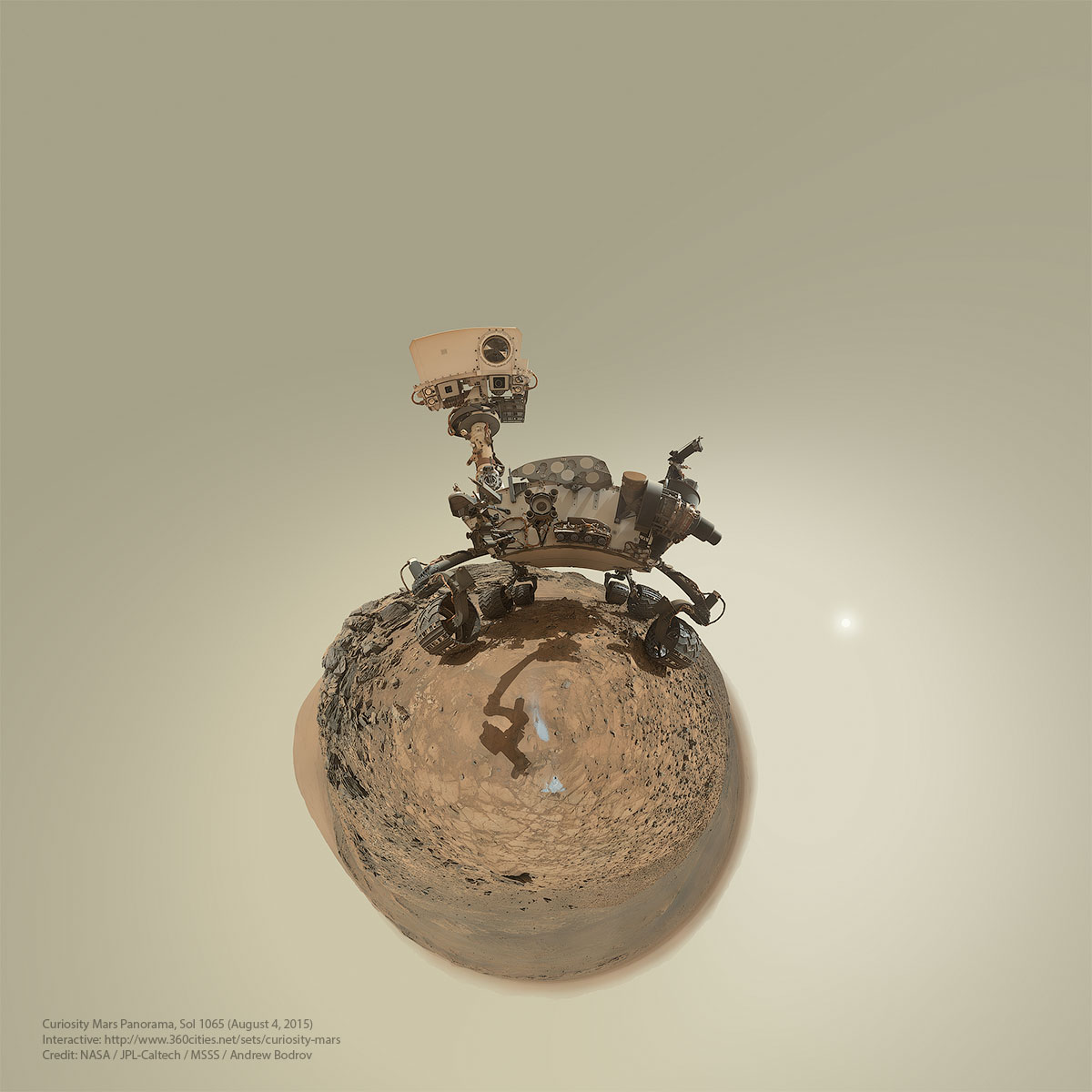
Re:Astronomy Picture of the Day Date Posted:05/05/2026 3:43 AMCopy HTML 2026 May 4 Image Credit: NASA, JPL-Caltech, MSSS - Little Planet: Andrew Bodrov Explanation: A curious robot almost completely straddles this rocky little planet. Of course, the planet is really Mars and the robot is the car-sized Curiosity Rover, posing over its recent drilling target in the Marias Pass area of lower Mount Sharp. The 92 images used to assemble the little planet projection, a digitally warped and stitched mosaic covering 360x180 degrees, were taken by the rover's Mars Hand Lens Imager (MAHLI) during the Curiosity mission sol (martian day) 1065. That corresponds to 2015 August 5, three Earth years since Curiosity landed on the surface of the Red Planet. The composite selfie excludes images that show the rover's robotic arm and mount of the MAHLI camera itself, but their shadow is visible beneath. Check out this spectacular interactive version of Curiosity's sol 1065 panorama. |
|
Niceguy2
|
#6332 |
|
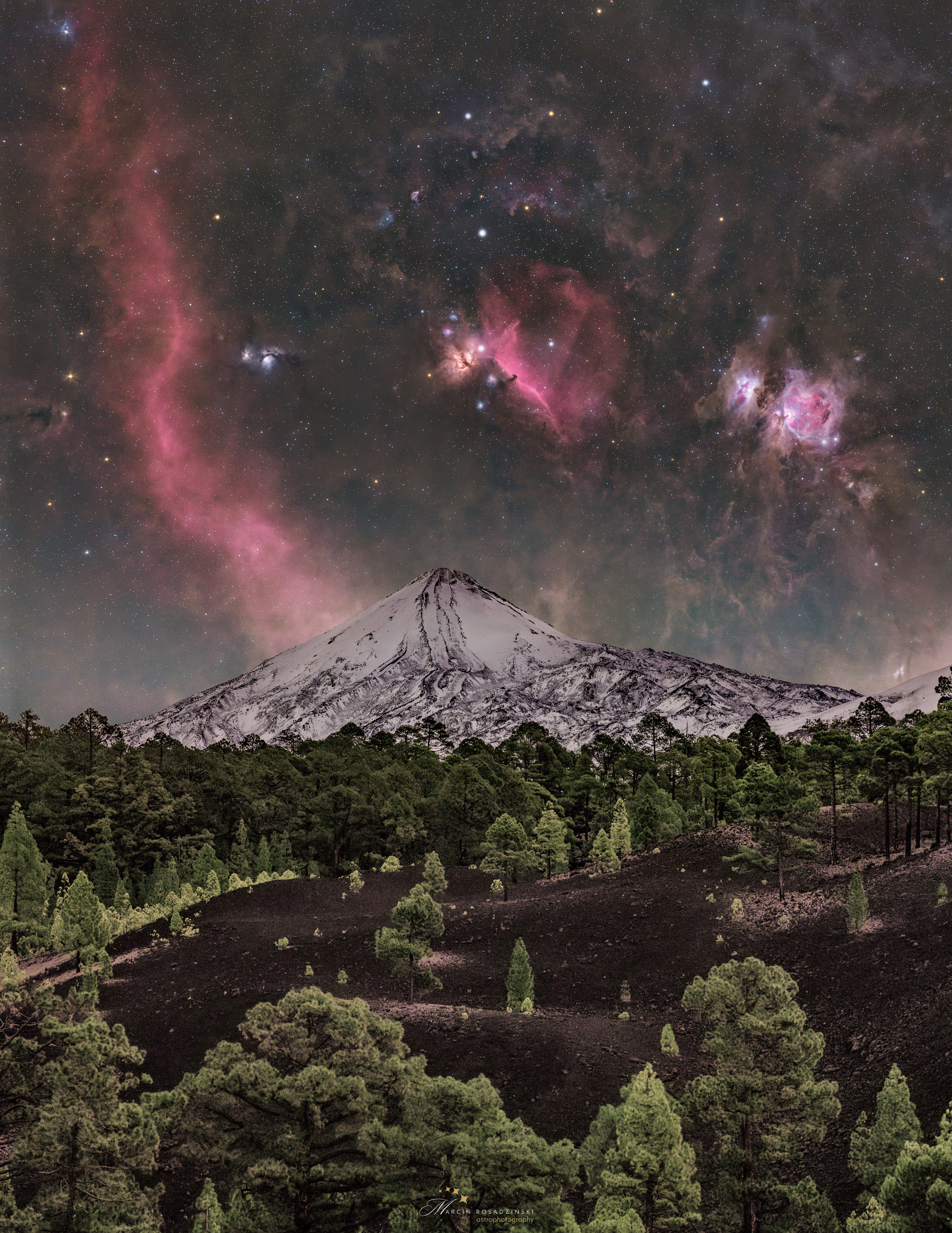
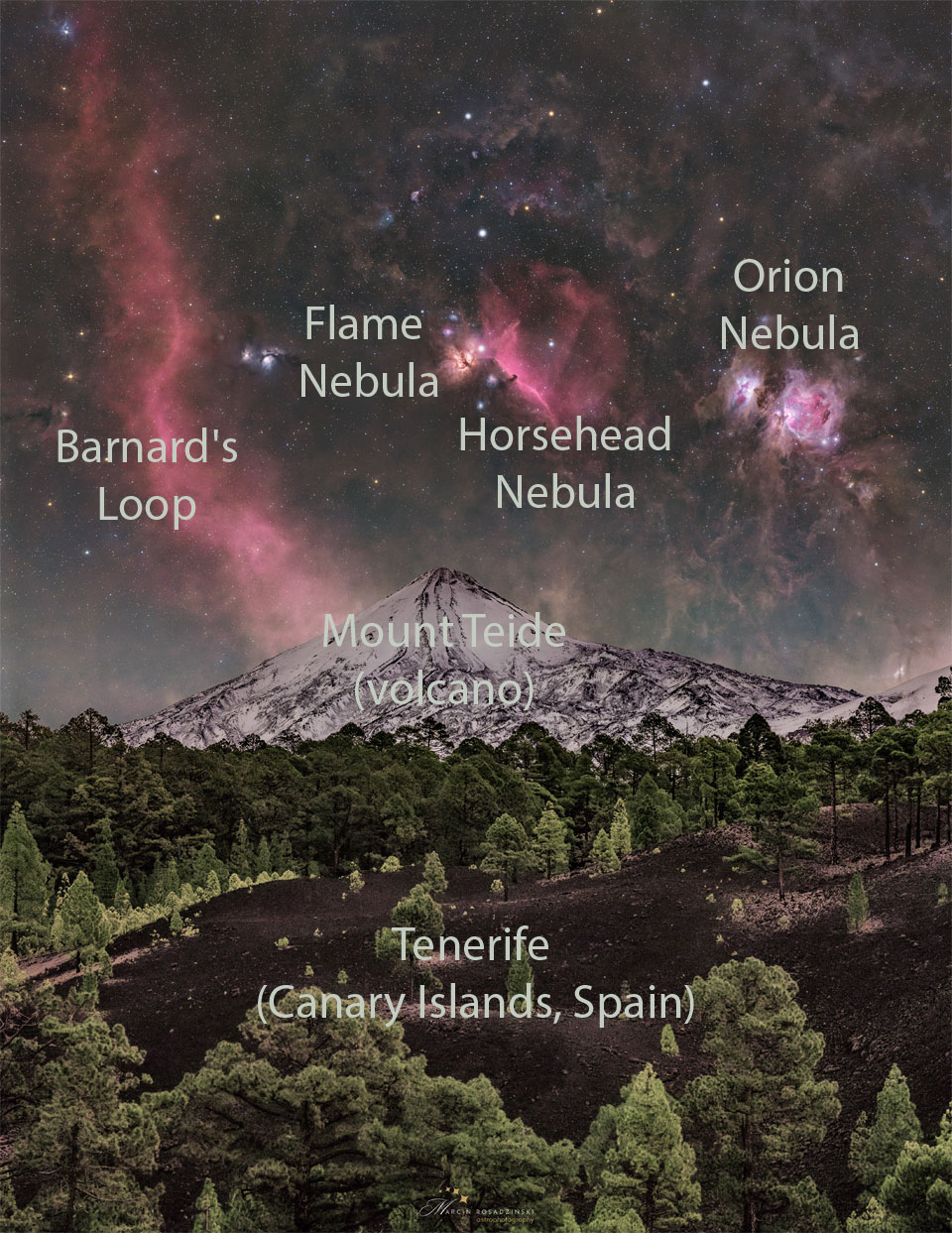
Re:Astronomy Picture of the Day Date Posted:05/06/2026 3:02 AMCopy HTML 2026 May 5 Image Credit & Copyright: Marcin Rosadziński Explanation: Orion is rarely seen like this. To achieve this majestic vista, you need a camera capable of taking such long duration exposures that faint features in the night sky become revealed. Iconic nebulas that appear include the Orion Nebula, the Flame Nebula, and Barnard's Loop. For contrast, it also helps to have a volcano on the foreground, in this case the Teide volcano on Tenerife on the Canary Islands of Spain. But if you want your Teide volcano snow-covered, you also need good timing -- because that only happens, typically, for a few days each year. Good timing also includes waiting for Orion to appear just behind Teide, which occurred late last year after sunset. The featured image is the result of a series of images taken consecutively with the same camera from the same location. |
|
Niceguy2
|
#6333 |
|
Re:Astronomy Picture of the Day Date Posted:05/06/2026 3:02 AMCopy HTML
|
|
Niceguy2
|
#6334 |
|
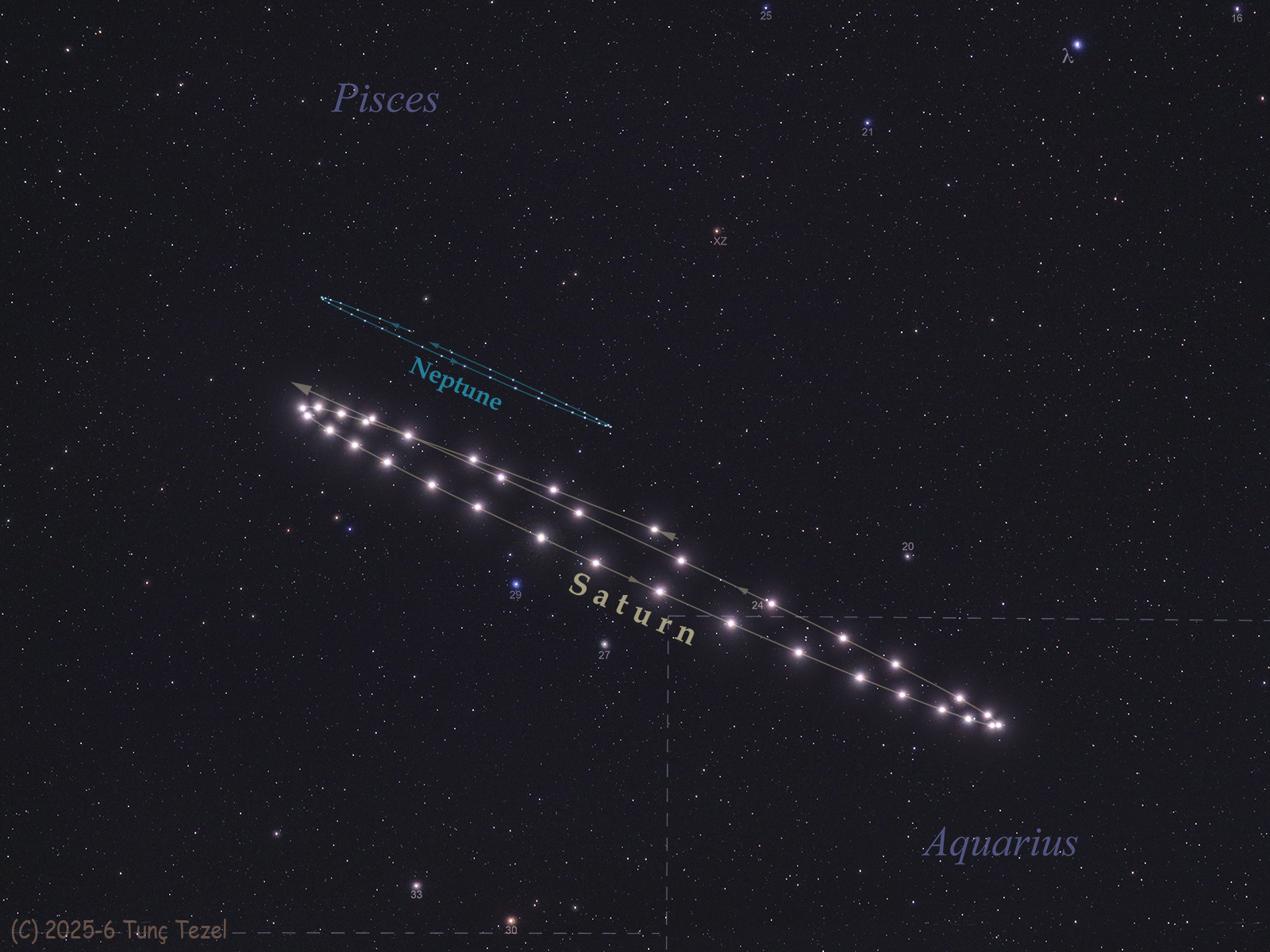
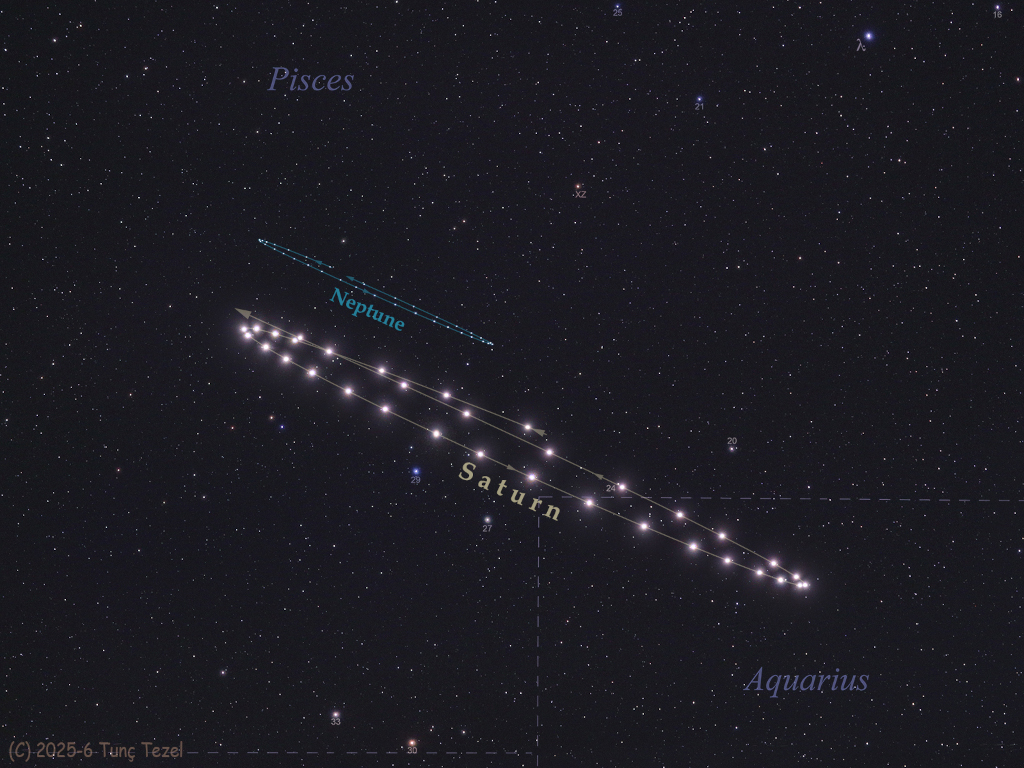
Re:Astronomy Picture of the Day Date Posted:05/07/2026 2:06 AMCopy HTML 2026 May 6 Image Credit & Copyright: Tunç Tezel (TWAN) Text: Keighley Rockcliffe (NASA GSFC, UMBC CSST, CRESST II) Explanation: What does it mean for Saturn and Neptune to be in retrograde? Featured is a composite of images taken over 34 nights from May 2025 to February 2026 tracing Saturn (brighter, foreground) and Neptune (dimmer, background). Over that time, the two planets exhibited retrograde motion, meaning they appeared to move backward in the sky. This apparent backwards motion occurs when Earth overtakes the slower outer planets as they orbit the Sun. Imagine the Solar System is a running track. Earth "runs" faster along the inside of the track compared to the outer planets. As Earth approaches, aligns, and then "laps" the outer planets, they change position from ahead to behind from the Earth's perspective. This perspective shift is what causes the outer planets to change position in the night sky. An animation corresponding to today’s image shows Saturn and Neptune’s months-long dance across the northern night sky. Saturn stepped from the Pisces constellation into Aquarius and back again while Neptune remained in Pisces. This is the closest Saturn and Neptune have been in the sky since their last conjunction in 1989. |
|
Niceguy2
|
#6335 |
|
Re:Astronomy Picture of the Day Date Posted:05/07/2026 2:10 AMCopy HTML
|
|
Niceguy2
|
#6336 |
|
Re:Astronomy Picture of the Day Date Posted:05/08/2026 4:12 AMCopy HTML 2026 May 7 Image Credit & Copyright: Josep Drudis Explanation: Do you see the bat? It haunts this cosmic close-up of the eastern Veil Nebula. The Veil Nebula itself is a large supernova remnant, the expanding debris cloud from the death explosion of a massive star. While the Veil is roughly circular in shape and covers nearly 3 degrees on the sky toward the constellation of the Swan (Cygnus), the Bat Nebula, NGC 6995, spans only 1/2 degree, about the apparent size of the Moon. That translates to 12 light-years at the Veil's estimated distance, a reassuring 1,400 light-years from planet Earth. In the composite of image data recorded through broad and narrow band filters, emission from hydrogen atoms in the remnant is shown in red with strong emission from oxygen and nitrogen atoms shown in hues of blue. Of course, in the western part of the Veil lies another seasonal apparition: the Witch's Broom Nebula. |
|
Niceguy2
|
#6337 |
|
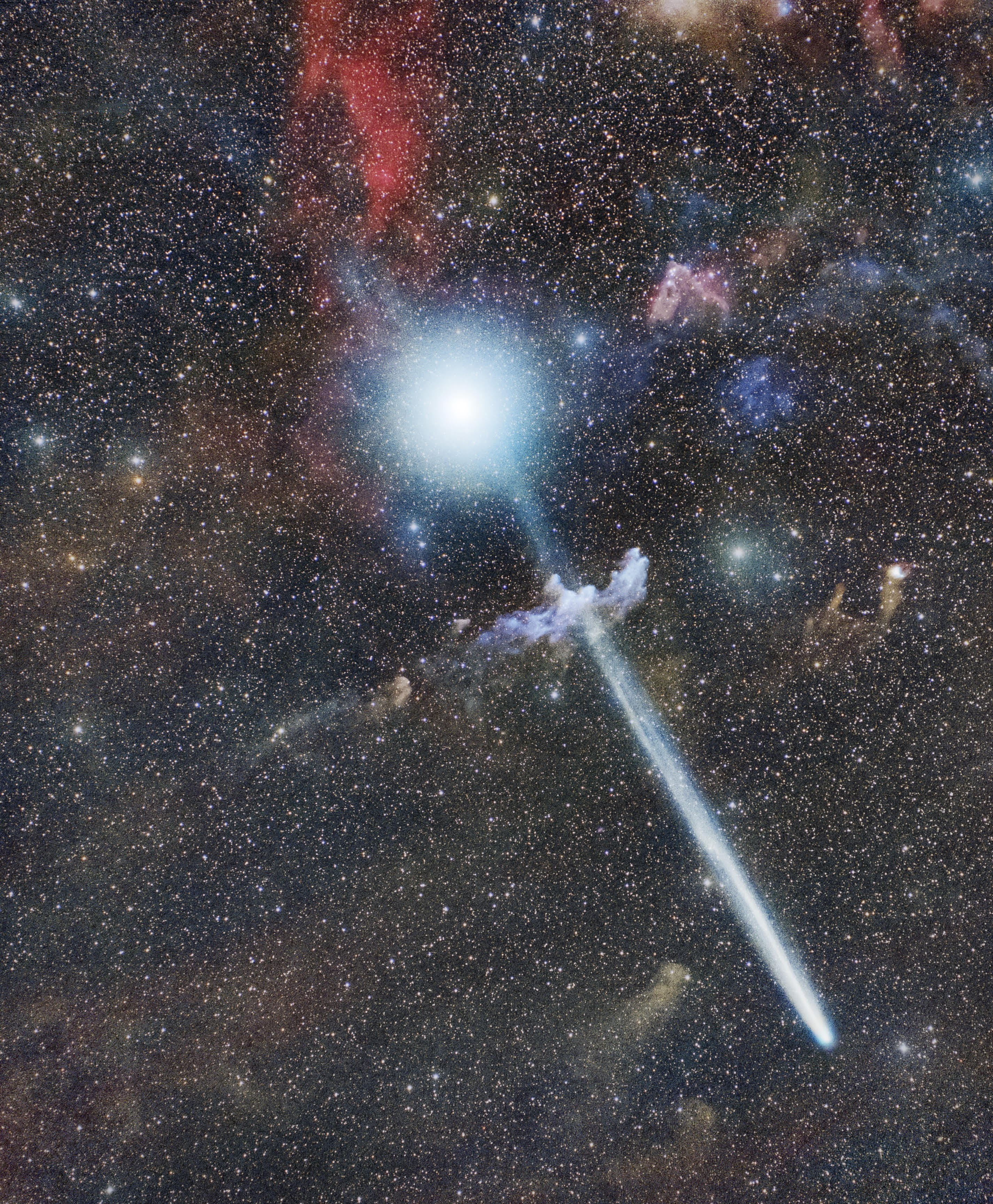
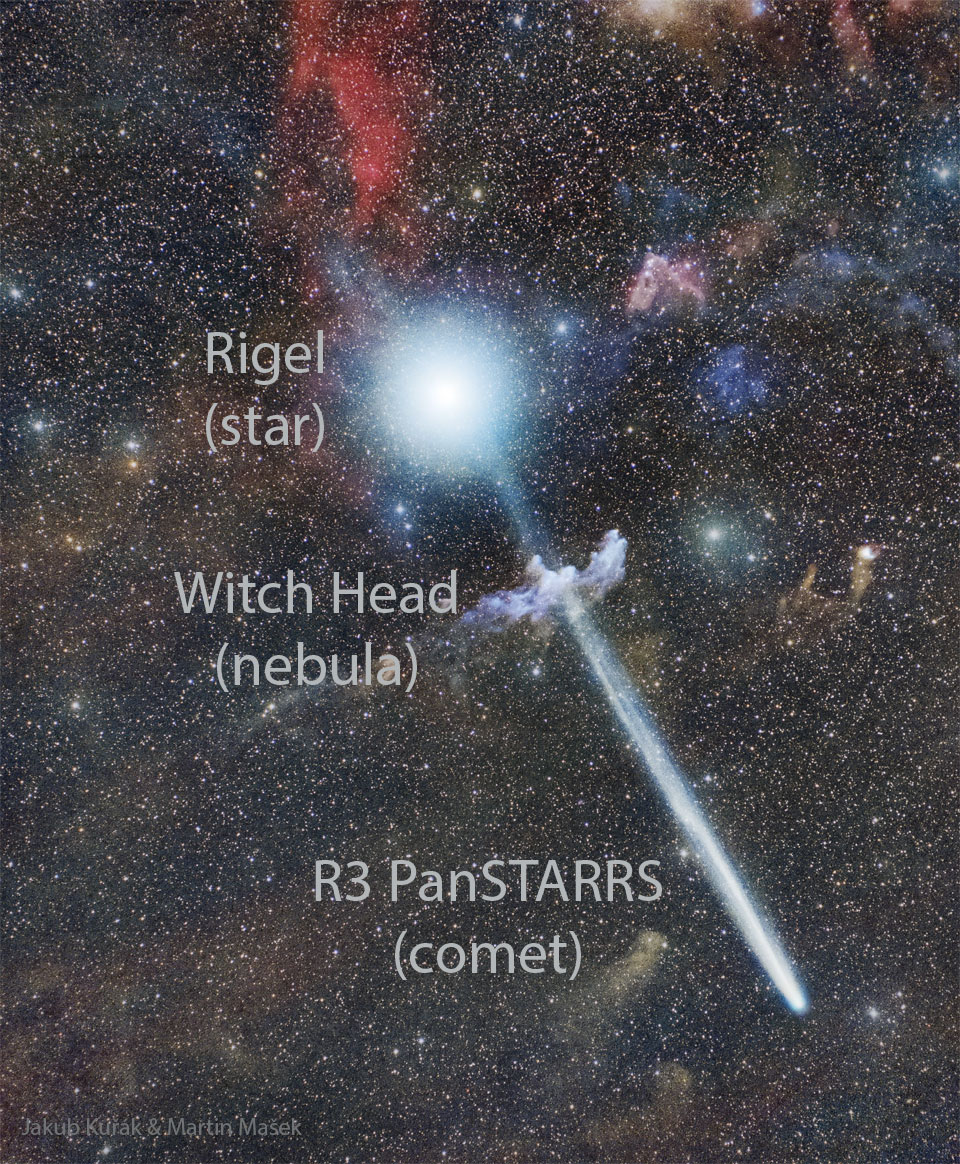
Re:Astronomy Picture of the Day Date Posted:05/09/2026 2:38 AMCopy HTML 2026 May 8 Image Credit & Copyright: Jakub Kuřák & Martin Mašek (FZU of the Czech Academy of Sciences) Explanation: Which way is Comet R3 PanSTARRS going? Not towards the star at the top of the image, because that is Rigel, which, being far in the background, is unrelated to the comet. Not through the nebula in the image middle, because that is the Witch Head Nebula and it, too, is far in the distance -- but not far from Rigel. Not into northern skies because over the past week Comet C/2025 R3 (PanSTARRS) has moved into southern skies and is now best visible in Earth's Southern Hemisphere toward the west after sunset. Angularly, Comet R3 PanSTARRS is slowly moving toward the upper right, night by night, and will soon be in the constellation Orion. Spatially, the comet is now headed out of our Solar System but should remain visible to cameras in southern skies for about a week. The featured image was captured last week near Cerro Paranal in Chile. |
|
Niceguy2
|
#6338 |
|
Re:Astronomy Picture of the Day Date Posted:05/09/2026 2:39 AMCopy HTML
|
|
Niceguy2
|
#6339 |
|
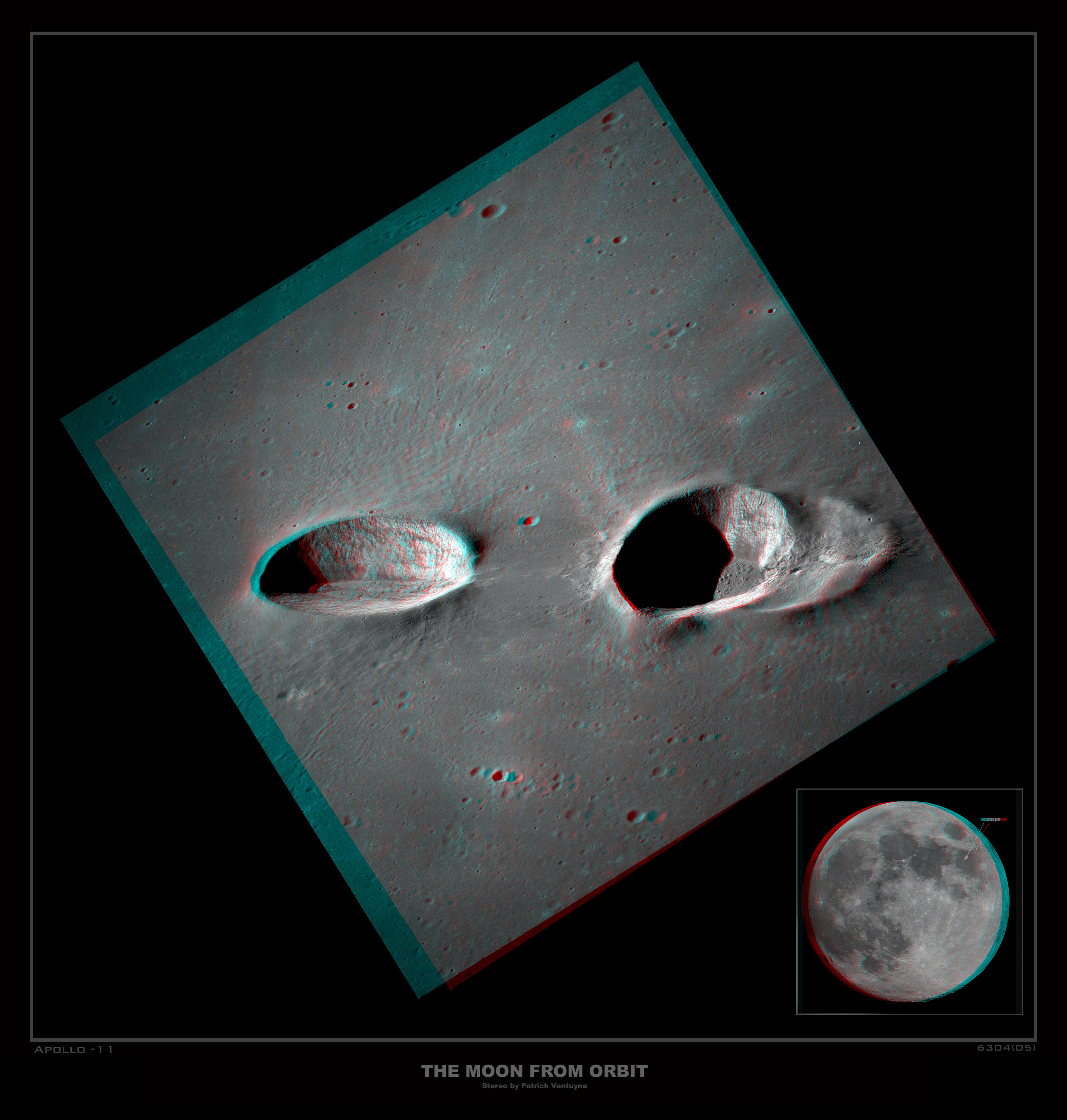
Re:Astronomy Picture of the Day Date Posted:05/10/2026 3:32 AMCopy HTML 2026 May 9 Image Credit: Apollo 11, NASA; Stereo Image Copyright Patrick Vantuyne Explanation: Many bright nebulae and star clusters in planet Earth's sky are associated with the name of astronomer Charles Messier from his famous 18th century catalog. His name is also given to these two large and remarkable craters on the Moon. Standouts in the dark, smooth lunar Sea of Fertility or Mare Fecunditatis, Messier (left) and Messier A have dimensions of 15 by 8 and 16 by 11 kilometers respectively. Their elongated shapes are explained by the extremely shallow-angle trajectory followed by an impactor, moving left to right, that gouged out the craters. The shallow impact also resulted in two bright rays of material extending along the surface to the right, beyond the picture. Intended to be viewed with red/blue glasses (red for the left eye), this striking stereo picture of the crater pair was recently created from high resolution scans of two images (AS11-42-6304, AS11-42-6305) taken during the Apollo 11 mission to the Moon. |
|
Niceguy2
|
#6340 |
|
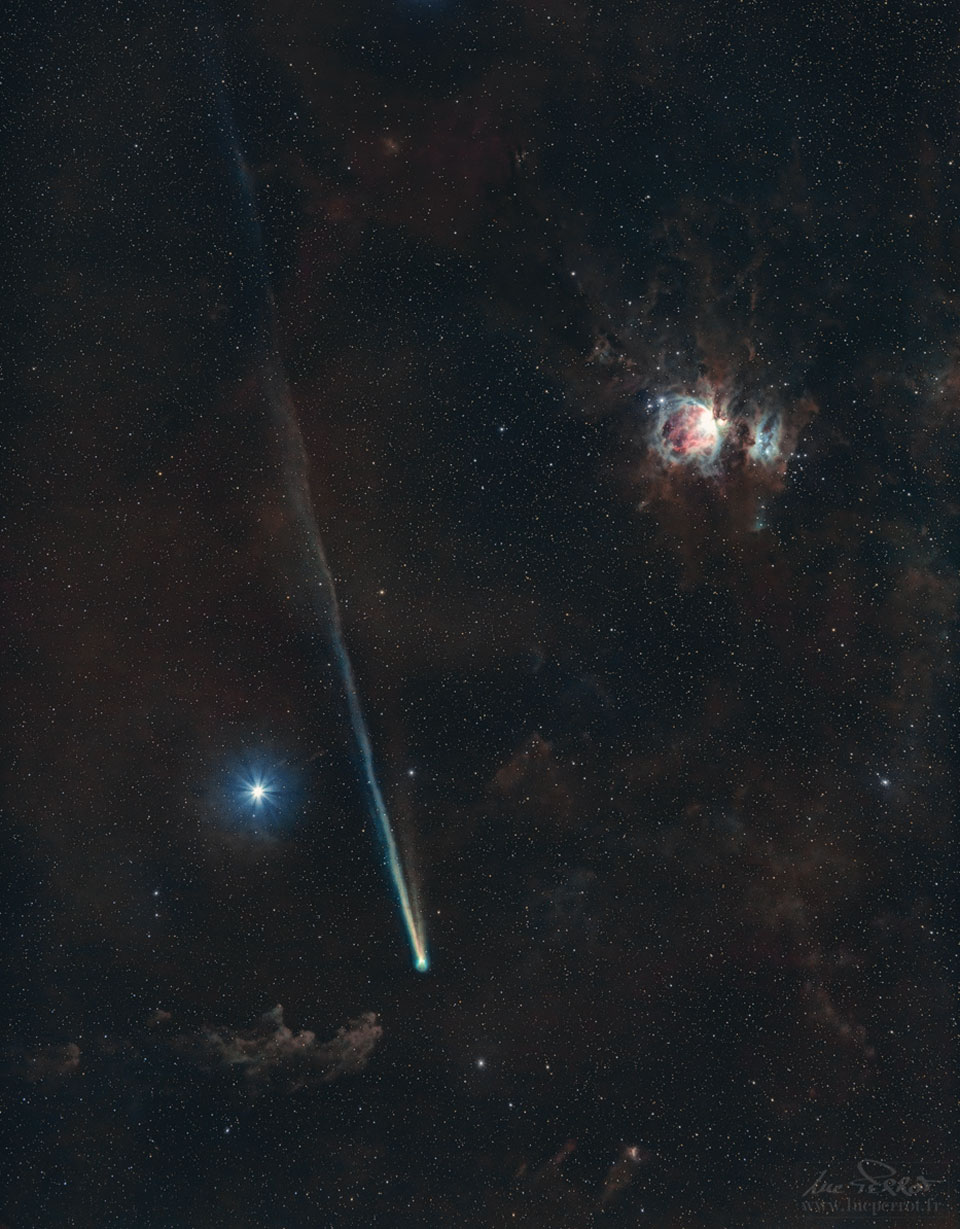
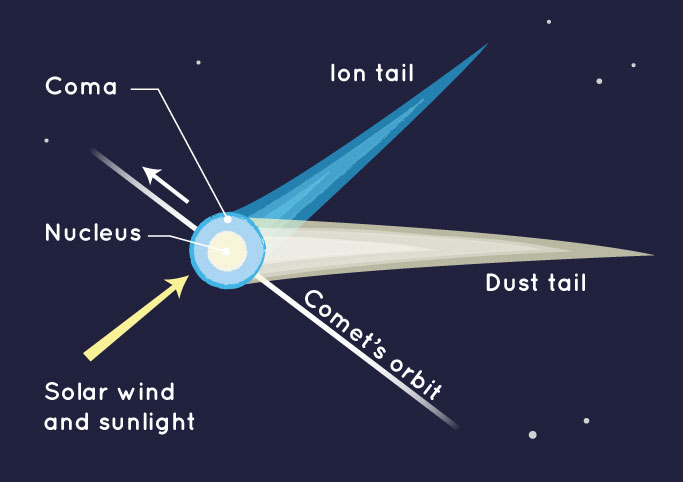
Re:Astronomy Picture of the Day Date Posted:05/11/2026 1:57 AMCopy HTML 2026 May 10 Image Credit & Copyright: Luc Perrot (TWAN) Explanation: Orion never had a sword like this. As Comet C/2025 R3 (PanSTARRS) heads out of the inner Solar System, it is putting on quite a show for long exposure cameras. Currently seen toward the constellation of Orion the Hunter, the distant Orion Nebula is visible on the upper right. Comet R3 PanSTARRS is now showing two distinct tails: a short dust tail pointing toward the top of the image and a long and wavy ion tail trailing off toward the upper left. The ion tail points away from the Sun and glows blue from excited carbon monoxide. Large particles in the dust tail somewhat resist the radiation pressure that push them away from the Sun and so retain a bit of the comet's orbit. The dust tail shines by reflected sunlight. The featured image was taken a few days ago from France's Reunion Island in the southern Indian Ocean. |
|
Niceguy2
|
#6341 |
|
Re:Astronomy Picture of the Day Date Posted:05/11/2026 1:57 AMCopy HTML
|