|
|

| Title: Astronomy Picture of the Day | |
| friendsoffortiesfive > General > General Discussion | Go to subcategory: |


| Author | Content |
Niceguy2

|
|
|
Date Posted:03/06/2014 11:29 PMCopy HTML I really love this site and |
|
Niceguy2
|
#5901 |
|
Re:Astronomy Picture of the Day Date Posted:04/11/2025 2:33 AMCopy HTML 2025 April 10 Image Credit & Copyright: Daniel Yang K. Explanation: From a garden on planet Earth, 38 hours of exposure with a camera and small telescope produced this cosmic photo of the M81 galaxy group. In fact, the group's dominant galaxy M81 is near the center of the frame sporting grand spiral arms and a bright yellow core. Also known as Bode's galaxy, M81 itself spans some 100,000 light-years. Near the top is cigar-shaped irregular galaxy M82. The pair have been locked in gravitational combat for a billion years. Gravity from each galaxy has profoundly affected the other during a series of cosmic close encounters. Their last go-round lasted about 100 million years and likely raised density waves rippling around M81, resulting in massive star forming regions arrayed along M81's spiral arms. M82 was left with violent star forming regions too, and colliding gas clouds so energetic that the galaxy glows in X-rays. In the next few billion years, their continuing gravitational encounters will result in a merger, and a single galaxy will remain. Another group member, NGC 3077 is below and left of the large spiral M81. Far far away, about 12 million light-years distant the M81 group galaxies are seen toward the northern constellation Ursa Major (the Great Bear). But in the closer foreground the wide-field image is filled with integrated flux nebulae whose faint, dusty interstellar clouds reflect starlight above the plane of our own Milky Way galaxy. |
|
Niceguy2
|
#5902 |
|
Re:Astronomy Picture of the Day Date Posted:04/12/2025 2:38 AMCopy HTML 2025 April 11 Image Credit & Copyright: A.J. Smadi Explanation: Made with a telescope shaded from bright sunlight by an umbrella, on April 5 a well-planned video captured a crescent Venus shining in clear daytime skies from Shoreline, Washington, USA at 11:57AM Pacific Time. It also caught the International Space Station in this single video frame. In close conjunction with the bright planet, the faint outline of the orbital outpost seen at a range of about 400 kilometers appears to be similar in size to the slender planetary crescent. Of course the ISS is much smaller than Venus. Now appearing as planet Earth's brilliant morning star and climbing above the eastern horizon in predawn skies, inner planet Venus was nearly 45 million kilometers from Shoreline. |
|
Niceguy2
|
#5903 |
|
Re:Astronomy Picture of the Day Date Posted:04/13/2025 2:03 AMCopy HTML 2025 April 12 Image Credit & Copyright: Jordi Coy Explanation: Most of us watch the Moon at night. But the Moon spends nearly as many daylight hours above our horizon, though in bright daytime skies the lunar disk looks pale and can be a little harder to see. Of course in daytime skies the Moon also appears to cycle through its phases, shining by reflected sunlight as it orbits our fair planet. For daytime moonwatchers, the Moon is probably easier to spot when the visible sunlit portion of the lunar disk is large and waxing following first quarter or waning approaching its third quarter phase. And though it might look unusual, a daytime moon is often seen even in urban skies. Captured here in a telephoto snapshot taken on March 12, a waxing daytime Moon is aligned near the edge of a popular observation deck that overlooks New York City's borough of Manahattan. |
|
Niceguy2
|
#5904 |
|
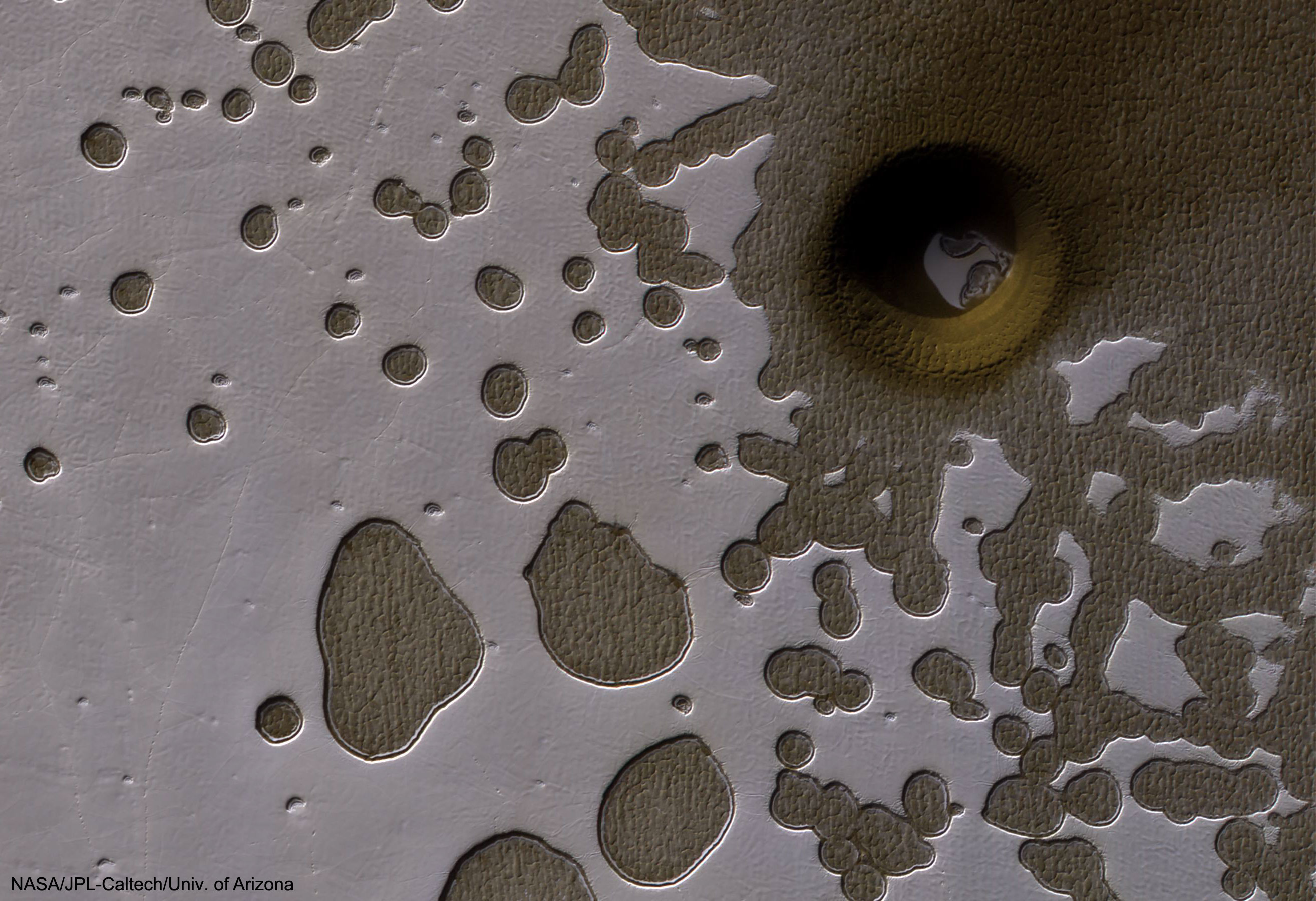
Re:Astronomy Picture of the Day Date Posted:04/14/2025 2:02 AMCopy HTML 2025 April 13 Image Credit: NASA, MRO, HiRISE, JPL, U. Arizona Explanation: What created this unusual hole in Mars? Actually, there are numerous holes pictured in this Swiss cheese-like landscape, with all-but-one of them showing a dusty, dark, Martian terrain beneath evaporating, light, carbon dioxide ice. The most unusual hole is on the upper right, spans about 100 meters, and seems to punch through to a lower level. Why this hole exists and why it is surrounded by a circular crater remains a topic of speculation, although a leading hypothesis is that it was created by a meteor impact. Holes such as this are of particular interest because they might be portals to lower levels that extend into expansive underground caves. If so, these naturally occurring tunnels are relatively protected from the harsh surface of Mars, making them relatively good candidates to contain Martian life. These pits are therefore also prime targets for possible future spacecraft, robots, and even human interplanetary explorers. |
|
Niceguy2
|
#5905 |
|
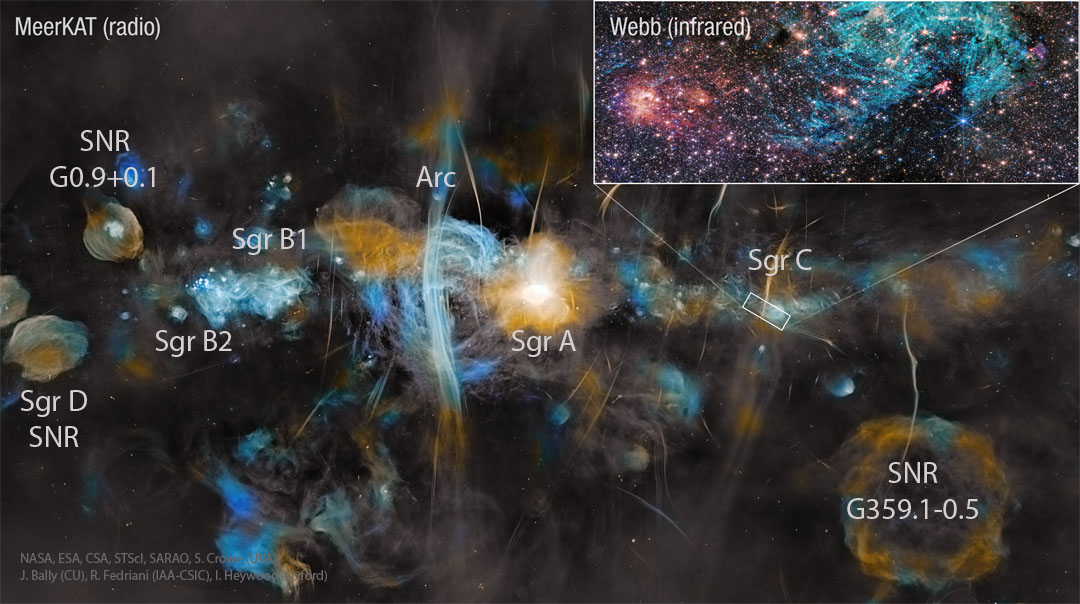
Re:Astronomy Picture of the Day Date Posted:04/15/2025 1:49 AMCopy HTML 2025 April 14 Image Credit: NASA, ESA, CSA, STScI, SARAO, S. Crowe (UVA), J. Bally (CU), R. Fedriani (IAA-CSIC), I. Heywood (Oxford) Explanation: What's happening at the center of our galaxy? It's hard to tell with optical telescopes since visible light is blocked by intervening interstellar dust. In other bands of light, though, such as radio, the galactic center can be imaged and shows itself to be quite an interesting and active place. The featured picture shows an image of our Milky Way's center by the MeerKAT array of 64 radio dishes in South Africa. Spanning four times the angular size of the Moon (2 degrees), the image is impressively vast, deep, and detailed. Many known sources are shown in clear detail, including many with a prefix of Sgr, since the galactic center is in the direction of the constellation Sagittarius. In our galaxy's center lies Sgr A, found here in the image center, which houses the Milky Way's central supermassive black hole. Other sources in the image are not as well understood, including the Arc, just to the left of Sgr A, and numerous filamentary threads. The inset image shows a small patch recently imaged in infrared light with the James Webb Space Telescope to investigate the effects of magnetic fields on star formation. |
|
Niceguy2
|
#5906 |
|
Re:Astronomy Picture of the Day Date Posted:04/15/2025 1:49 AMCopy HTML
|
|
Niceguy2
|
#5907 |
|
Re:Astronomy Picture of the Day Date Posted:04/16/2025 2:00 AMCopy HTML 2025 April 15 Image Credit: NASA, ESA, CSA, M. E. Ressler (JPL) et al.; Processing: Judy Schmidt Explanation: What happens when a star runs out of nuclear fuel? For stars like our Sun, the center condenses into a white dwarf while the outer atmosphere is expelled into space to appear as a planetary nebula. The expelled outer atmosphere of planetary nebula NGC 1514 appears to be a jumble of bubbles -- when seen in visible light. But the view from the James Webb Space Telescope in infrared, as featured here, confirms a different story: in this light the nebula shows a distinct hourglass shape, which is interpreted as a cylinder seen along a diagonal. If you look closely at the center of the nebula, you can also see a bright central star that is part of a binary system. More observations might better reveal how this nebula is evolving and how the central stars are working together to produce the interesting cylinder and bubbles observed. |
|
Niceguy2
|
#5908 |
|
Re:Astronomy Picture of the Day Date Posted:04/17/2025 1:53 AMCopy HTML 2025 April 16 Image Credit & Copyright: Taavi Niittee (Tõrva Astronomy Club) Explanation: What created the unusual halo around the Cat's Eye Nebula? No one is sure. What is sure is that the Cat's Eye Nebula (NGC 6543) is one of the best known planetary nebulae on the sky. Although haunting symmetries are seen in the bright central region, this image was taken to feature its intricately structured outer halo, which spans over three light-years across. Planetary nebulae have long been appreciated as a final phase in the life of a Sun-like star. Only recently however, have some planetaries been found to have expansive halos, likely formed from material shrugged off during earlier puzzling episodes in the star's evolution. While the planetary nebula phase is thought to last for around 10,000 years, astronomers estimate the age of the outer filamentary portions of the Cat's Eye Nebula's halo to be 50,000 to 90,000 years. |
|
Niceguy2
|
#5909 |
|
Re:Astronomy Picture of the Day Date Posted:04/18/2025 1:20 AMCopy HTML 2025 April 17 Image Credit & Copyright: Daniel Adibi Explanation: Galaxies of the Virgo Cluster are scattered across this nearly 4 degree wide telescopic field of view. About 50 million light-years distant, the Virgo Cluster is the closest large galaxy cluster to our own local galaxy group. Prominent here are Virgo's bright elliptical galaxies from the Messier catalog, M87 at bottom left, and M86 and M84 near center right. M86 and M84 are recognized as part of Markarian's Chain, the visually striking line-up of galaxies on the that runs through the upper portion of this frame. Near the middle of the chain lies an intriguing interacting pair of galaxies, NGC 4438 and NGC 4435, known to some as Markarian's Eyes. Still, giant elliptical galaxy M87 dominates the Virgo cluster. It's the home of a super massive black hole, the first black hole ever imaged by planet Earth's Event Horizon Telescope. |
|
Niceguy2
|
#5910 |
|
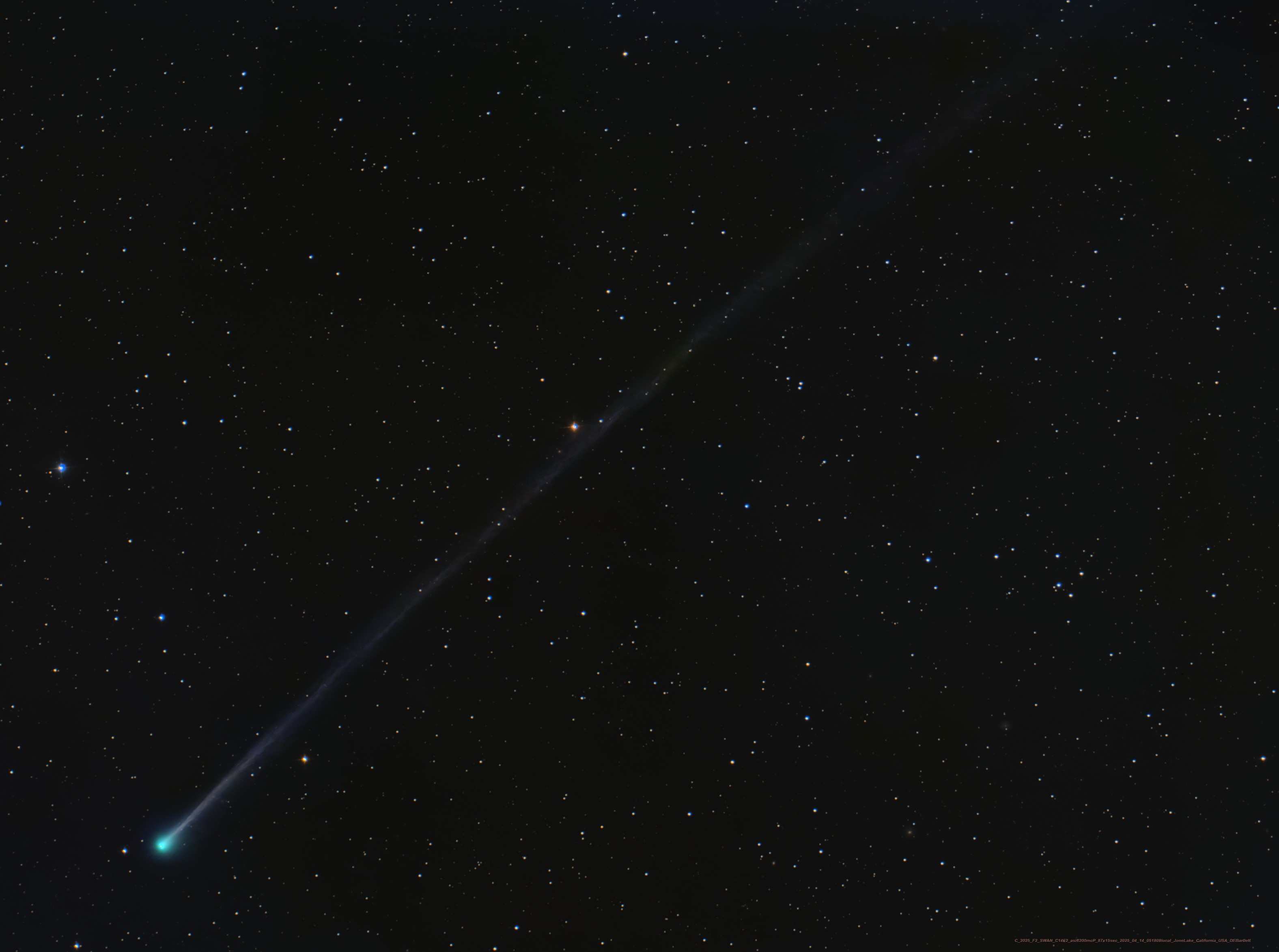
Re:Astronomy Picture of the Day Date Posted:04/19/2025 2:49 AMCopy HTML 2025 April 18 Image Credit & Copyright: Dan Bartlett Explanation: In late March, the comet now designated C/2025 F2 SWAN was found independently by citizen scientists Vladimir Bezugly, Michael Mattiazzo, and Rob Matson while examining publicly available image data from the Solar Wind ANisotropies (SWAN) camera on the sun-staring SOHO spacecraft. Comet SWAN's coma, its greenish color a signature of diatomic carbon molecules fluorescing in sunlight, is at lower left in this telescopic image. SWAN's faint ion tail extends nearly two degrees toward the upper right across the field of view. The interplanetary scene was captured in clear but moonlit skies from June Lake, California on April 14. Seen against background of stars toward the constellation Andromeda, the comet was then some 10 light-minutes from our fair planet. Now a target for binoculars and small telescopes in northern hemisphere morning skies this comet SWAN is headed for a perihelion, its closest approach to the Sun, on May 1. That will bring this visitor from the distant Oort cloud almost as close to the Sun as the orbit of inner planet Mercury. |
|
Niceguy2
|
#5911 |
|
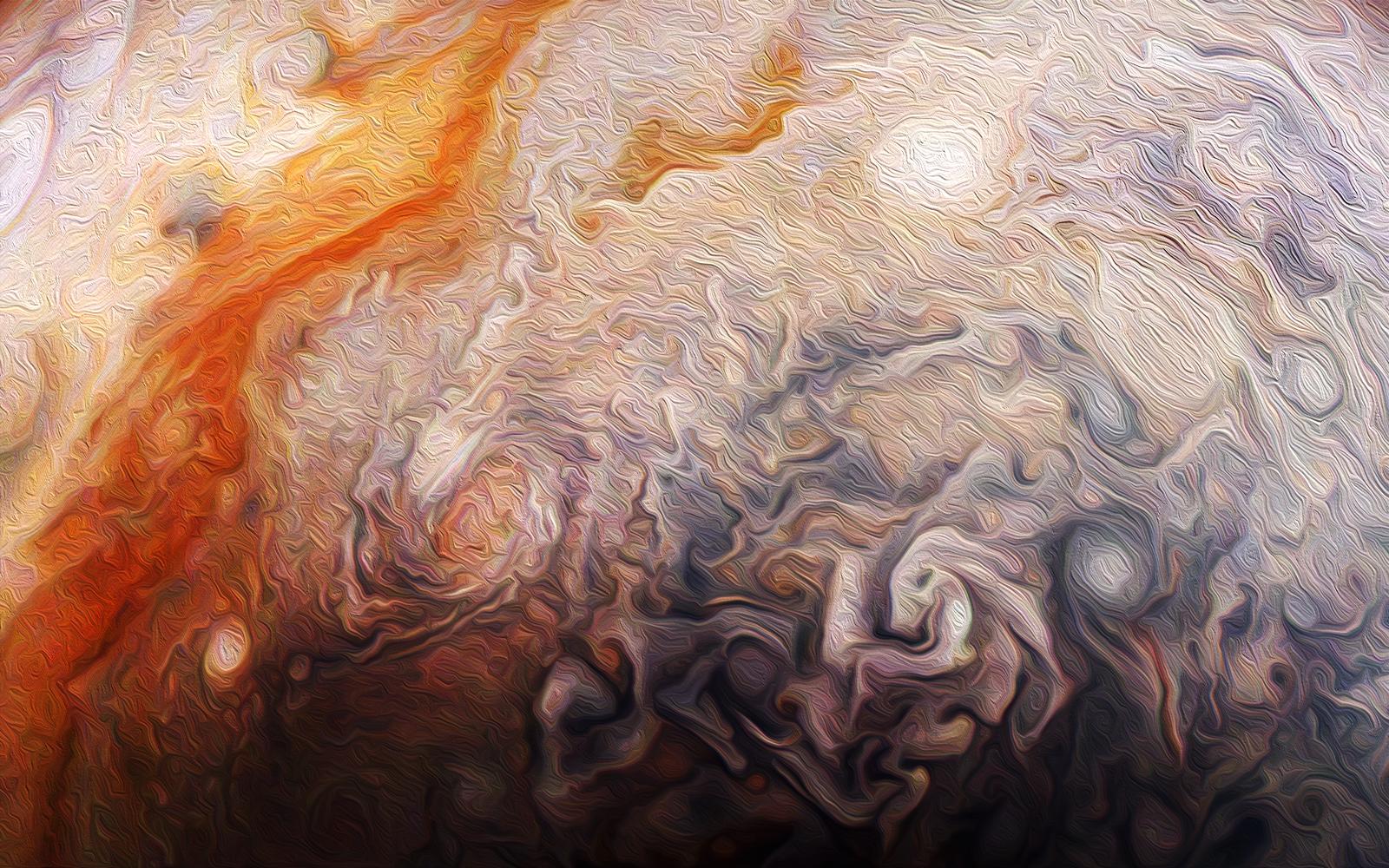
Re:Astronomy Picture of the Day Date Posted:04/20/2025 1:37 AMCopy HTML 2025 April 19 Image Credit: NASA, JPL-Caltech, SwRI, MSSS; Processing: Rick Lundh Explanation: In digital brush strokes, Jupiter's signature atmospheric bands and vortices were used to form this interplanetary post-impressionist work of art. The creative image from citizen scientist Rick Lundh uses data from the Juno spacecraft's JunoCam. To paint on the digital canvas, a JunoCam image with contrasting light and dark tones was chosen for processing and an oil-painting software filter applied. The image data was captured during perijove 10. That was Juno's December 16, 2017 close encounter with the solar system's ruling gas giant. At the time the spacecraft was cruising about 13,000 kilometers above northern Jovian cloud tops. Now in an extended mission, Juno has explored Jupiter and its moons since entering orbit around Jupiter in July of 2016. |
|
Niceguy2
|
#5912 |
|
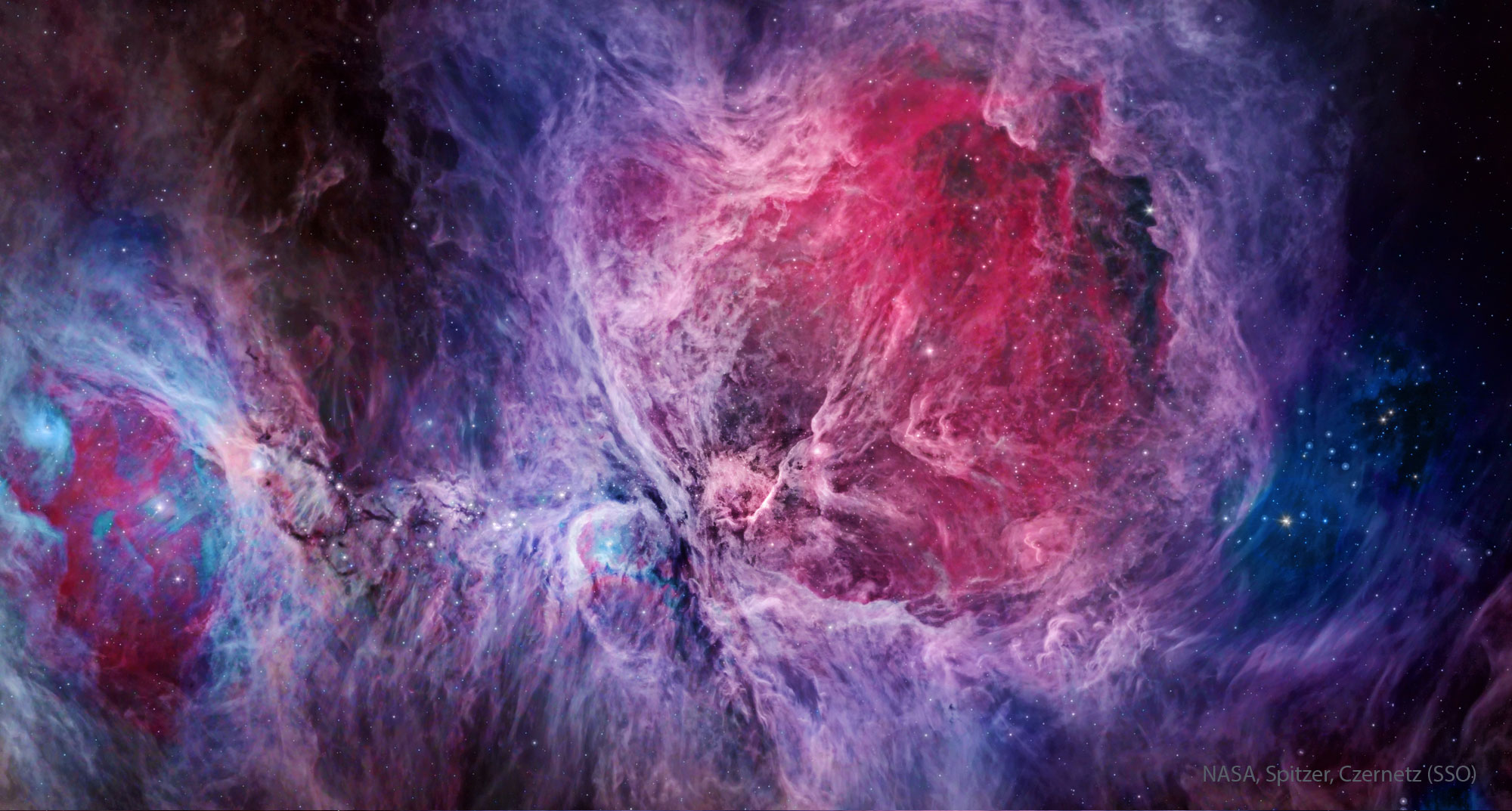
Re:Astronomy Picture of the Day Date Posted:04/21/2025 1:54 AMCopy HTML 2025 April 20 Image Credit & Copyright: Infrared: NASA, Spitzer Space Telescope; Visible: Oliver Czernetz, Siding Spring Obs. Explanation: The Great Nebula in Orion is a colorful place. Visible to the unaided eye, it appears as a small fuzzy patch in the constellation of Orion. Long exposure, multi-wavelength images like this, however, show the Orion Nebula to be a busy neighborhood of young stars, hot gas, and dark dust. This digital composite features not only three colors of visible light but four colors of infrared light taken by NASA's orbiting Spitzer Space Telescope as well. The power behind much of the Orion Nebula (M42) is the Trapezium - four of the brightest stars in the nebula. Many of the filamentary structures visible are actually shock waves - fronts where fast moving material encounters slow moving gas. The Orion Nebula spans about 40 light years and is located about 1500 light years away in the same spiral arm of our Galaxy as the Sun. |
|
Niceguy2
|
#5913 |
|
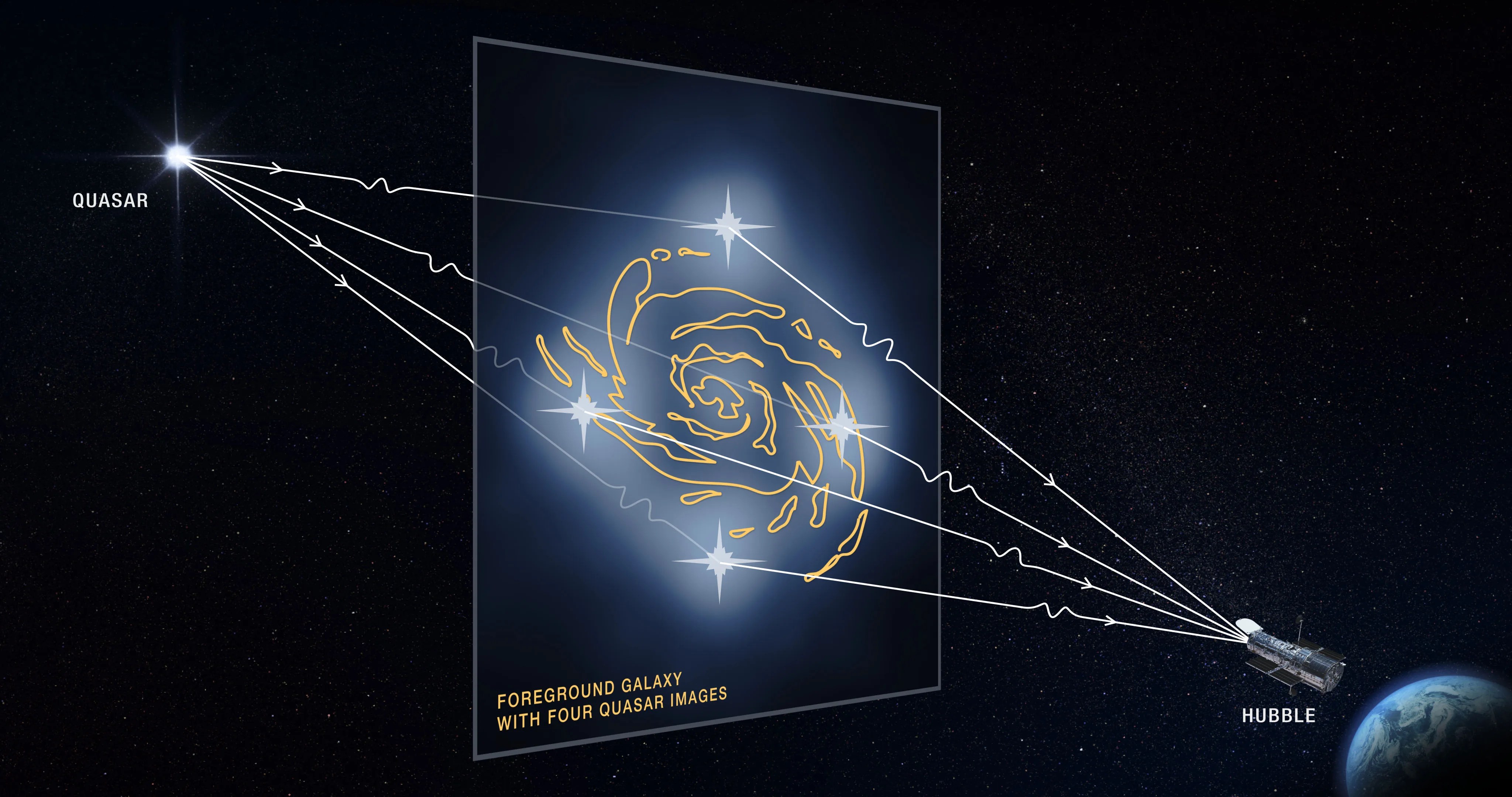
Re:Astronomy Picture of the Day Date Posted:04/22/2025 2:46 AMCopy HTML 2025 April 21 Image Credit: ESA/Webb, NASA & CSA, G. Mahler Explanation: Is this one galaxy or two? Although it looks like one, the answer is two. One path to this happening is when a small galaxy collides with a larger galaxy and ends up in the center. But in the featured image, something more rare is going on. Here, the central light-colored elliptical galaxy is much closer than the blue and red-colored spiral galaxy that surrounds it. This can happen when near and far galaxies are exactly aligned, causing the gravity of the near galaxy to pull the light from the far galaxy around it in an effect called gravitational lensing. The featured galaxy double was taken by the Webb Space Telescope and shows a complete Einstein ring, with great detail visible for both galaxies. Galaxy lenses like this can reveal new information about the mass distribution of the foreground lens and the light distribution of the background source. |
|
Niceguy2
|
#5914 |
|
Re:Astronomy Picture of the Day Date Posted:04/23/2025 1:50 AMCopy HTML 2025 April 22 Image Credit & Copyright: Rich Addis Explanation: What's different about this Moon? It's the terminators. In the featured image, you can't directly see any terminator -- the line that divides the light of day from the dark of night. That's because the featured image is a digital composite of many near-terminator lunar strips over a full Moon. Terminator regions show the longest and most prominent shadows -- shadows which, by their contrast and length, allow a flat photograph to appear three-dimensional. The overlay images were taken over two weeks in early April. Many of the Moon's craters stand out because of the shadows they all cast to the right. The image shows in graphic detail that the darker regions known as maria are not just darker than the rest of the Moon -- they are also flatter. |
|
Niceguy2
|
#5915 |
|
Re:Astronomy Picture of the Day Date Posted:04/23/2025 1:51 AMCopy HTML
|
|
Niceguy2
|
#5916 |
|
Re:Astronomy Picture of the Day Date Posted:04/24/2025 2:22 AMCopy HTML 2025 April 23 Image Credit & Copyright: Koen van Barneveld Explanation: This surprising sky has almost everything. First, slanting down from the upper left and far in the distance is the central band of our Milky Way Galaxy. More modestly, slanting down from the upper right and high in Earth's atmosphere is a bright meteor. The dim band of light across the central diagonal is zodiacal light: sunlight reflected from dust in the inner Solar System. The green glow on the far right is aurora high in Earth's atmosphere. The bright zigzagging bright line near the bottom is just a light that was held by the scene-planning astrophotographer. This "almost everything" sky was captured over rocks on Castle Hill, New Zealand late last month. The featured finished frame is a combination of 10 exposures all taken with the same camera and from the same location. But what about the astrophotographer himself? He's pictured too -- can you find him? |
|
Niceguy2
|
#5917 |
|
Re:Astronomy Picture of the Day Date Posted:04/24/2025 2:22 AMCopy HTML
|
|
Niceguy2
|
#5918 |
|
Re:Astronomy Picture of the Day Date Posted:04/25/2025 3:03 AMCopy HTML 2025 April 24 Image Credit & Copyright: Daniel Stern Explanation: Beautiful emission nebula NGC 6164 was created by a rare, hot, luminous O-type star, some 40 times as massive as the Sun. Seen at the center of the cosmic cloud, the star is a mere 3 to 4 million years old. In another three to four million years the massive star will end its life in a supernova explosion. Spanning around 4 light-years, the nebula itself has a bipolar symmetry. That makes it similar in appearance to more common and familiar planetary nebulae - the gaseous shrouds surrounding dying sun-like stars. Also like many planetary nebulae, NGC 6164 has been found to have an extensive, faint halo, revealed in this deep image of the region. Expanding into the surrounding interstellar medium, the material in the halo is likely from an earlier active phase of the O star. This gorgeous telescopic view is a composite of extensive narrow-band image data, highlighting glowing atomic hydrogen gas in red and oxygen in greenish hues, with broad-band data for the surrounding starfield. Also known as the Dragon's Egg nebula, NGC 6164 is 4,200 light-years away in the right-angled southern constellation of Norma. |
|
Niceguy2
|
#5919 |
|
Re:Astronomy Picture of the Day Date Posted:04/26/2025 1:55 AMCopy HTML 2025 April 25 Image Credit: Lucy/NASA/Goddard/SwRI/Johns Hopkins APL/NOIRLab Explanation: Main belt asteroid 52246 Donaldjohanson is about 8 kilometers long and 3.5 kilometers across. On April 20, this sharp close-up of the asteroid was captured at a distance of about 1100 kilometers by the Lucy spacecraft's long range camera during its second asteroid encounter. Named after American paleoanthropologist Donald Johanson, discoverer of the Lucy hominid fossil, the elongated asteroid was likely formed about 150 million years ago from a gentle collision of two smaller bodies creating its characteristic contact binary shape. Launched in October of 2021, the Lucy spacecraft will continue its travels through the main asteroid belt in 2025, but is on its way to explore Jupiter's swarm of Trojan asteroids. Lucy is expected to encounter its first Trojan asteroid target, 3548 Eurybates, in August 2027. |
|
Niceguy2
|
#5920 |
|
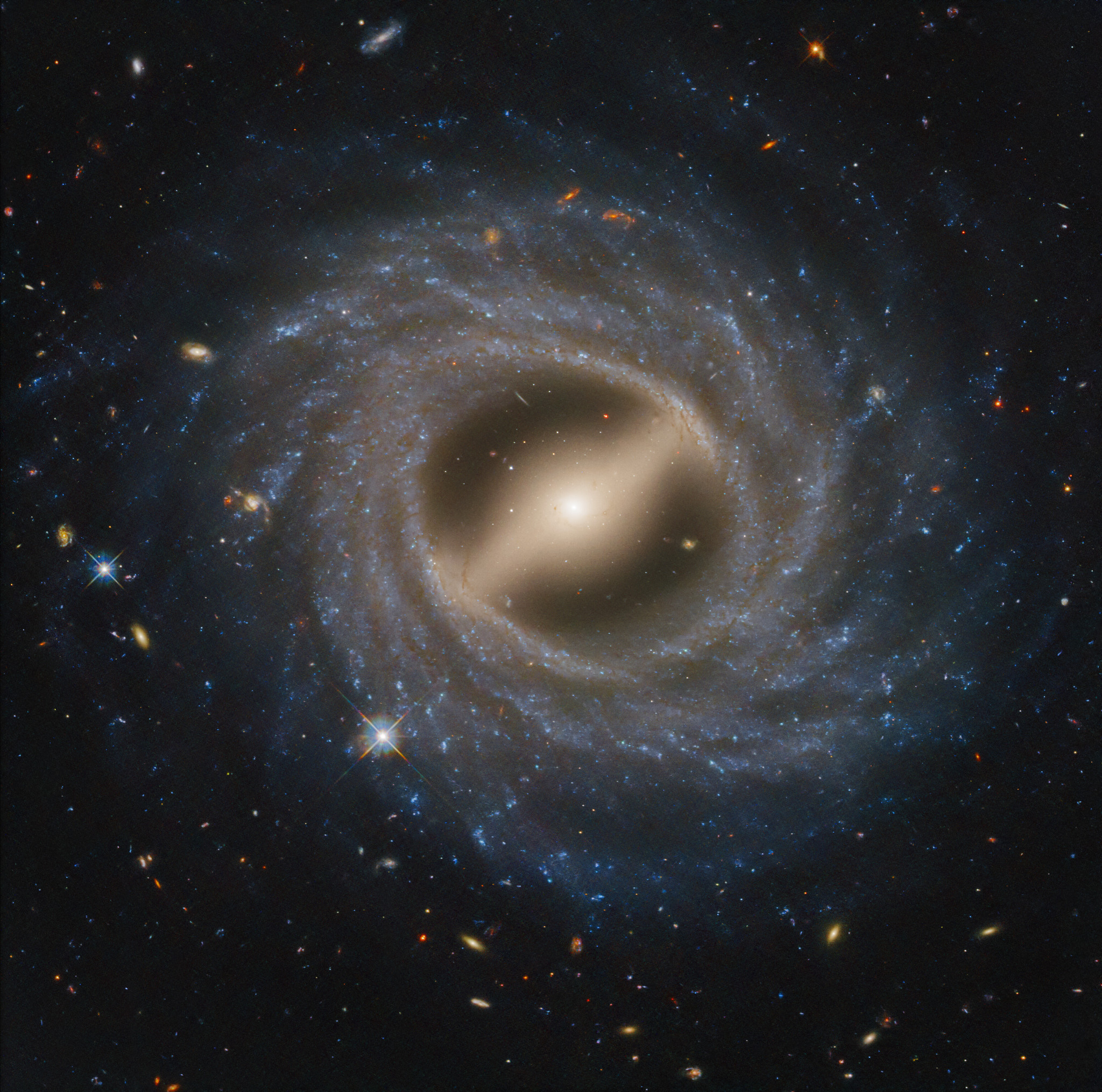
Re:Astronomy Picture of the Day Date Posted:04/28/2025 2:20 AMCopy HTML 2025 April 26 Image Credit: NASA, ESA, STScI Explanation: This stunning portrait of NGC 5335 was captured by the Hubble Space Telescope. Some 170,000 light-years across and over 200 million light-years away toward the constellation Virgo, the magnificent spiral galaxy is seen face-on in Hubble's view. Within the galactic disk, loose streamers of star forming regions lie along the galaxy's flocculent spiral arms. But the most striking feature of NGC 5335 is its prominent central bar. Seen in about 30 percent of galaxies, including our Milky Way, bar structures are understood to channel material inward toward the galactic center, fueling star formation. Of course, distant background galaxies are easy to spot, scattered around the sharp Hubble image. Launched in 1990, Hubble is now celebrating its 35th year exploring the cosmos from orbit around planet Earth. WOW! |
|
Niceguy2
|
#5921 |
|
Re:Astronomy Picture of the Day Date Posted:04/28/2025 2:23 AMCopy HTML 2025 April 27 Image Credit: NASA, ESA, and the Hubble Heritage Team (STScI/AURA); Acknowledgement: R. Sahai (JPL) et al. Explanation: What is creating the strange texture of IC 418? Dubbed the Spirograph Nebula for its resemblance to drawings from a cyclical drawing tool, planetary nebula IC 418 shows patterns that are not well understood. Perhaps they are related to chaotic winds from the variable central star, which changes brightness unpredictably in just a few hours. By contrast, evidence indicates that only a few million years ago, IC 418 was probably a well-understood star similar to our Sun. Only a few thousand years ago, IC 418 was probably a common red giant star. Since running out of nuclear fuel, though, the outer envelope has begun expanding outward leaving a hot remnant core destined to become a white-dwarf star, visible in the image center. The light from the central core excites surrounding atoms in the nebula causing them to glow. IC 418 lies about 2000 light-years away and spans 0.3 light-years across. This false-color image taken from the Hubble Space Telescope reveals the unusual details. |
|
Niceguy2
|
#5922 |
|
Re:Astronomy Picture of the Day Date Posted:04/29/2025 1:54 AMCopy HTML 2025 April 28 Image Credit & Copyright: Francis Bozon & Cecil Navick (AstroA. R. O.) Explanation: This cosmic skyscape features glowing gas and dark dust clouds alongside the young stars of NGC 3572. A beautiful emission nebula and star cluster, it sails far southern skies within the nautical constellation Carina. Stars from NGC 3572 are toward top center in the telescopic frame that would measure about 100 light-years across at the cluster's estimated distance of 9,000 light-years. The visible interstellar gas and dust, shown in colors of the Hubble palette, is part of the star cluster's natal molecular cloud, itself cataloged as Gum 37. Dense streamers of material within the nebula, eroded by stellar winds and radiation, clearly trail away from the energetic young stars. They are likely sites of ongoing star formation with shapes reminiscent of the Tadpoles of IC 410 -- better known to northern skygazers. In the coming tens to hundreds of millions of years, gas and stars in the cluster will be dispersed though, by gravitational tides and by violent supernova explosions that end the short lives of the massive cluster stars. |
|
Niceguy2
|
#5923 |
|
Re:Astronomy Picture of the Day Date Posted:04/30/2025 2:25 AMCopy HTML 2025 April 29 Image Credit & Copyright: Natan Fontes Explanation: Where are Saturn's ears? Galileo is credited, in 1610, as the first person to see Saturn's rings. Testing out Lipperhey's recently co-invented telescope, Galileo did not know what they were and so called them "ears". The mystery deepened in 1612, when Saturn's ears mysteriously disappeared. Today we know exactly what happened: from the perspective of the Earth, Saturn's rings had become too thin to see. The same drama plays out every 15 years because Saturn, like Earth, undergoes tilt-driven seasons. This means that as Saturn goes around the Sun, its equator and rings can tilt noticeably toward the Sun and inner Solar System, making them easily visible, but from other orbital locations will appear almost not at all. The featured picture from Brasilia, Brazil shows a modern version of this sequence: the top ring-dominated image was taken in 2020, while the bottom ring-obscure image taken earlier in 2025. |
|
Niceguy2
|
#5924 |
|
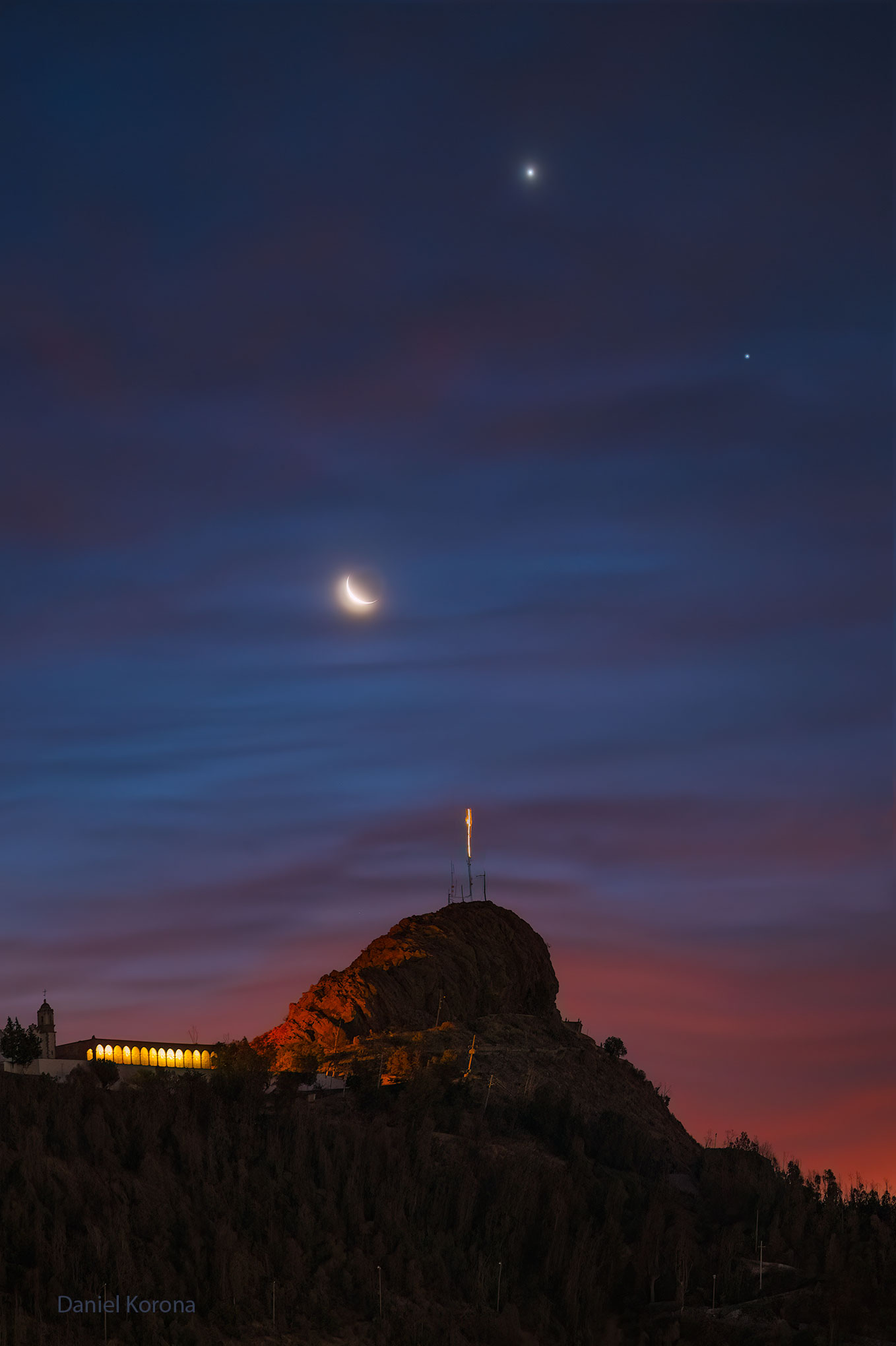
Re:Astronomy Picture of the Day Date Posted:05/01/2025 2:52 AMCopy HTML 2025 April 30 Image Credit & Copyright: Daniel Korona Explanation: Sometimes, the sky itself seems to smile. A few days ago, visible over much of the world, an unusual superposition of our Moon with the planets Venus and Saturn created just such an iconic facial expression. Specifically, a crescent Moon appeared to make a happy face on the night sky when paired with seemingly nearby planets. Pictured is the scene as it appeared over Zacatecas, México, with distinctive Bufa Hill in the foreground. On the far right and farthest in the distance is the planet Saturn. Significantly closer and visible to Saturn's upper left is Venus, the brightest planet on the sky. Just above the central horizon is Earth's Moon in a waning crescent phase. To create this gigantic icon, the crescent moon phase must be smiling in the correct direction. |
|
Niceguy2
|
#5925 |
|
Re:Astronomy Picture of the Day Date Posted:05/01/2025 2:52 AMCopy HTML
|