|
 AimooHelpForum
Aimoo Forum List |
Ticket |
Today |
Member |
Search |
Who's On |
Chat Room | Photos | Help |
Sign In |
AimooHelpForum
Aimoo Forum List |
Ticket |
Today |
Member |
Search |
Who's On |
Chat Room | Photos | Help |
Sign In |
 |
|

| Title: Astronomy Picture of the Day | |
| friendsoffortiesfive > General > General Discussion | Go to subcategory: |


| Author | Content |
Niceguy2

|
|
|
Date Posted:03/06/2014 11:29 PMCopy HTML I really love this site and |
|
Niceguy2
|
#6201 |
|
Re:Astronomy Picture of the Day Date Posted:01/09/2026 3:00 AMCopy HTML 2026 January 8 Image Credit & Copyright: Gaetan Maxant Explanation: Similar in size to large, bright spiral galaxies in our neighborhood, IC 342 is a mere 10 million light-years distant toward the long-necked, northern constellation Camelopardalis. A sprawling island universe, IC 342 would otherwise be a prominent galaxy in our night sky, but it is hidden from clear view and only glimpsed through the veil of stars, gas and dust clouds along the plane of our own Milky Way galaxy. Even though IC 342's light is dimmed and reddened by intervening cosmic clouds, this sharp telescopic image traces the galaxy's own obscuring dust, young star clusters, and glowing star forming regions along spiral arms that wind far from the galaxy's core. IC 342 has undergone a recent burst of star formation activity and is close enough to have influenced the evolution of the local group of galaxies and the Milky Way. |
|
Niceguy2
|
#6202 |
|
Re:Astronomy Picture of the Day Date Posted:01/10/2026 4:24 AMCopy HTML 2026 January 9 Image Credit & Copyright: Antonella Cicala Explanation: Both Moon and Sun create beautiful ice halos in planet Earth's sky. In fact, the two brightest celestial beacons are each surrounded by a complex of ice halos in these photos of the sky above Chamonix-Mont-Blanc in France. The panels were recorded one night (left) and the following day at the end of December 2025. Similar ice halos appear in moonlight and sunlight because they are all formed through the geometry of flat, hexagonal ice crystals. The ice crystals reflect and refract light as they flutter in the cold atmosphere above the mountain resort. In the pictures both Moon and Sun are surrounded by a more commonly seen 22 degree circular halo. Bright and sometimes colorful patches at the intersections of the 22 degree circular halos with the indicated parselenic and parhelic arcs are also known as Moon dogs and Sun dogs. (Editor's note: Annotations updated by Marcella Pace) |
|
Niceguy2
|
#6203 |
|
Re:Astronomy Picture of the Day Date Posted:01/11/2026 3:19 AMCopy HTML 2026 January 10 Image Credit & Copyright: Christopher Go Explanation: Jupiter reaches its 2026 opposition today, January 10. That puts our Solar System's most massive planet opposite the Sun and near its closest and brightest for viewing from planet Earth. In fact, captured only 3 days ago this sharp telescopic snapshot reveals excellent details of the ruling gas giant's swirling cloudtops, in light zones and dark belts girdling the rapidly rotating outer planet. Jupiter's famous, persistent anticyclonic vortex, known as the Great Red Spot, is south of the equator at the lower right. But two smaller red spots are also visible, one near the top in the northernmost zone, and one close to Jupiter's south pole. And while Jupiter's Great Red Spot is known to be shrinking, it's still about the size of the Earth itself. |
|
Niceguy2
|
#6204 |
|
Re:Astronomy Picture of the Day Date Posted:01/12/2026 3:03 AMCopy HTML 2026 January 11 Image Credit: NASA, JPL, Caltech, SSC, R. Kennicutt (Steward Obs.) et al., Explanation: This floating ring is the size of a galaxy. In fact, it is a galaxy -- or at least part of one: the photogenic Sombrero Galaxy, one of the largest galaxies in the nearby Virgo Cluster of Galaxies. The dark band of dust that obscures the mid-section of the Sombrero Galaxy in visible light actually glows brightly in infrared light. The featured image, digitally sharpened, shows the infrared glow, recently recorded by the orbiting Spitzer Space Telescope, superposed in false-color on an existing image taken by NASA's Hubble Space Telescope in visible light. The Sombrero Galaxy, also known as M104, spans about 50,000 light years and lies 28 million light years away. M104 can be seen with a small telescope in the direction of the constellation Virgo. |
|
Niceguy2
|
#6205 |
|
Re:Astronomy Picture of the Day Date Posted:01/13/2026 3:54 AMCopy HTML 2026 January 12 Image Credit & Copyright: Xu Chen Explanation: What's happening to this meteor? It is shedding its outer layers as it passes through the Earth's atmosphere and heats up. The sudden high temperatures not only cause the bright glow along the dramatic streak but also melt and vaporize the meteor's component rock and ice, creating dust. Wind in the atmosphere typically blows this dust away over the next few seconds, leaving no visible trace after only a few minutes. Much of this dust will eventually settle down to the Earth. The featured image was captured in mid-December, coincident with the Geminids meteor shower. On the upper left is Sirius, the brightest star in the night sky, while in the foreground is fog-engulfed Huangshan, the Yellow Mountains of eastern China. |
|
Niceguy2
|
#6206 |
|
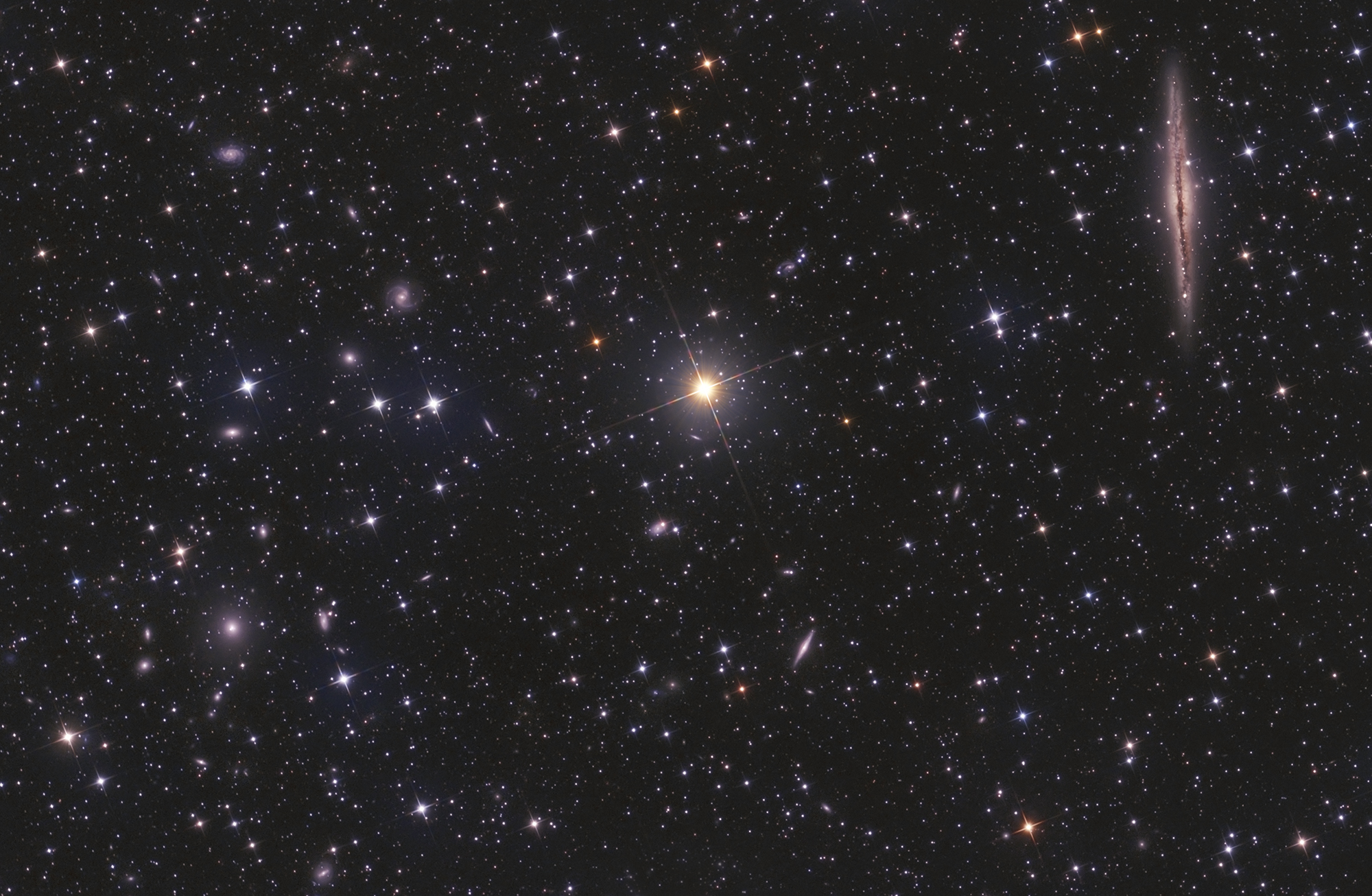
Re:Astronomy Picture of the Day Date Posted:01/14/2026 3:17 AMCopy HTML 2026 January 13
Image Credit & Copyright: Laszlo Bagi Explanation: Distant galaxies lie beyond a foreground of spiky Milky Way stars in this telescopic field of view. Centered on yellowish star HD 14771, the scene spans about 1 degree on the sky toward the northern constellation Andromeda. At top right is large spiral galaxy NGC 891, 100 thousand light-years across and seen almost exactly edge-on. About 30 million light-years distant, NGC 891 looks a lot like our own Milky Way with a flattened, thin, galactic disk. Its disk and central bulge are cut along the middle by dark, obscuring dust clouds. Scattered toward the lower left are members of galaxy cluster Abell 347. Nearly 240 million light-years away, Abell 347 shows off its own large galaxies in the sharp image. They are similar to NGC 891 in physical size but located almost 8 times farther away, so Abell 347 galaxies have roughly one eighth the apparent size of NGC 891. |
|
Niceguy2
|
#6207 |
|
Re:Astronomy Picture of the Day Date Posted:01/15/2026 3:52 AMCopy HTML 2026 January 14 Image Credit & Copyright: Michael Sleeman Explanation: The Whirlpool Galaxy is a classic spiral galaxy. At only 30 million light years distant and fully 60 thousand light years across, M51, also known as NGC 5194, is one of the brightest and most picturesque galaxies on the sky. The featured deep image is a digital combination of images taken in different colors over 58 hours with a telescope from Lijiang, China. Anyone with a good pair of binoculars, however, can see this Whirlpool toward the constellation of the Hunting Dogs (Canes Venatici). M51 is a spiral galaxy of type Sc and is the dominant member of a whole group of galaxies. Astronomers speculate that M51's spiral structure is primarily due to its gravitational interaction with the smaller galaxy just above it. |
|
Niceguy2
|
#6208 |
|
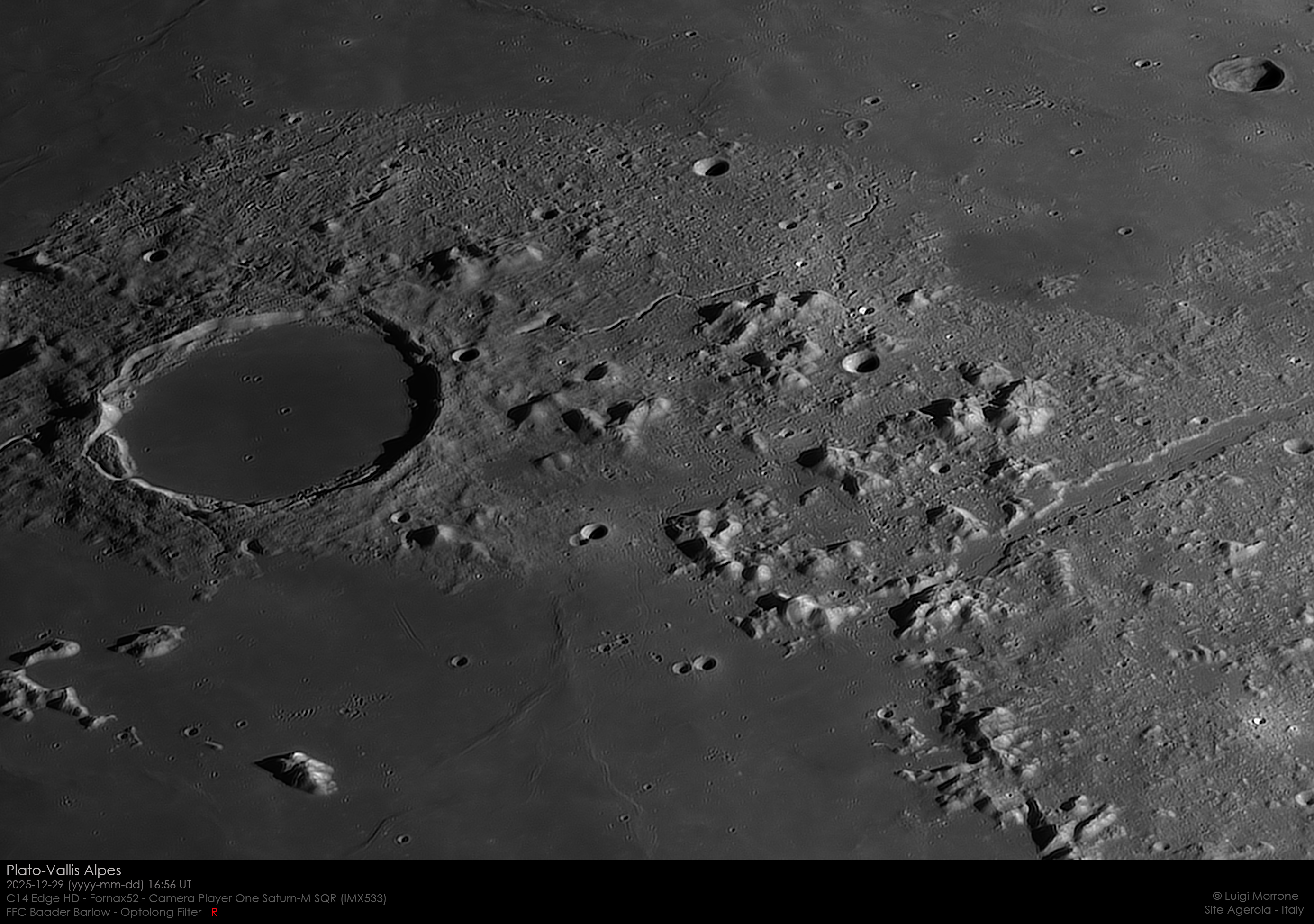
Re:Astronomy Picture of the Day Date Posted:01/16/2026 3:37 AMCopy HTML 2026 January 15 Image Credit & Copyright: Luigi Morrone Explanation: The dark-floored, 95 kilometer wide crater Plato and sunlit peaks of the lunar Alps (Montes Alpes) are highlighted in this this sharp telescopic snapshot of the Moon's surface. While the Alps of planet Earth were uplifted over millions of years as continental plates slowly collided, the lunar Alps were likely formed by a sudden collision that created the giant impact basin known as the Mare Imbrium or Sea of Rains. The mare's generally smooth, lava-flooded floor is seen below the bordering mountain range. The prominent straight feature cutting through the mountains is the lunar Alpine Valley (Vallis Alpes). Joining the Mare Imbrium and northern Mare Frigoris (Sea of Cold) the valley extends toward the upper right, about 160 kilometers long and up to 10 kilometers wide. Of course, the large, bright lunar alpine mountain below and right of Plato crater is named Mont Blanc. Lacking an atmosphere, not to mention snow, the lunar Alps are probably not an ideal location for a winter vacation. Still, a 150 pound skier would weigh a mere 25 pounds on the Moon. |
|
Niceguy2
|
#6209 |
|
Re:Astronomy Picture of the Day Date Posted:01/17/2026 2:31 AMCopy HTML 2026 January 16 Image Credit & Copyright: Justus Falk Explanation: These cosmic clouds have blossomed 1,300 light-years away in the fertile starfields of the constellation Cepheus. Called the Iris Nebula, NGC 7023 is not the only nebula to evoke the imagery of flowers. Still, this deep telescopic image shows off the Iris Nebula's range of colors and symmetries embedded in surrounding fields of interstellar dust. Within the Iris itself, dusty nebular material surrounds a hot, young star. The dominant color of the brighter reflection nebula is blue, characteristic of dust grains reflecting starlight. Central filaments of the reflection nebula glow with a faint reddish photoluminescence as some dust grains effectively convert the star's invisible ultraviolet radiation to visible red light. Infrared observations indicate that this nebula contains complex carbon molecules known as PAHs. The dusty blue petals of the Iris Nebula span about six light-years. |
|
Niceguy2
|
#6210 |
|
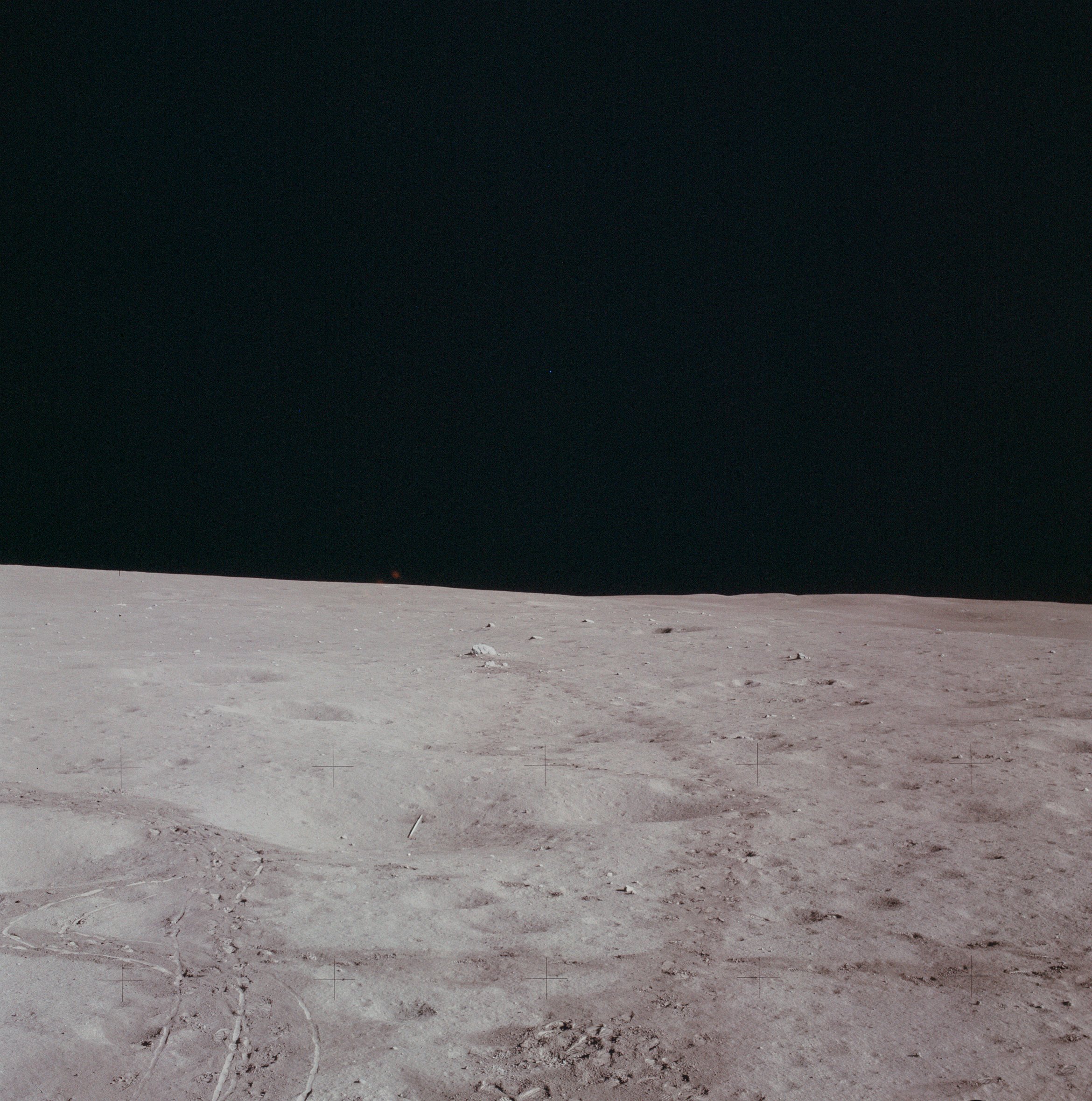
Re:Astronomy Picture of the Day Date Posted:01/18/2026 4:25 AMCopy HTML 2026 January 17 Image Credit: Edgar Mitchell, Apollo 14, NASA; Mosaic - Eric M. Jones Explanation: Apollo 14's Lunar Module Antares landed on the Moon on February 5, 1971. Toward the end of the stay astronaut Ed Mitchell snapped a series of photos of the lunar surface while looking out a window, assembled into this detailed mosaic by Apollo Lunar Surface Journal editor Eric Jones. The view looks across the Fra Mauro highlands to the northwest of the landing site after the Apollo 14 astronauts had completed their second and final walk on the Moon. Prominent in the foreground is their Modular Equipment Transporter, a two-wheeled, rickshaw-like device used to carry tools and samples. Near the horizon at top center is a 1.5 meter wide boulder dubbed Turtle rock. In the shallow crater below Turtle rock is the long white handle of a sampling instrument, thrown there javelin-style by Mitchell. Mitchell's fellow moonwalker and first American in space, Alan Shepard, also used a makeshift six iron to hit two golf balls. One of Shepard's golf balls is just visible as a white spot below Mitchell's javelin. |
|
Niceguy2
|
#6211 |
|
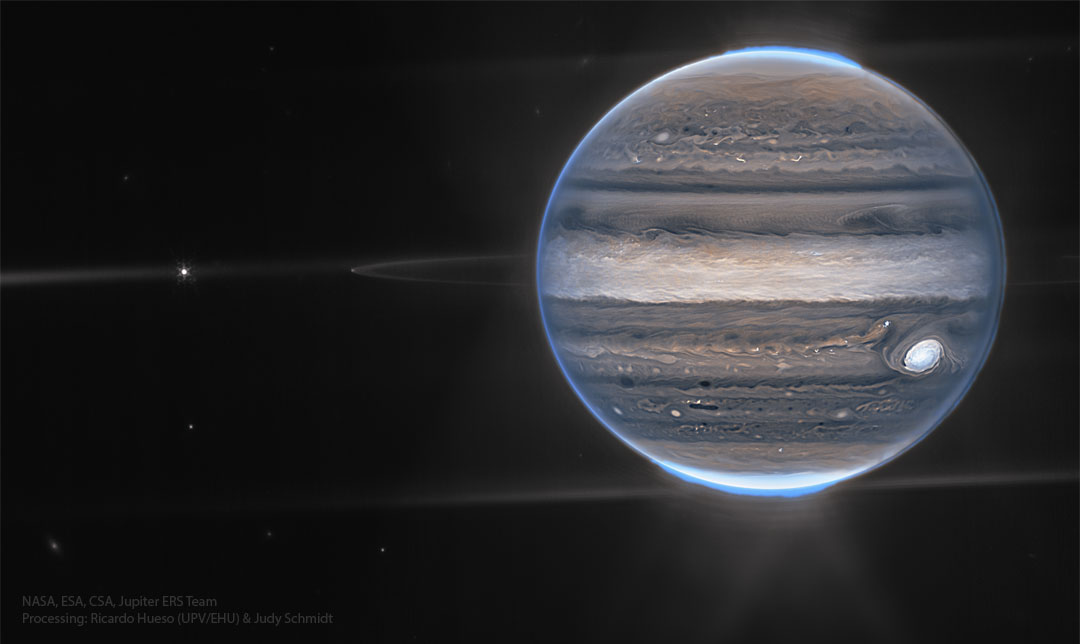
Re:Astronomy Picture of the Day Date Posted:01/19/2026 4:04 AMCopy HTML 2026 January 18 Image Credit: NASA, ESA, CSA, Jupiter ERS Team; Processing: Ricardo Hueso (UPV/EHU) & Judy Schmidt Explanation: This infrared view of Jupiter by Webb is illuminating. High-resolution infrared images of Jupiter from the James Webb Space Telescope (Webb) reveal, for example, differences between high-floating bright clouds -- including the Great Red Spot -- and low-lying dark clouds. Also clearly visible in the featured Webb image are Jupiter's dust ring, bright auroras at the poles, and Jupiter's moons Amalthea and Adrastea. The footprint of large volcanic moon Io's magnetic funneling of charged particles onto Jupiter is also visible in the southern aurora. Some objects are so bright that light noticeably diffracts around Webb's optics creating streaks. Webb, which orbits the Sun near the Earth, has a mirror over six meters across making it the largest astronomical telescope ever launched -- with over six times more light-collecting area than Hubble. |
|
Niceguy2
|
#6212 |
|
Re:Astronomy Picture of the Day Date Posted:01/19/2026 4:04 AMCopy HTML
|
|
Niceguy2
|
#6213 |
|
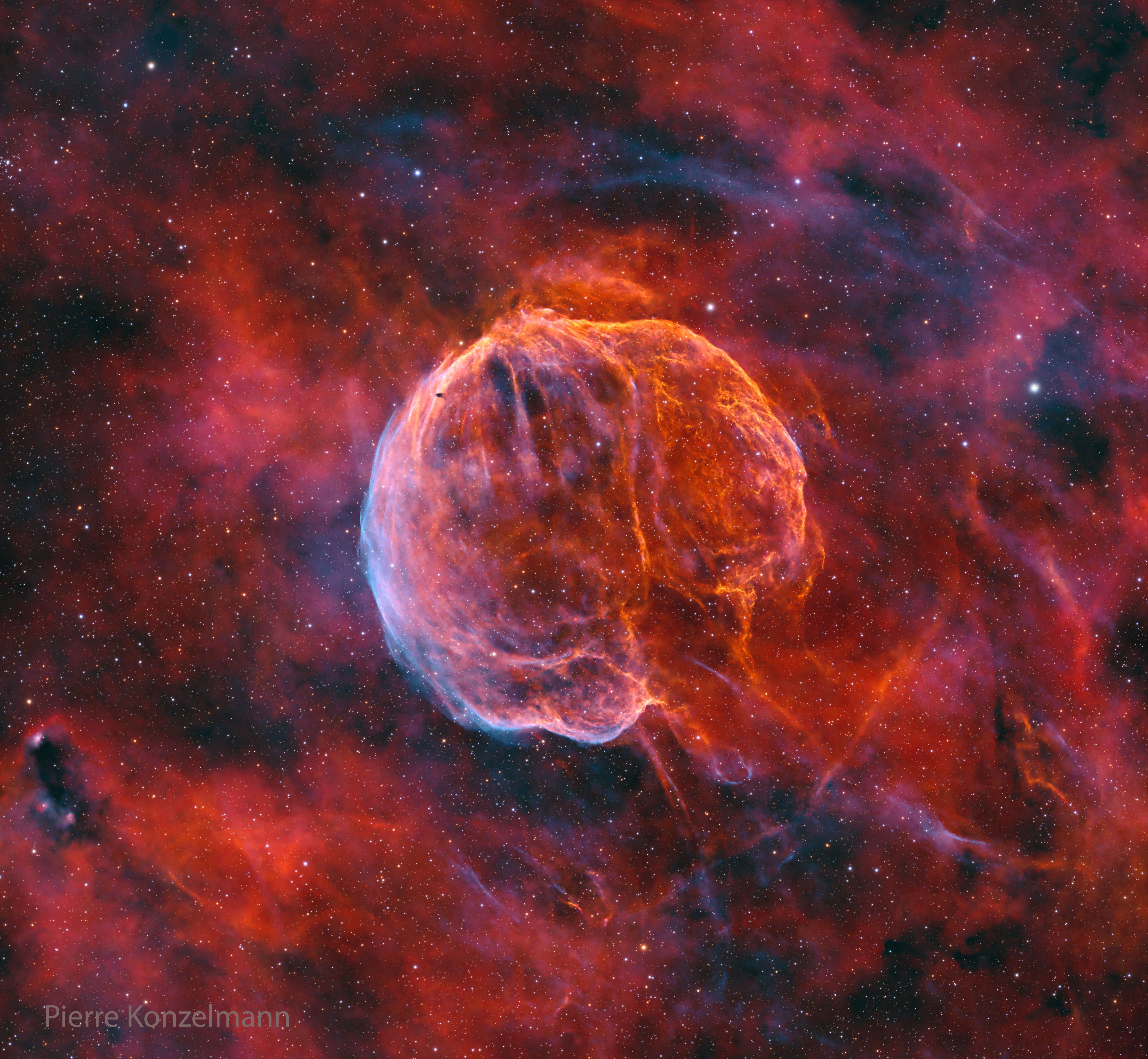
Re:Astronomy Picture of the Day Date Posted:01/20/2026 4:06 AMCopy HTML 2026 January 19 Image Credit: Pierre Konzelmann Explanation: What powers this unusual nebula? CTB 1 is the expanding gas shell that was left when a massive star toward the constellation of Cassiopeia exploded about 10,000 years ago. The star likely detonated when it ran out of elements, near its core, that could create stabilizing pressure with nuclear fusion. The resulting supernova remnant, nicknamed the Medulla Nebula for its brain-like shape, still glows in visible light because of the heat generated by its collision with confining interstellar gas. Why the nebula also glows in X-ray light, though, remains a topic of research. One hypothesis holds that an energetic pulsar was created and powers the nebula with a fast outwardly moving wind. Following this lead, a pulsar was found in radio waves that appears to have been expelled by the supernova explosion at over 1000 kilometers per second. Although the Medulla Nebula appears as large as a full moon, it is so faint that it took 84-hours of exposure with a small telescope in Texas, USA, to create the featured image. |
|
Niceguy2
|
#6214 |
|
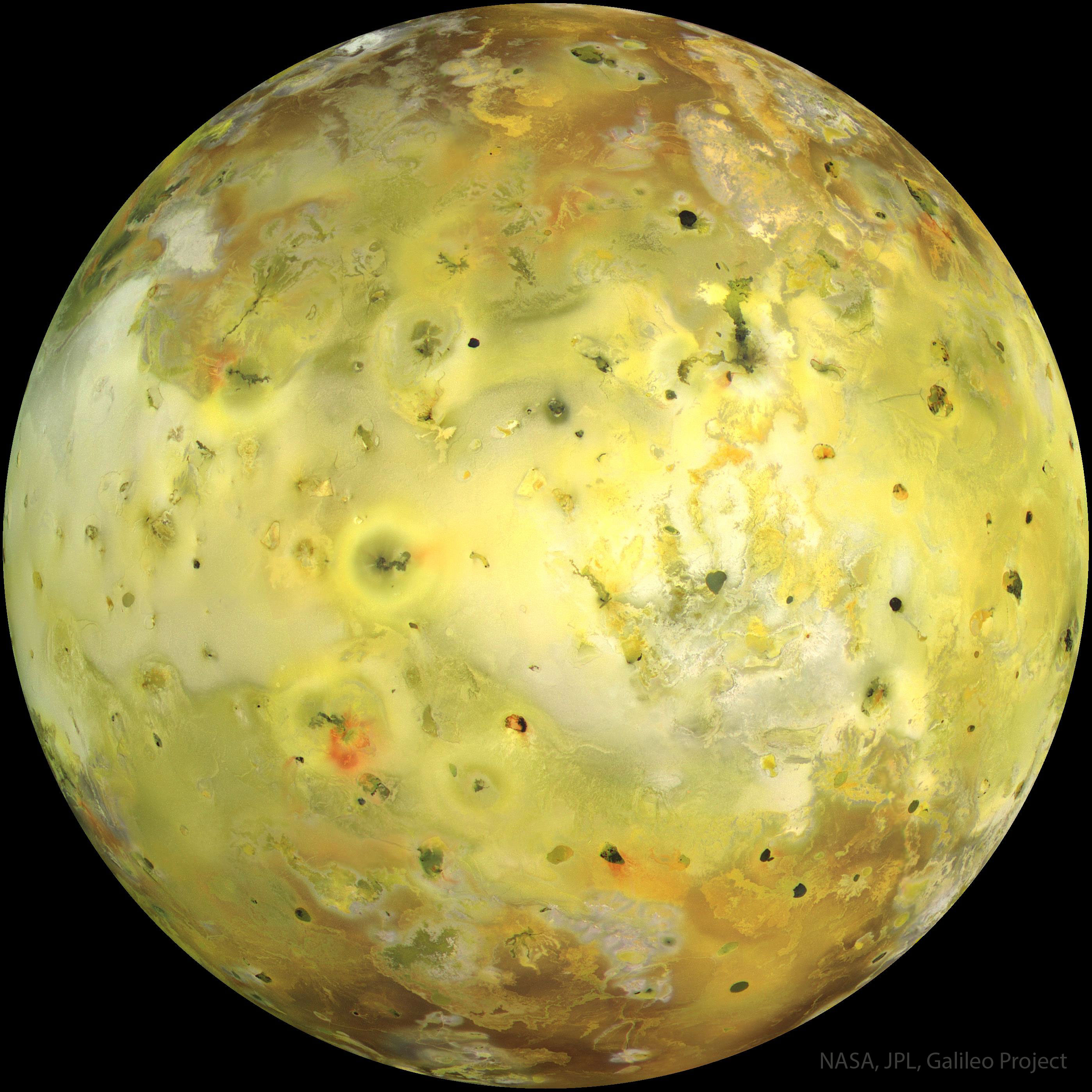
Re:Astronomy Picture of the Day Date Posted:01/21/2026 3:38 AMCopy HTML 2026 January 20 Image Credit: NASA, JPL, Galileo Project Explanation: The strangest moon in the Solar System is bright yellow. The featured picture, an attempt to show how Io would appear in the "true colors" perceptible to the average human eye, was taken in 1999 July by the Galileo spacecraft that orbited Jupiter from 1995 to 2003. Io's colors derive from sulfur and molten silicate rock. The unusual surface of Io is kept very young by its system of active volcanoes. The intense tidal gravity of Jupiter stretches Io and damps wobbles caused by Jupiter's other Galilean moons. The resulting friction greatly heats Io's interior, causing molten rock to explode through the surface. Io's volcanoes are so active that they are effectively turning the whole moon inside out. Some of Io's volcanic lava is so hot it glows in the dark. |
|
Niceguy2
|
#6215 |
|
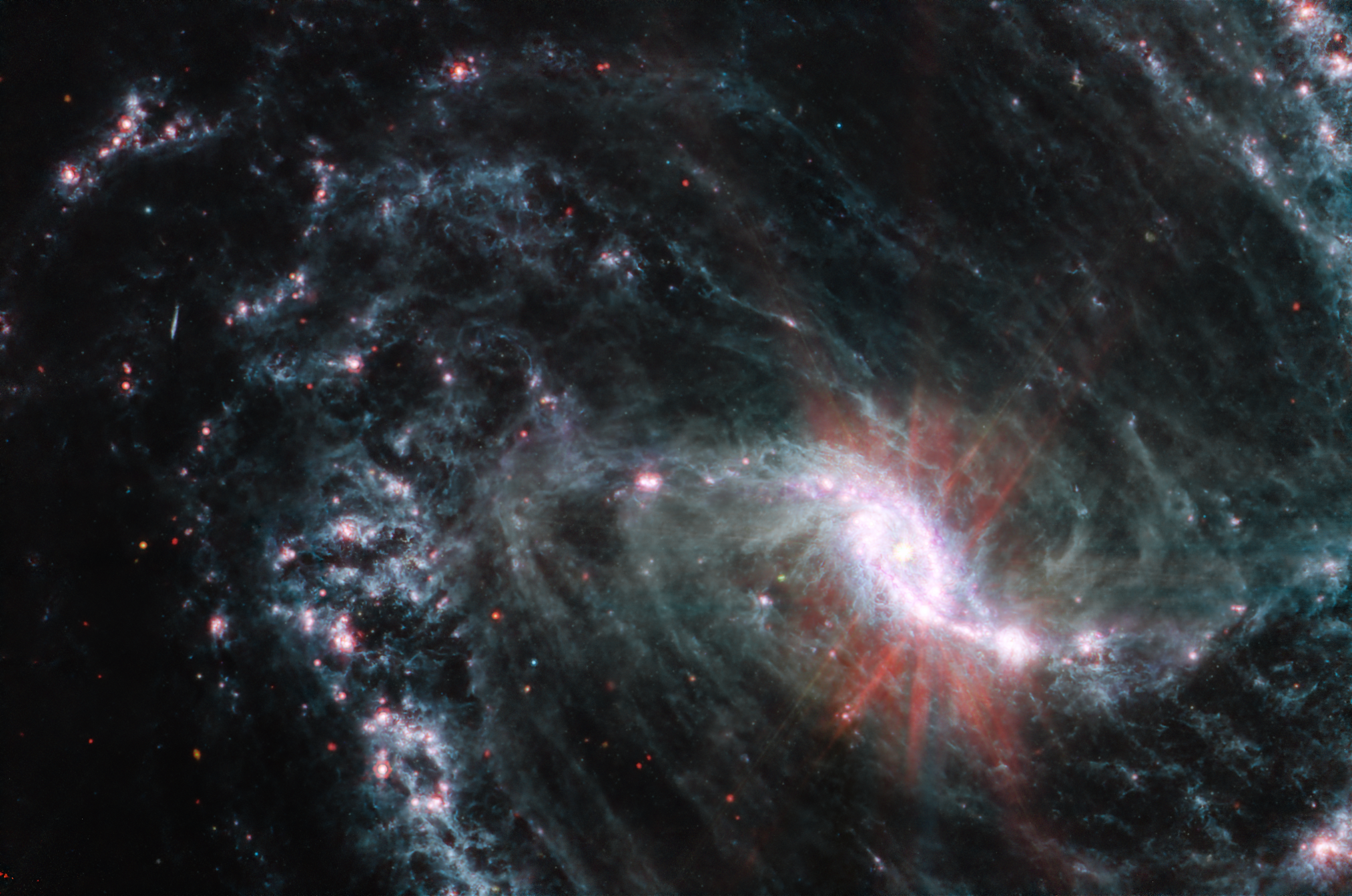
Re:Astronomy Picture of the Day Date Posted:01/22/2026 2:17 AMCopy HTML 2026 January 21 Image Credit: NASA, ESA, CSA, Janice Lee (NOIRLab) - Processing: Alyssa Pagan (STScI) Explanation: A mere 56 million light-years distant toward the southern constellation Fornax, NGC 1365 is an enormous barred spiral galaxy about 200,000 light-years in diameter. That's twice the size of our own barred spiral Milky Way. This sharp image from the James Webb Space Telescope's Mid-Infrared Instrument (MIRI) reveals stunning details of this magnificent spiral in infrared light. Webb's field of view stretches about 60,000 light-years across NGC 1365, exploring the galaxy's core and bright newborn star clusters. The intricate network of dusty filaments and bubbles is created by young stars along spiral arms winding from the galaxy's central bar. Astronomers suspect the gravitational field of NGC 1365's bar plays a crucial role in the galaxy's evolution, funneling gas and dust into a star-forming maelstrom and ultimately feeding material into the active galaxy's central, supermassive black hole. |
|
Niceguy2
|
#6216 |
|
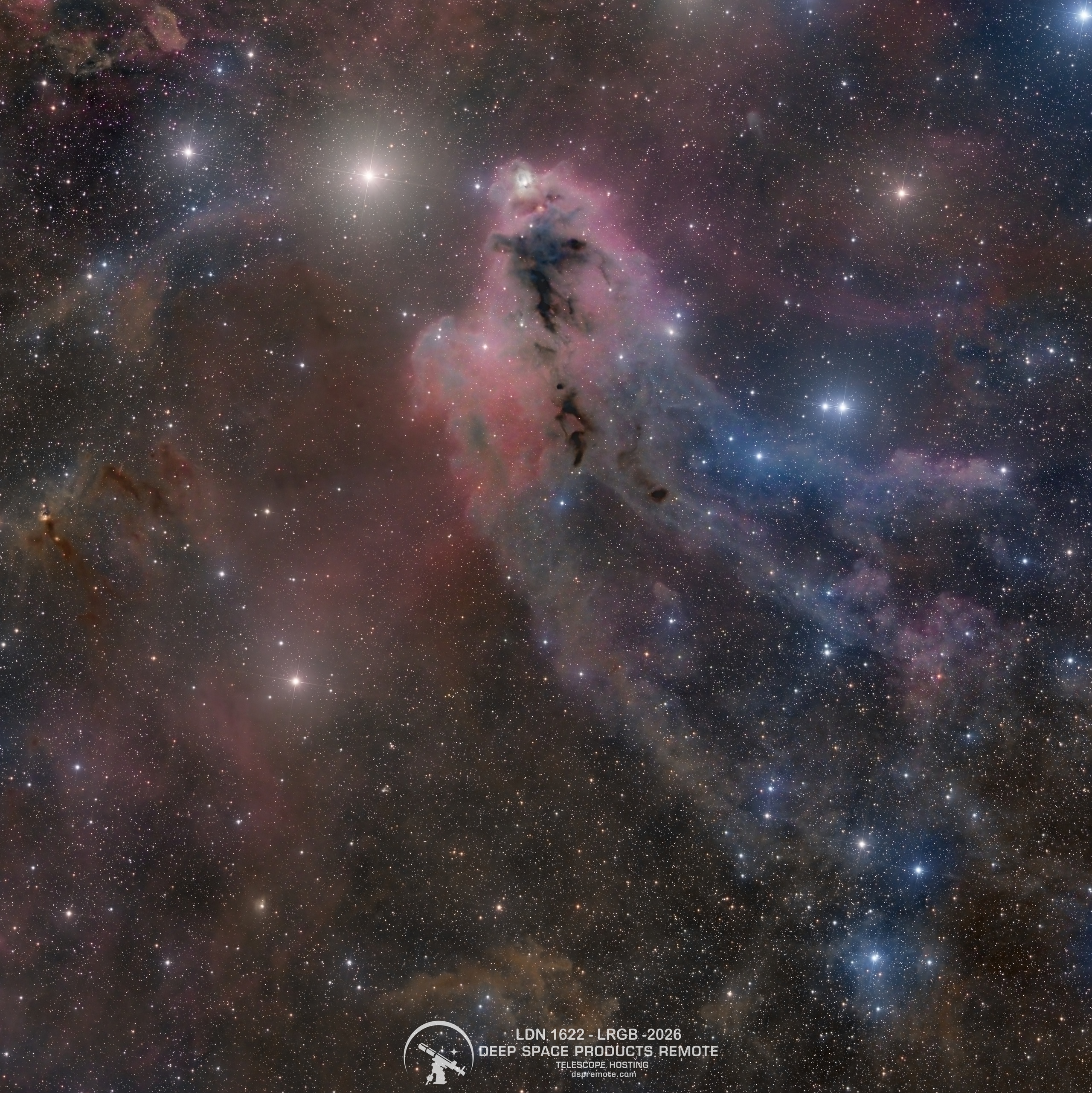
Re:Astronomy Picture of the Day Date Posted:01/23/2026 3:19 AMCopy HTML 2026 January 22 Image Credit & Copyright: Chris Fellows Explanation: The silhouette of an intriguing dark nebula inhabits this cosmic scene. Lynds' Dark Nebula (LDN) 1622 appears against a faint background of glowing hydrogen gas only visible in long telescopic exposures of the region. In contrast, a brighter reflection nebula, vdB 62, is more easily seen just above the dusty dark nebula. LDN 1622 lies near the plane of our Milky Way Galaxy, close on the sky to Barnard's Loop, a large cloud surrounding the rich complex of emission nebulae found in the Belt and Sword of Orion. With swept-back outlines, the obscuring dust of LDN 1622 is thought to lie at a similar distance, perhaps 1,500 light-years away. At that distance, this 3 degree wide field of view would span about 100 light-years. Young stars do lie hidden within the dark expanse and have been revealed in Spitzer Space telescope infrared images. Still, the foreboding visual appearance of LDN 1622 inspires its popular name, the Boogeyman Nebula. |
|
Niceguy2
|
#6217 |
|
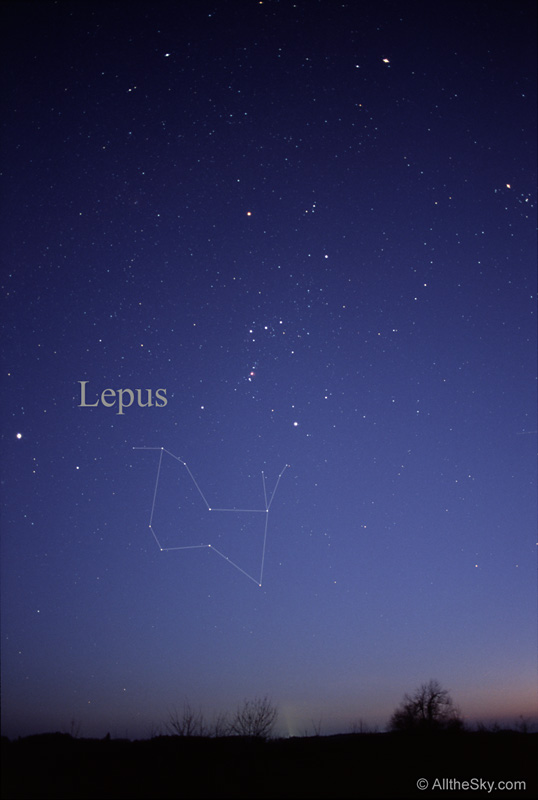
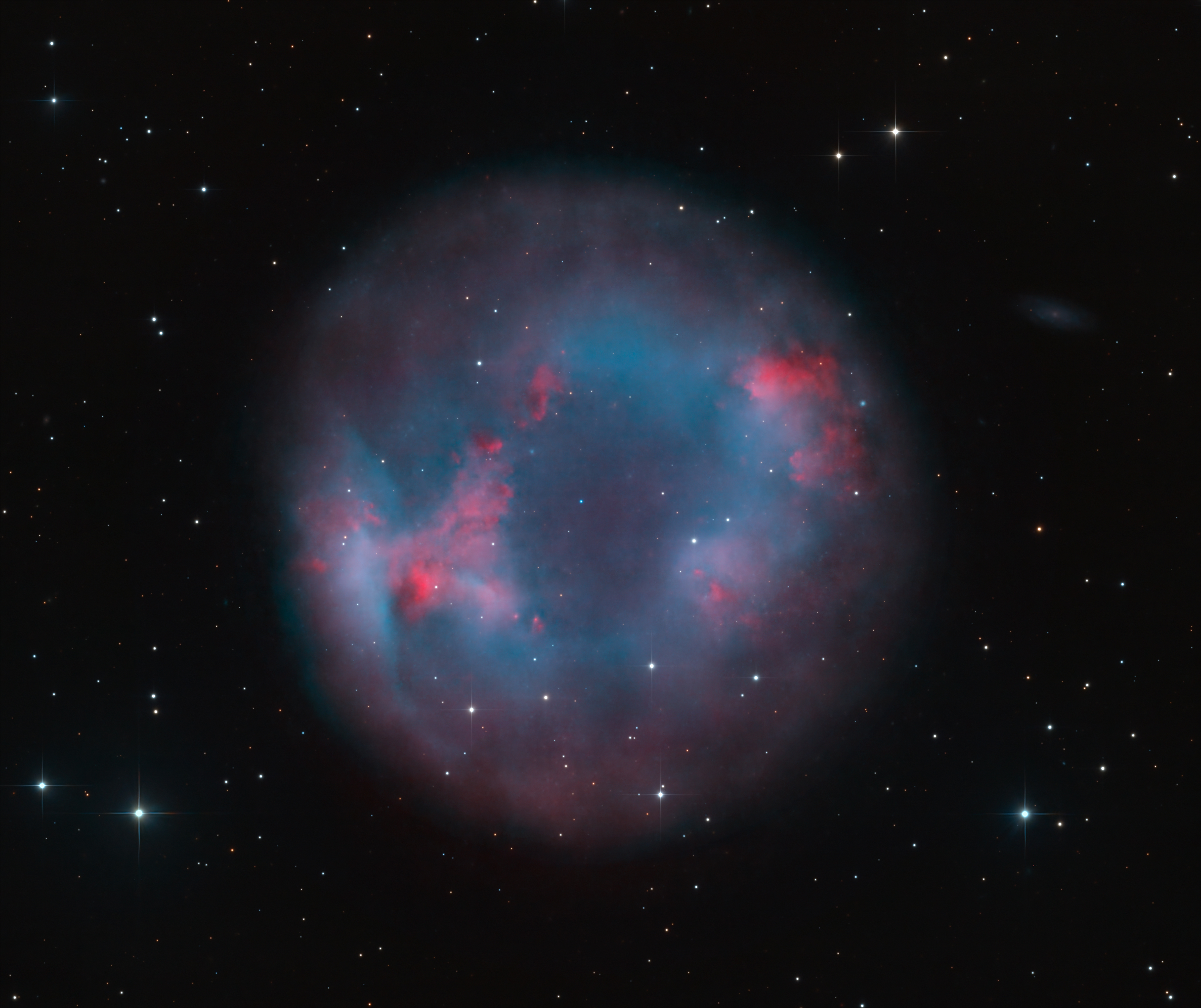
Re:Astronomy Picture of the Day Date Posted:01/24/2026 3:50 AMCopy HTML 2026 January 23 Image Credit & Copyright: Martin Pugh Explanation: Very faint planetary nebula Abell 7 is about 1,800 light-years distant. It lies just south of Orion in planet Earth's skies toward the constellation Lepus, The Hare. Posing with scattered Milky Way stars, its generally simple spherical shape about 8 light-years in diameter is revealed in this deep telescopic image. The beautiful and complex shapes seen within the cosmic cloud are visually enhanced by the use of long exposures and narrowband filters that capture emission from hydrogen and oxygen atoms. Otherwise Abell 7 would be much too faint to be appreciated by eye. A planetary nebula represents a very brief final phase in stellar evolution that our own Sun will experience 5 billion years hence, as the nebula's central, once sun-like star shrugs off its outer layers. Abell 7 itself is estimated to be 20,000 years old. But its central star, seen here as a fading white dwarf, is some 10 billion years old. |
|
Niceguy2
|
#6218 |
|
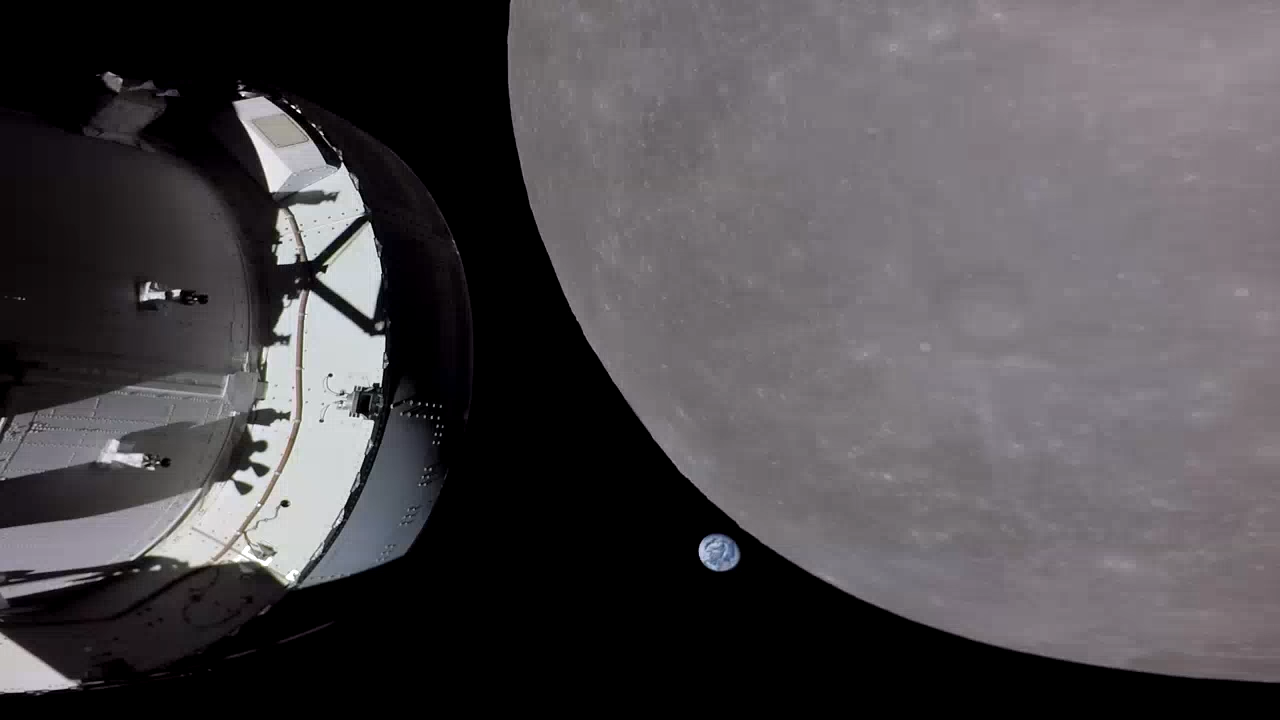
Re:Astronomy Picture of the Day Date Posted:01/25/2026 3:49 AMCopy HTML 2026 January 24 Image Credit: NASA, Artemis 1 Explanation: Eight billion people are about to disappear in this snapshot from space taken on 2022 November 21. On the sixth day of the Artemis I mission, their home world is setting behind the Moon's bright edge as viewed by an external camera on the outbound Orion spacecraft. Orion was headed for a powered flyby that took it to within 130 kilometers of the lunar surface. Velocity gained in the flyby maneuver was used to reach a distant retrograde orbit around the Moon. That orbit is considered distant because it's another 92,000 kilometers beyond the Moon, and retrograde because the spacecraft orbited in the opposite direction of the Moon's orbit around planet Earth. Swinging around the Moon, Orion reached a maximum distance (just over 400,000 kilometers) from Earth on 2022 November 28, exceeding a record set by Apollo 13 for most distant spacecraft designed for human space exploration. The Artemis II mission, carrying 4 astronauts around the moon and back again, is due to launch as early as February 6. |
|
Niceguy2
|
#6219 |
|
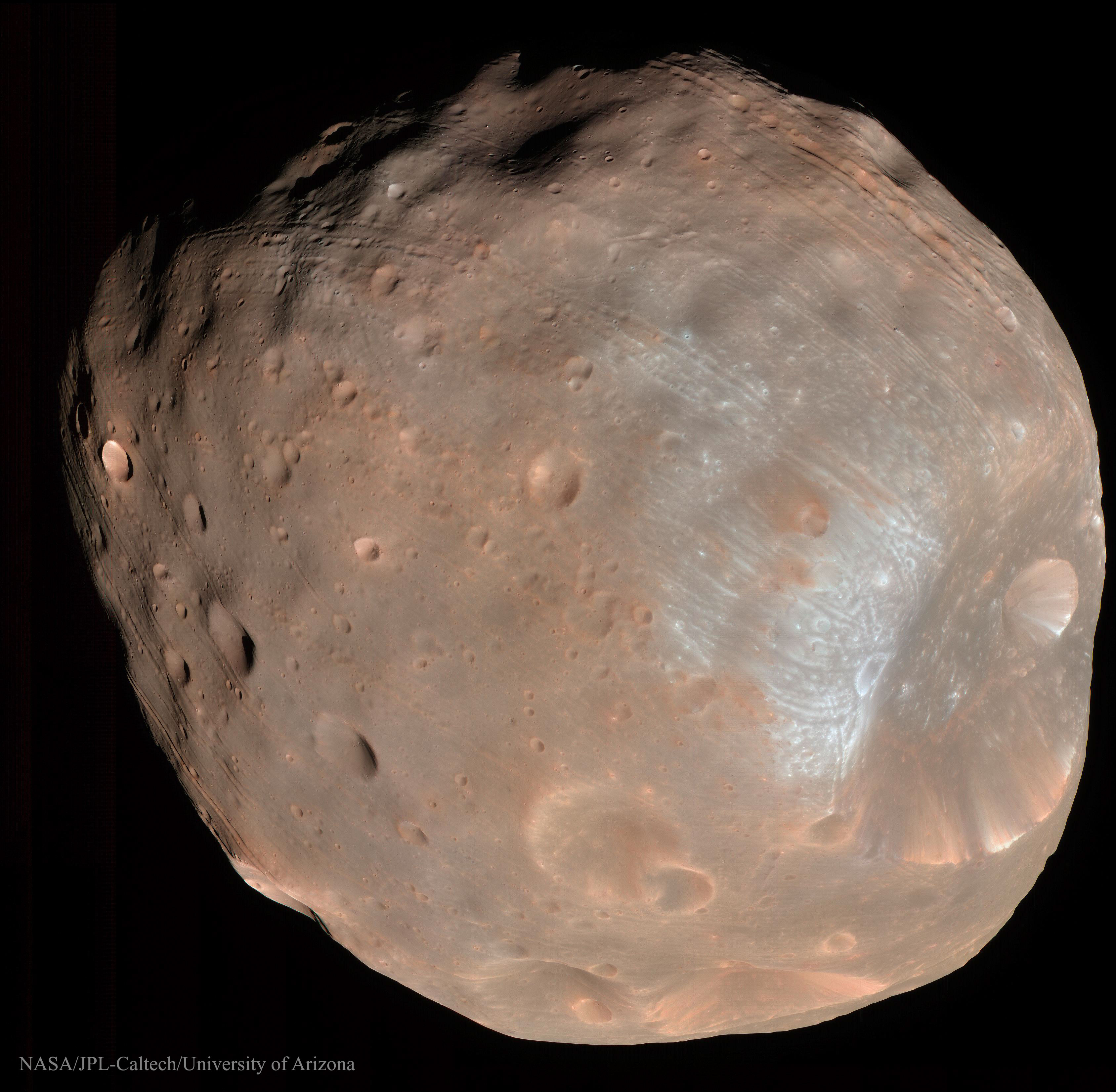
Re:Astronomy Picture of the Day Date Posted:01/26/2026 4:37 AMCopy HTML 2026 January 25 Image Credit: NASA, LPL (U. Arizona), MRO, HiRISE Explanation: This moon is doomed. Mars, the red planet named for the Roman god of war, has two tiny moons, Phobos and Deimos, whose names are derived from the Greek for Fear and Panic. These Martian moons may well be captured asteroids originating in the main asteroid belt between Mars and Jupiter or perhaps from even more distant reaches of our Solar System. The larger moon, Phobos, is indeed seen to be a cratered, asteroid-like object in this stunning color image from the robotic Mars Reconnaissance Orbiter, which can image objects as small as 10 meters. But Phobos orbits so close to Mars - about 5,800 kilometers above the surface compared to 400,000 kilometers for our Moon - that gravitational tidal forces are dragging it down. In perhaps 50 million years, Phobos is expected to disintegrate into a ring of debris. |
|
Niceguy2
|
#6220 |
|
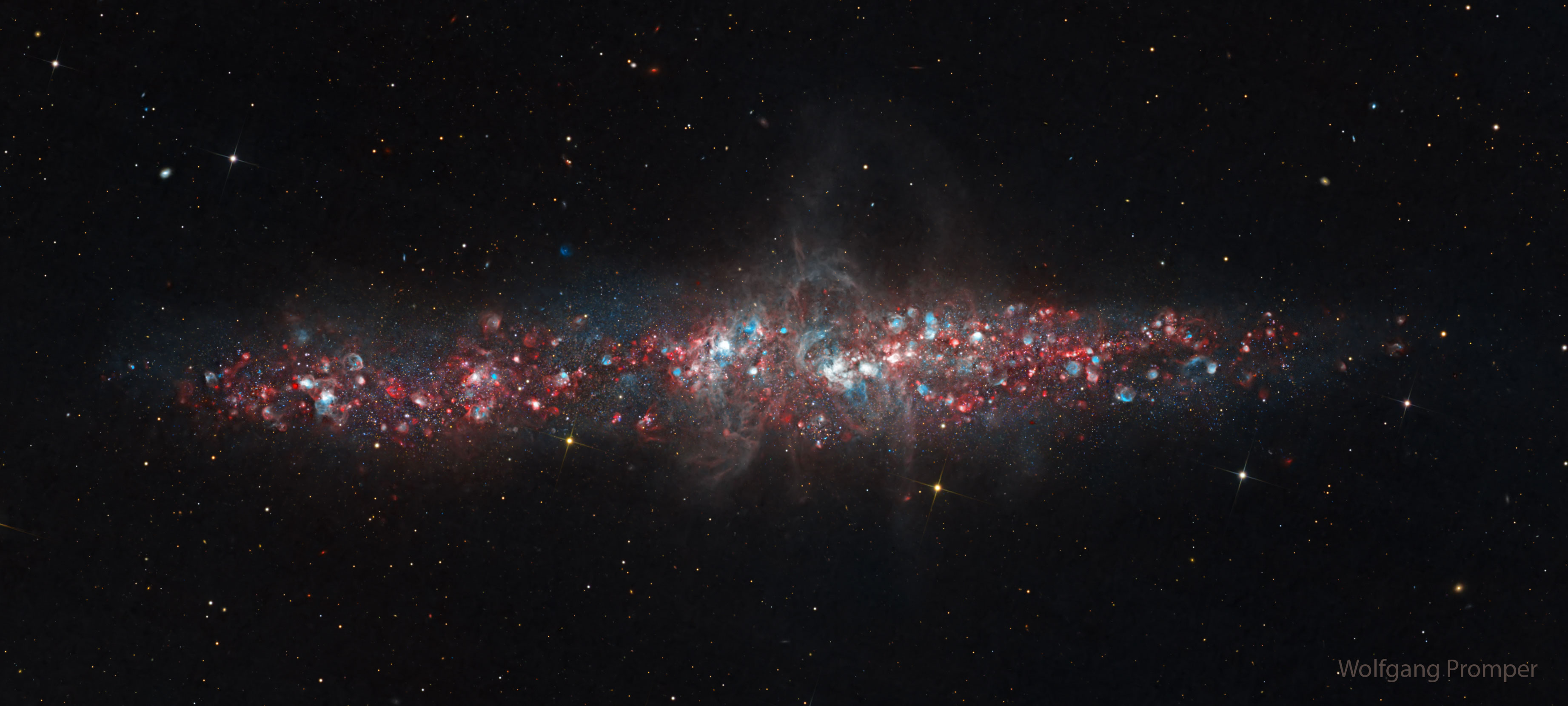
Re:Astronomy Picture of the Day Date Posted:01/27/2026 3:42 AMCopy HTML 2026 January 26 Image Credit & Copyright: Wolfgang Promper; Text: Ogetay Kayali (MTU) Explanation: Can you see nebulas in other galaxies? Yes, some nebulas shine brightly enough -- if you know how to look. Clouds of hydrogen and oxygen emit light at very specific colors, and by isolating them, astronomers and astrophotographers can reveal structures that would otherwise be too faint to notice. This deep, 50-hour exposure highlights glowing hydrogen (red) and oxygen (blue) across galaxy NGC 55, viewed nearly edge-on. Also known as the String of Pearls Galaxy, NGC 55 is often compared to our Milky Way's satellite galaxy the Large Magellanic Cloud (LMC), although NGC 55 lies much farther away at about 6.5 million light-years. The resulting image uncovers a sprinkling of emission nebulas within and sometimes above the galaxy's dusty disk, offering a detailed look at distant star-forming regions. |
|
Niceguy2
|
#6221 |
|
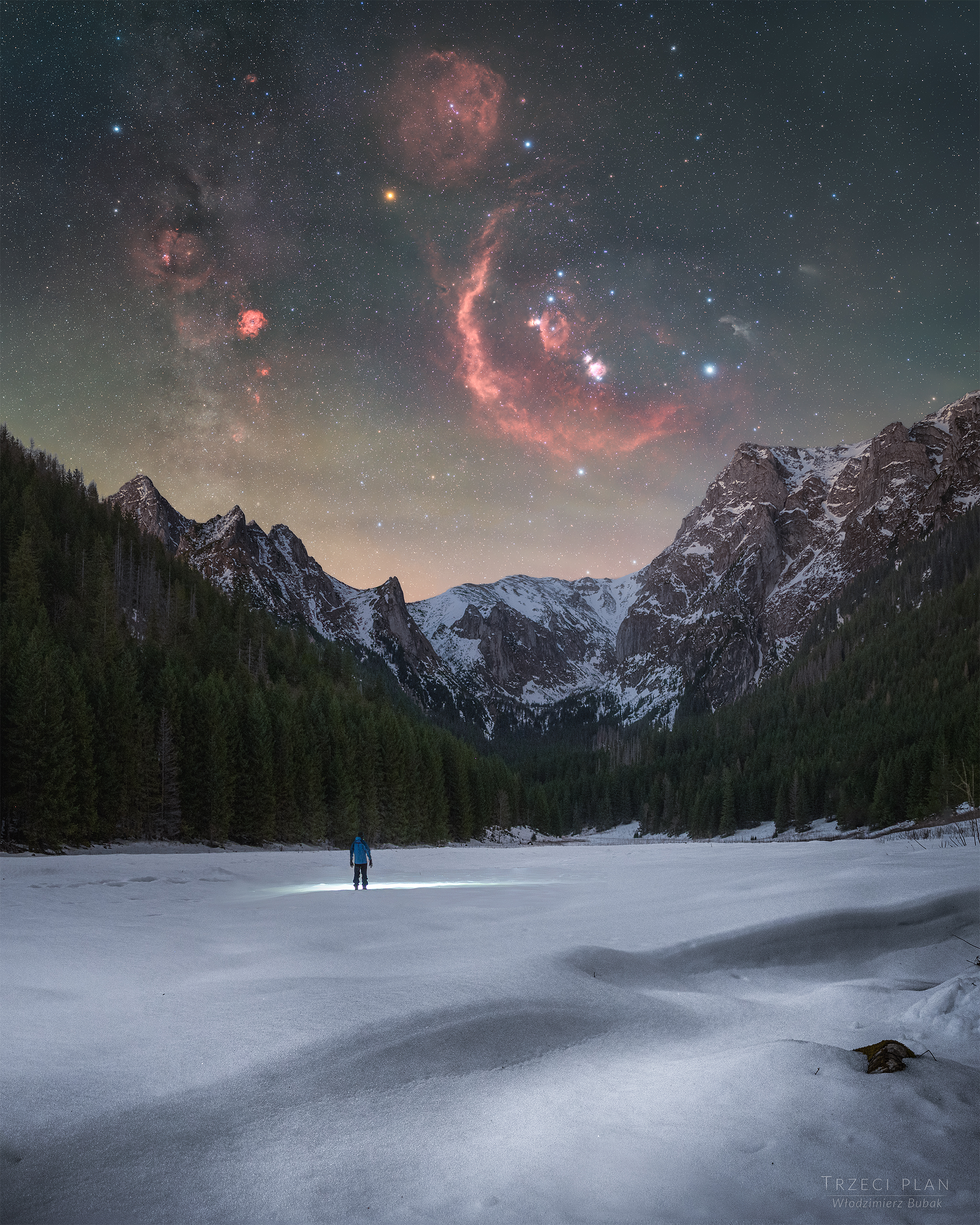
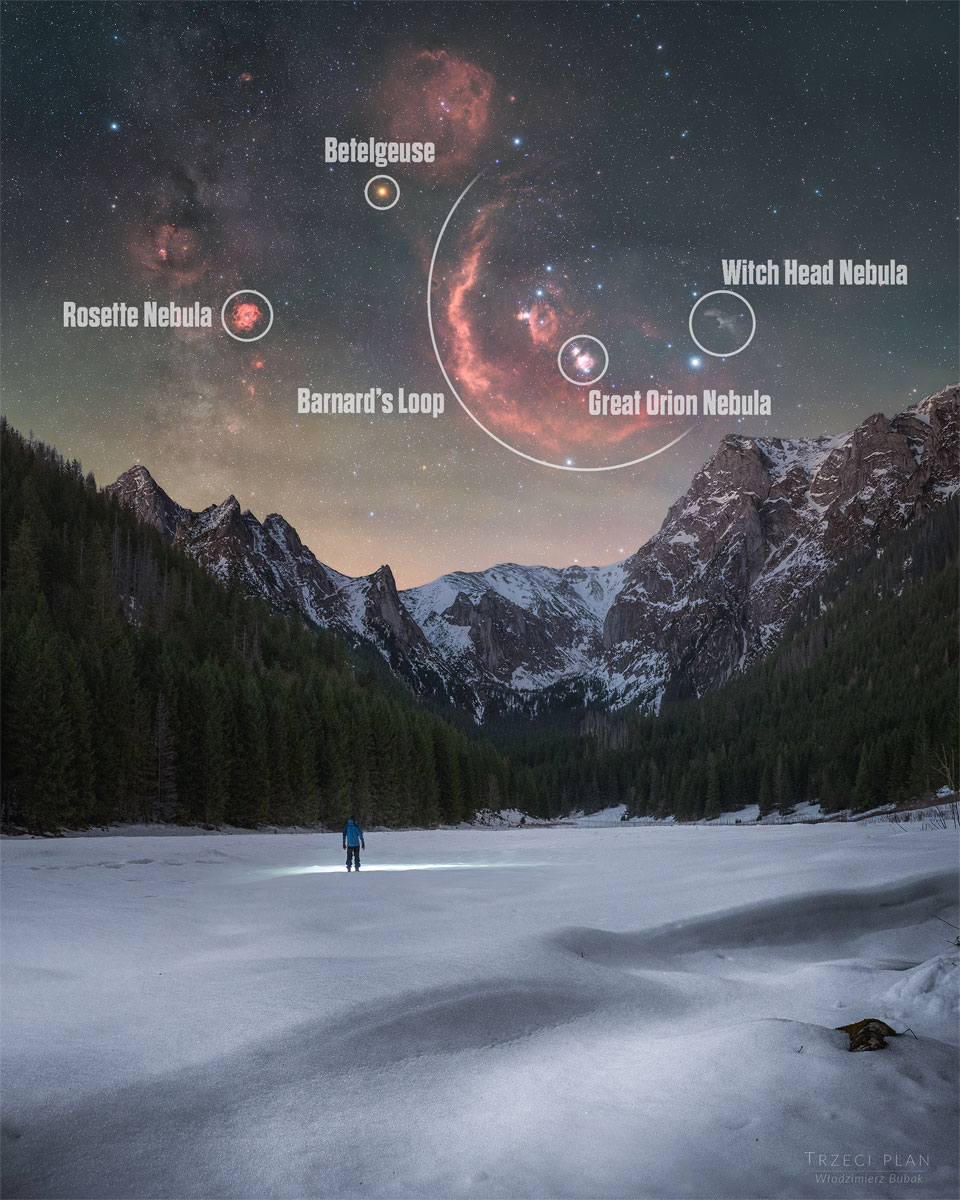
Re:Astronomy Picture of the Day Date Posted:01/28/2026 4:09 AMCopy HTML 2026 January 27 Image Credit & Copyright: Włodzimierz Bubak; Text: Ogetay Kayali (MTU) Explanation: Rising over a frozen valley in the Tatra Mountains, the familiar stars and nebulas of Orion dominate this wide-field nightscape. The featured deep photo was taken in southern Poland's highest mountain range last month, where dark skies and alpine terrain combined to reveal both Earth's rugged beauty and the structure of our galaxy. Above the snowy mountains, Orion's bright belt stars anchor a region of glowing interstellar clouds. The Great Orion Nebula, a vast stellar nursery visible even to the unaided eye, shines near the center of the scene. Surrounding it is the enormous arc of Barnard's Loop, a faint shell of ionized hydrogen gas spanning much of the constellation. To the left, the round Rosette Nebula glows softly, while the grayish Witch Head Nebula hovers to the right, illuminated by nearby starlight. Near the top, the orange supergiant Betelgeuse marks the hunter's shoulder. |
|
Niceguy2
|
#6222 |
|
Re:Astronomy Picture of the Day Date Posted:01/28/2026 4:09 AMCopy HTML
|
|
Niceguy2
|
#6223 |
|
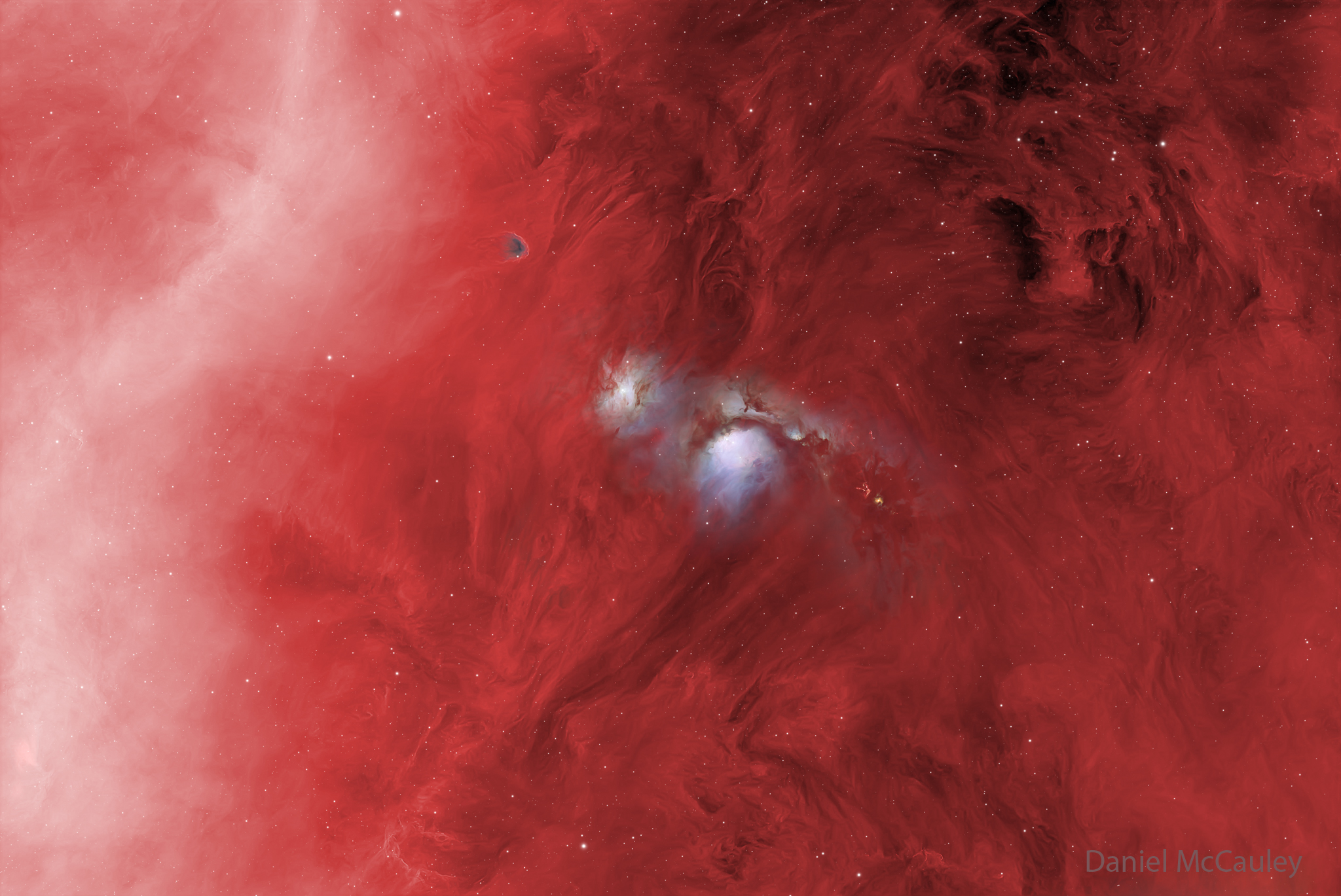
Re:Astronomy Picture of the Day Date Posted:01/29/2026 3:42 AMCopy HTML 2026 January 28 Image Credit & Copyright: Daniel McCauley Explanation: In the vast Orion Molecular Cloud complex, several bright blue nebulas are particularly apparent. Pictured here in the center are two of the most prominent reflection nebulas - dust clouds lit by the reflecting light of bright embedded stars. The more famous nebula is M78, in the image center, cataloged over 200 years ago. To its upper left is the lesser known NGC 2071. Astronomers continue to study these reflection nebulas to better understand how interior stars form. The overall red glow is from diffuse hydrogen gas that covers much of the Orion complex that spans much of the constellation of Orion. Nearby in the greater complex, which lies about 1,500 light years away, are the Orion Nebula, the Horsehead Nebula, and Barnard's Loop -- partially seen here as the white band on the upper left. |
|
Niceguy2
|
#6224 |
|
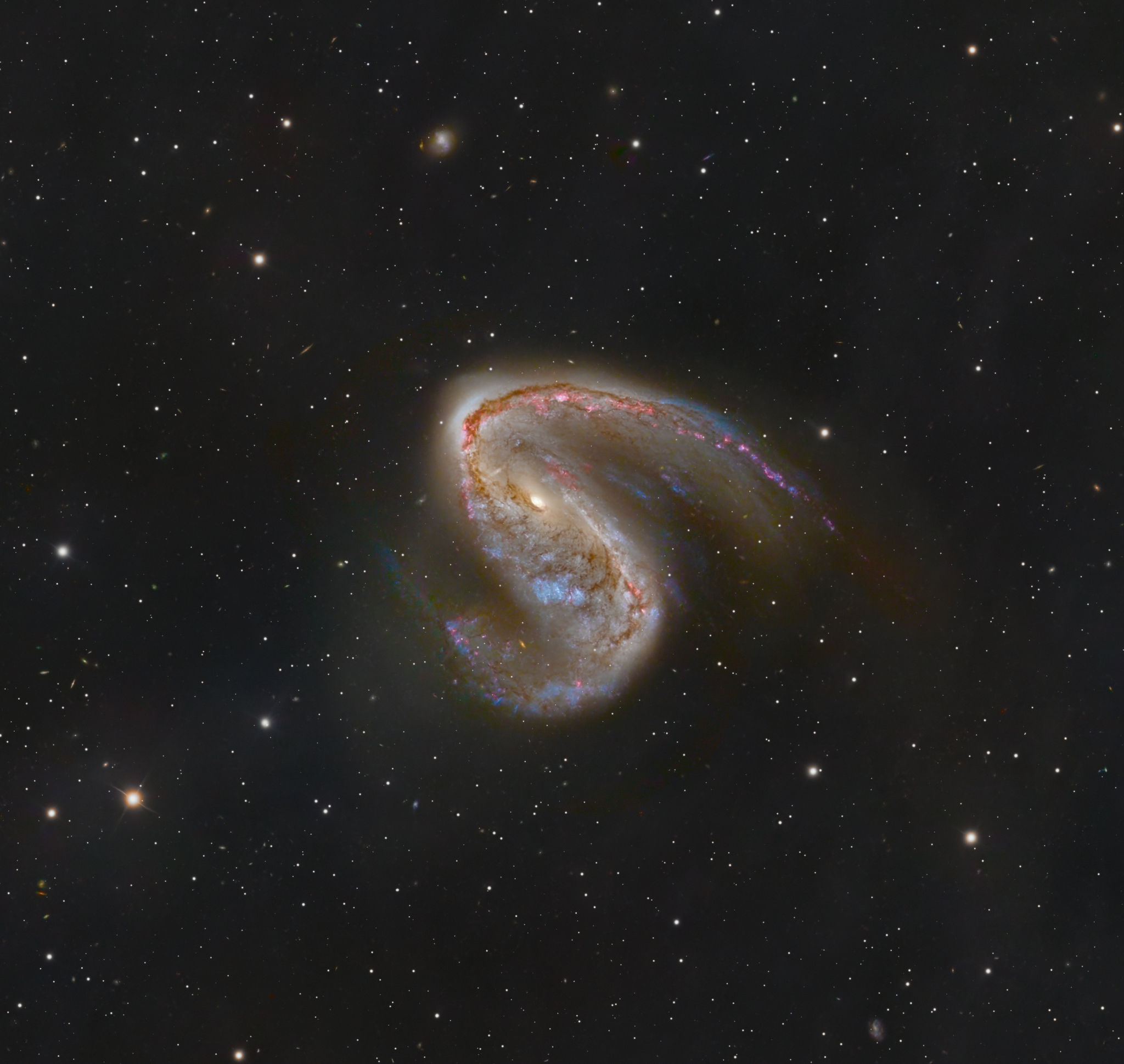
Re:Astronomy Picture of the Day Date Posted:01/30/2026 3:27 AMCopy HTML 2026 January 29 Image Credit & Copyright: Mike Selby Explanation: Distorted galaxy NGC 2442 can be found in the southern constellation of the flying fish, (Piscis) Volans. Located about 50 million light-years away, the galaxy's two spiral arms extending from a pronounced central bar give it a hook-shaped appearance in this deep and colorful image, with foreground stars scattered across the telescopic field of view. The image also reveals the distant galaxy's obscuring dust lanes, young blue star clusters and reddish star forming regions surrounding a core of yellowish light from an older population of stars. But the star forming regions seem more concentrated along the drawn-out (upper right) spiral arm. The distorted structure is likely the result of an ancient close encounter with a smaller galaxy that lies off top left of the frame. This telescopic field of view spans over 200,000 light-years at the estimated distance of NGC 2442. |
|
Niceguy2
|
#6225 |
|
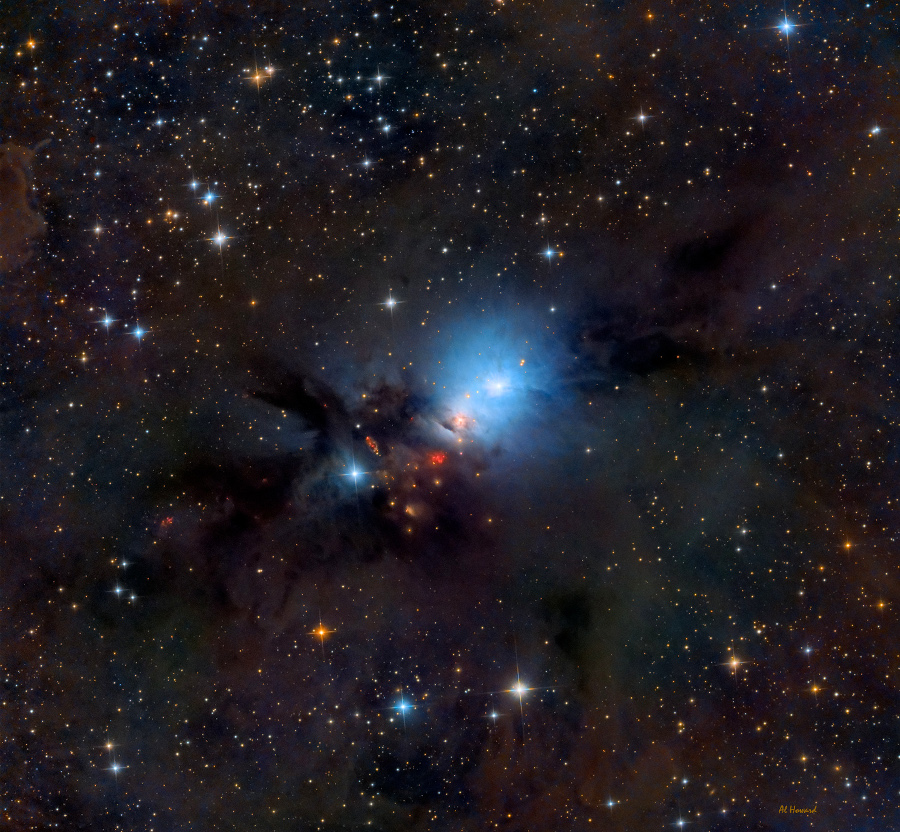
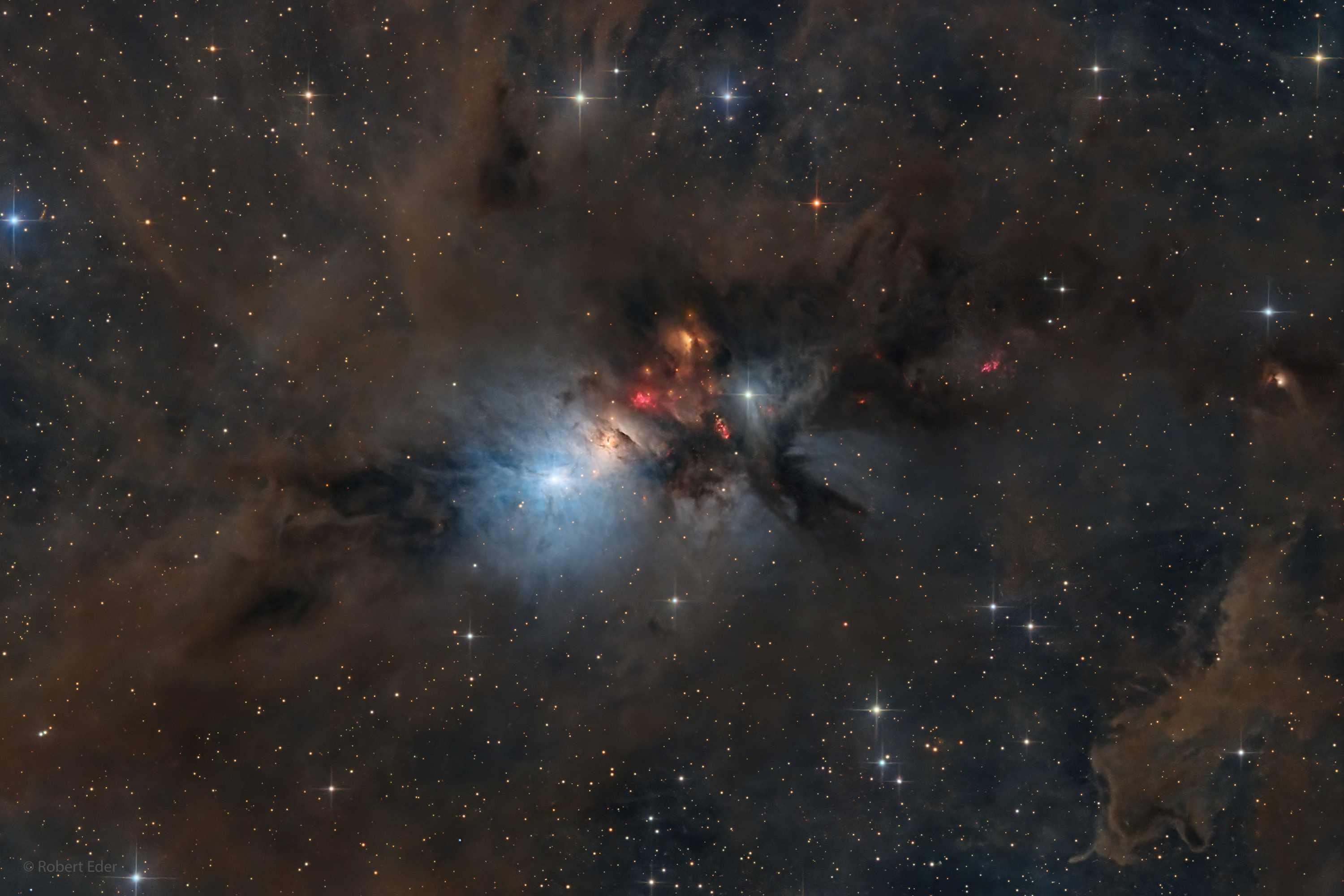
Re:Astronomy Picture of the Day Date Posted:01/31/2026 4:31 AMCopy HTML 2026 January 30 Image Credit & Copyright: Robert Eder Explanation: NGC 1333 is seen in visible light as a reflection nebula, dominated by bluish hues characteristic of starlight reflected by interstellar dust. A mere 1,000 light-years distant toward the heroic constellation Perseus, it lies at the edge of a large, star-forming molecular cloud. This telescopic close-up spans over two full moons on the sky or just over 15 light-years at the estimated distance of NGC 1333. It shows details of the dusty region along with telltale hints of contrasty red emission from Herbig-Haro objects, jets and shocked glowing gas emanating from recently formed stars. In fact, NGC 1333 contains hundreds of stars less than a million years old, most still hidden from optical telescopes by the pervasive stardust. The chaotic environment may be similar to one in which our own Sun formed over 4.5 billion years ago. |












,_published_1799,_NGA_7459.jpg)